
Neck Rejuvenation at 50: Restoring Structural Integrity
What if the most effective approach to a more defined neck and jawline at 50 begins with understanding the structural changes beneath the skin?
Many people exploring neck rejuvenation for 50 year olds notice a combination of concerns: reduced jawline definition, vertical platysmal bands, loose or crepey skin, and changes in the transition between the face and neck. Topical skincare can support skin quality, but it cannot reposition deeper tissues or correct structural changes within the neck.
A comprehensive approach begins with understanding the anatomy involved and determining which treatments are appropriate for the individual patient. Depending on the degree of laxity, treatment may range from skincare and nonsurgical procedures to a surgical neck lift or a combined facelift and neck lift.
In this guide, we’ll explore the biological and anatomical changes that commonly affect the neck around age 50, how nonsurgical and surgical approaches differ, and how a structural approach can be incorporated into a broader skin longevity strategy.
Key Takeaways
- Understand how aging affects the skin, platysma muscle, fat distribution, and jawline definition.
- Learn why neck rejuvenation should be individualized according to anatomy, skin quality, and the degree of tissue laxity.
- Explore the role of skincare and nutritional health in supporting overall tissue quality.
- Compare nonsurgical treatments with surgical neck rejuvenation and understand what each approach can and cannot address.
- Learn how the Longevity Facelift and neck lift may be considered together when aging affects both the lower face and neck.
Table of Contents
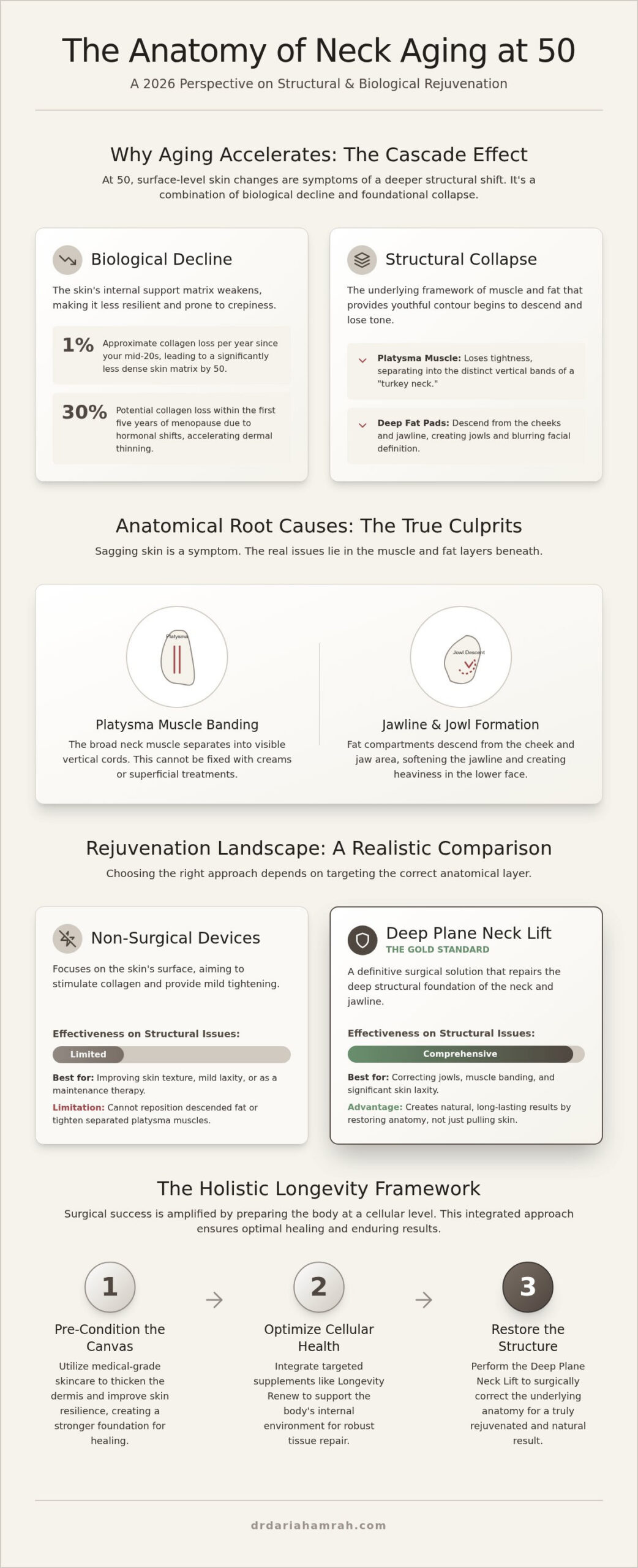
- Why Neck Aging Changes Around 50: The Intersection of Biology and Structure
- Anatomical Root Causes: Why “Turkey Neck” and Jowls Form
- Non-Surgical vs. Surgical Rejuvenation: A Realistic 2026 Comparison
- The Holistic Longevity Framework: Supporting Tissue Health
- Advanced Surgical Solutions: Understanding Deep Plane Neck Lift Techniques
Why Neck Aging Changes Around 50: The Intersection of Biology and Structure
For many people, the years around 50 bring noticeable changes in skin quality, elasticity, and the definition of the lower face and neck.
These changes are not caused by a single factor. Aging affects the skin, connective tissue, fat compartments, muscles, and other anatomical structures at different rates. In women, the hormonal changes associated with perimenopause and menopause can also influence skin thickness, hydration, elasticity, and collagen content. Research has demonstrated a relationship between estrogen decline and changes in skin collagen and elasticity.
This means that neck rejuvenation at 50 should not automatically be treated as a skin-tightening problem.
For some patients, the primary concern may be skin quality. For others, it may be platysmal banding, submental fullness, loss of jawline definition, or a combination of these factors.
A thorough evaluation helps determine whether the appropriate strategy involves skincare, nonsurgical treatment, surgery, or a combination.
The Biological Clock: Collagen and Elastin at 50
Collagen is one of the major structural proteins in the skin, while elastin contributes to its elasticity.
Collagen content naturally changes with age, and hormonal changes around menopause can contribute to further changes in skin thickness and connective tissue. Studies have found significant reductions in skin collagen associated with menopause, although the exact rate of change varies between individuals.
These changes can contribute to thinner, less resilient skin and increased visibility of fine lines and laxity.
However, chronological age alone does not determine how a patient’s neck will age. Genetics, sun exposure, smoking, weight changes, hormonal status, skin type, and overall health can all influence the appearance and quality of the tissue.
Hormonal Influence and Tissue Resilience
For women, perimenopause and menopause can introduce significant changes in skin biology.
Declining estrogen is associated with reductions in collagen, elasticity, hydration, and skin thickness. Some recent reviews continue to explore the extent of these changes and the potential role of interventions designed to support postmenopausal skin health.
A comprehensive approach to neck rejuvenation may therefore include:
- Evidence-based skincare: Appropriate topical products can help support the skin barrier, texture, and photoaging concerns.
- Nutritional support: A balanced diet and adequate protein and micronutrient intake provide the foundation for normal tissue maintenance and healing.
- Structural assessment: A consultation can determine whether the primary concern involves skin laxity, platysmal banding, fat distribution, or deeper structural changes.
Skincare can be an important part of maintaining skin quality, but it cannot substitute for surgery when significant excess skin or structural laxity is present.
Anatomical Root Causes: Why “Turkey Neck” and Jowls Form
What appears to be a single problem in the mirror can actually reflect several anatomical changes.
The appearance of the neck is influenced by the skin, subcutaneous fat, platysma muscle, submental tissues, jawline, and the underlying skeletal structure.
Understanding these components is important when determining the appropriate treatment.
The Platysma Muscle: An Important Component of the Neck
The platysma is a thin sheet-like muscle extending across the lower face and neck.
With aging, the platysma can become more visible, and vertical bands may develop. These bands are one of the features commonly associated with an aging neck.
Because the platysma is a muscle, topical skincare cannot directly reposition it. Surgical techniques such as platysmaplasty may be used as part of a neck lift when platysmal banding or muscle laxity is an important component of the patient’s anatomy.
For more information, see our guide to turkey neck surgery and platysmaplasty.
Jawline Integrity and the Descent of Jowls
Changes in facial fat distribution and soft-tissue support can contribute to jowling and reduced definition along the jawline.
Because the lower face and neck are anatomically connected, some patients may benefit from treating both areas rather than focusing on the neck alone.
A lower facelift and neck lift may therefore be considered when lower-face descent and neck laxity occur together.
Submandibular gland prominence can also contribute to the appearance of fullness beneath the jaw in some patients. This is another reason why treatment planning should be based on an individual’s anatomy rather than applying a single technique to every patient.
Non-Surgical vs. Surgical Rejuvenation: A Realistic 2026 Comparison
Choosing between nonsurgical and surgical neck rejuvenation depends on the degree and type of aging present.
Nonsurgical treatments can be useful for selected concerns, including mild skin laxity, texture changes, dynamic platysmal bands, or localized fullness. Options may include neuromodulators, energy-based treatments, injectables, or skin-resurfacing procedures.
However, these treatments have limitations.
A neck lift can directly address structural changes that nonsurgical treatments cannot, including significant excess skin and certain forms of platysmal laxity. ASPS notes that nonsurgical treatments can complement neck rejuvenation but do not produce the same structural changes as surgical neck lifting.
There is also no universal timeline for how long a treatment will last. Nonsurgical treatments generally require individualized maintenance, while surgical results can remain visible for years as the face and neck continue to age naturally.
Energy-Based Devices and Skin Resurfacing
Energy-based treatments can be useful for selected patients with mild to moderate skin-quality concerns.
Ultrasound, radiofrequency, laser treatments, and other energy-based technologies may be used to improve aspects of skin texture, collagen remodeling, or mild laxity.
Their effectiveness depends on the device, treatment parameters, skin quality, and degree of laxity.
They cannot, however, reproduce every structural change achieved through surgery.
For patients with concerns extending beyond the neck, treatments may also be incorporated into a broader facial rejuvenation plan, including approaches to perioral wrinkles.
The Surgical Threshold: When a Neck Lift May Be Appropriate
There is no single measurement that determines when someone “needs” a neck lift.
A surgical consultation may be appropriate when there is noticeable excess skin, persistent platysmal banding, submental fullness, or loss of jawline definition that the patient feels is not adequately addressed by nonsurgical treatment.
The appropriate procedure depends on the underlying anatomy.
A neck lift may involve repositioning or tightening deeper tissues, addressing the platysma, treating excess fat when appropriate, and redraping the skin. ASPS notes that neck lift techniques can include repositioning underlying tissues and tightening the platysma, with the specific approach determined by the patient’s needs.
The Holistic Longevity Framework: Supporting Tissue Health
Surgery is one part of a broader approach to facial and neck rejuvenation.
The quality of the skin and soft tissues can be influenced by nutrition, sun exposure, smoking, sleep, medications, hormonal changes, and overall health.
This does not mean that supplements or skincare can guarantee a better surgical outcome. Instead, the goal is to optimize general health and follow evidence-based preoperative and postoperative recommendations.
Longevity Renew: Supporting Nutritional Health
Dr. Hamrah’s Longevity Renew supplements can be incorporated into a broader nutritional strategy when appropriate.
However, supplements should not be presented as a guaranteed way to reduce bruising, swelling, improve scar quality, or accelerate surgical healing.
Patients should disclose all vitamins, supplements, and medications to their surgical team before a procedure. Some supplements can affect bleeding, blood pressure, blood sugar, or medication metabolism.
The goal should be appropriate nutritional support rather than taking high doses in an attempt to accelerate healing.
Medical-Grade Skincare as a Surgical Adjunct
Skincare can play an important role in maintaining the quality of the skin before and after aesthetic procedures.
Depending on the patient’s skin type and treatment plan, a surgeon or dermatologist may recommend ingredients such as retinoids, antioxidants, moisturizers, and sunscreen.
However, skincare should be individualized around surgery. Certain active ingredients may need to be paused before or after a procedure depending on the treatment, incision sites, skin sensitivity, and the surgeon’s instructions.
Procedures such as hydrating facials or other aesthetic treatments may also be appropriate for selected patients, but they should be timed carefully around surgery.
The objective is not to create a rigid “pre-conditioning” protocol for everyone. It is to maintain healthy skin while respecting the healing process.
Advanced Surgical Solutions: Understanding Deep Plane Neck Lift Techniques
Modern neck rejuvenation can involve several different surgical approaches.
A neck lift may address excess skin, platysmal laxity, submental fullness, or deeper soft-tissue changes depending on the patient’s anatomy.
The term deep plane neck lift refers to approaches that work within deeper tissue planes rather than relying solely on superficial skin tightening.
These techniques can be appropriate for selected patients, but there is no single surgical technique that is ideal for every neck.
Deep Plane vs. Traditional Neck Lifts
The key difference between techniques is not simply whether a procedure is labeled “deep plane” or “traditional.”
The surgical plan should be based on the patient’s anatomy and the structures contributing to their concerns.
Depending on the patient, surgery may involve platysmaplasty, repositioning deeper tissues, fat contouring, skin redraping, or a combination of techniques.
Modern neck lift procedures can address deeper structures while still requiring careful management of the overlying skin. ASPS describes neck lift surgery as potentially involving fat contouring, repositioning underlying tissue, platysma tightening, and skin redraping.
For patients whose aging involves both the lower face and neck, the Longevity Facelift may be considered as part of a combined rejuvenation strategy.
The Longevity Facelift is a specific modification of the Deep Plane Facelift. When appropriate, it can be combined with neck rejuvenation to address the relationship between the lower face, jawline, and neck.
What to Expect: Consultation, Procedure, and Longevity
A surgical consultation is the most important step in determining whether a neck lift is appropriate.
During the consultation, the surgeon evaluates factors such as skin quality, excess skin, platysmal banding, submental fullness, facial proportions, previous procedures, and the relationship between the face and neck.
Recovery also varies between patients and procedures.
Patients should follow their surgeon’s individualized instructions regarding wound care, activity, medications, swelling management, and follow-up. ASPS notes that swelling and bruising gradually subside after neck lift surgery and that final changes can continue over several weeks to months.
Rather than promising a specific recovery timeline or number of years of longevity, it is more accurate to explain that surgical results can be long-lasting while the natural aging process continues.
Maintaining healthy skin, protecting against ultraviolet exposure, and following a healthy lifestyle can help support the appearance of the result over time.
Embracing a Structural Approach to Neck Rejuvenation
Restoring the appearance of the neck at 50 is not about finding a single treatment that works for everyone.
It begins with understanding the anatomy responsible for the visible changes.
Skin quality, platysmal banding, excess skin, fat distribution, jawline definition, and lower-face descent may all contribute to the appearance of an aging neck. Some concerns can be addressed with skincare or nonsurgical treatments, while others require surgery to create a meaningful structural change.
The Longevity Facelift is a specific modification of the Deep Plane Facelift and may be considered when aging affects both the lower face and neck. A neck lift can be performed alone or in combination with facial rejuvenation depending on the patient’s anatomy and goals.
Nutritional health and skincare can support the overall condition of the tissue, but they should complement rather than replace appropriate surgical or nonsurgical treatment.
Dr. Daria Hamrah’s approach focuses on individualized facial rejuvenation and structural assessment rather than applying a single technique to every patient.
Schedule a consultation with Dr. Daria Hamrah to discuss your individual neck and facial rejuvenation goals.
Frequently Asked Questions
Is 50 too young or too old for a neck lift?
There is no universally ideal age for a neck lift.
Some people develop significant neck laxity in their 40s, while others may not consider surgery until their 50s, 60s, or later. The decision depends on anatomy, skin quality, degree of laxity, overall health, and personal goals rather than age alone.
A consultation can help determine whether surgical or nonsurgical treatment is appropriate.
How long do the results of neck rejuvenation last?
The answer depends on the treatment and the individual patient.
Nonsurgical treatments generally require ongoing maintenance because they do not stop the natural aging process.
Surgical neck rejuvenation can produce long-lasting improvement, but the face and neck continue to age naturally after surgery. ASPS notes that results can continue to evolve as swelling resolves and that healthy lifestyle habits and sun protection can help maintain the appearance of the result.
What is the difference between a neck lift and a platysmaplasty?
A neck lift is a broader procedure designed to improve visible aging of the neck and jawline.
Platysmaplasty specifically addresses the platysma muscle and may be performed as one component of a neck lift.
Depending on the patient’s anatomy, a neck lift may also involve treatment of excess skin, fat, or other underlying tissues.
Can Botox alone fix a “turkey neck” at age 50?
Botox can temporarily reduce the appearance of some platysmal bands by relaxing the muscle.
However, it cannot remove excess skin or reposition deeper tissues. ASPS lists neuromodulators as one nonsurgical option for vertical neck bands, while noting that nonsurgical treatments do not produce the same structural changes as a neck lift.
Whether Botox is appropriate depends on the specific anatomy and severity of the concern.
What is the typical recovery time for a deep plane neck lift in 2026?
There is no single recovery timeline that applies to every patient.
Initial bruising and swelling generally improve over the first several weeks, while residual swelling and tissue settling can continue for months. ASPS recommends following the surgeon’s individualized instructions regarding activity, wound care, medications, and follow-up.
Your surgeon can provide a more specific recovery plan based on the exact procedure performed.
Will I have visible scars after neck rejuvenation surgery?
Neck lift incisions are typically placed in locations designed to be as discreet as possible, including around the ear and, when appropriate, beneath the chin.
Scar appearance varies between patients and depends on incision placement, healing, genetics, skin characteristics, and postoperative care.
No surgical technique can guarantee an invisible scar.
How do supplements like Longevity Renew help with surgery recovery?
Supplements should be viewed as nutritional support rather than a guaranteed method for improving surgical recovery.
Adequate protein, calories, vitamins, minerals, and hydration are important for normal tissue repair. However, taking additional supplements does not necessarily improve healing if nutritional needs are already being met.
Before surgery, patients should provide their surgeon with a complete list of supplements because some ingredients may affect bleeding, blood pressure, blood sugar, or medication interactions.
Can non-surgical treatments like Ultherapy replace a surgical neck lift?
Nonsurgical treatments can be useful for selected patients with mild skin laxity or texture concerns.
However, they cannot reproduce every structural change achieved through surgery. ASPS notes that nonsurgical neck treatments may complement rejuvenation but cannot achieve the same results as a surgical neck lift.
The appropriate option depends on the amount of laxity, skin quality, platysmal banding, submental fullness, and the patient’s goals.