
True facial rejuvenation isn’t found in stretching the skin tighter; it’s achieved by restoring the structural foundation that once held your features in place. You’ve likely noticed your jawline losing its crispness or skin beginning to pool at the base of your neck. It’s common to feel a disconnect between your internal vitality and the reflection showing jowls or a “turkey neck,” yet the anxiety of looking “surgical” often stalls the path to restoration. A combined lower facelift and neck lift addresses these concerns by treating the face and neck as a single, continuous unit of anatomy.
By shifting our focus from the surface to the underlying deep plane layers, we can restore structural harmony and provide long-term results for a defined jawline and youthful neck. You deserve a profile that looks as vibrant as you feel, with results that last for decades rather than just years. This guide explores the science of deep tissue release, the importance of biological resilience during recovery, and how a holistic surgical approach ensures your transformation remains both natural and enduring.
Key Takeaways
- Understand why viewing the jawline and neck as a single structural unit is essential for avoiding an unfinished or “surgical” appearance.
- Learn how the Deep Plane technique prioritizes internal tissue release over skin tension to create results that look natural and last for decades.
- Discover the specific anatomical differences between a lower facelift and neck lift and how their synergy restores a crisp, youthful profile.
- Identify the three layers of facial aging—skin, fat, and muscle—to better understand how structural descent leads to the formation of jowls.
- Explore the modern 2026 recovery timeline and how biological support through Longevity Renew supplements can accelerate your cellular repair.
The Jawline-Neck Continuum: Why One Often Requires the Other
In modern aesthetic medicine, we’ve moved past the era of treating the face as a collection of separate parts. We now recognize that the lower face and neck function as a single, interdependent structural unit. When gravity begins to pull at the mid-face, the effects don’t stop at the jawline; they cascade down into the neck. The jawline-neck continuum is the seamless transition between the mandibular border and the cervical region. Restoring this area isn’t just about removing excess skin; it’s about rebuilding the foundation that supports your entire lower profile.
Treating jowls in isolation while ignoring the neck often results in an “unfinished” appearance. If the jawline is sharpened but the neck remains lax, the eye immediately detects a lack of harmony. This mismatch is what often leads to that “surgical” look patients fear most. True rejuvenation requires a deep understanding of how these tissues interact. By approaching the lower facelift and neck lift as a unified procedure, we can restore the structural integrity that defines a youthful, vibrant appearance.
The Aesthetic Impact of a Unified Jawline
A crisp jawline is more than just a beauty standard; it’s the architectural boundary that defines the transition from the face to the body. It provides the frame for your features and communicates a sense of health and vitality. When this frame softens, the psychological impact can be significant. Many patients report feeling that they look tired or older than they feel inside. Surface-level treatments like fillers or threads often fail here because they add volume to an already heavy area. They don’t solve the underlying issue of deep-seated structural descent. To achieve lasting results, one must look at a comprehensive overview of facelift surgery to see how deep-tissue techniques provide the necessary support for the skin to rest naturally over a firm foundation.
When a Single Procedure Isn’t Enough
It’s rare for aging to affect the jawline without also impacting the submental area under the chin. If you have significant skin laxity or muscle banding in the neck, a lower facelift alone won’t provide the “crisp” result you’re looking for. You might end up with a sharp jawline that sits above a sagging throat, creating a visible aesthetic disconnect. In these cases, neck lift surgery becomes the essential partner to the facelift. Utilizing a lower facelift and neck lift allows for the simultaneous repositioning of the platysma muscle and the removal of jowl fat, ensuring the entire lower third of the face moves as one cohesive, rejuvenated unit. This synergy is the secret to results that look entirely natural and last for decades.
The Anatomy of Lower Facial Aging: Jowls, Bands, and Structural Descent
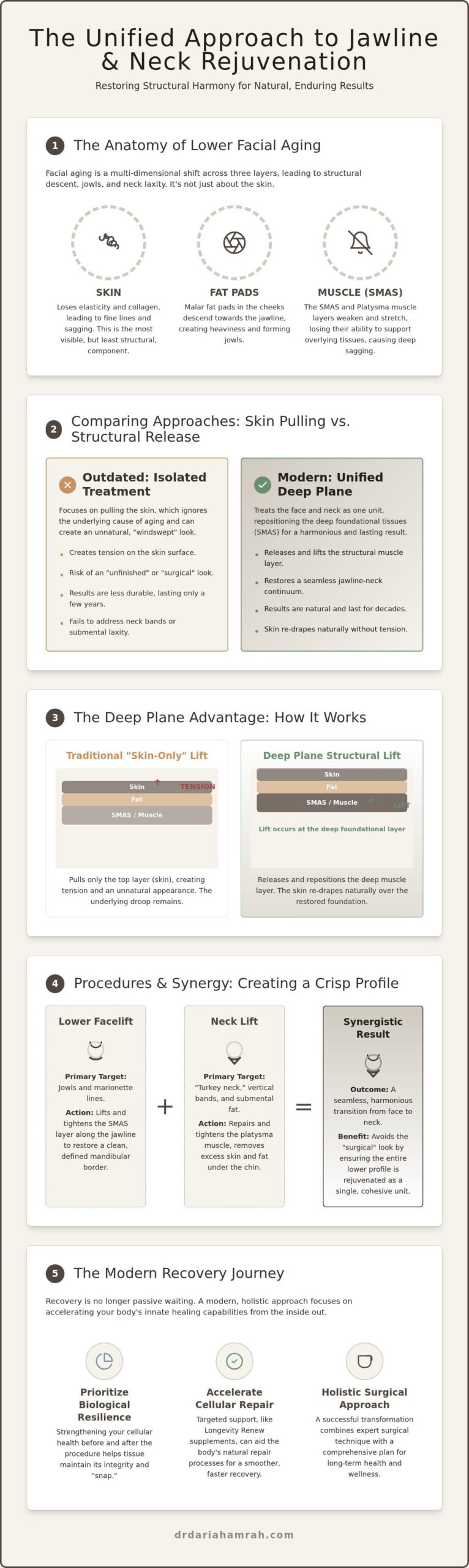
Facial aging is rarely a surface-level event. It’s a complex, multi-dimensional shift involving three distinct layers: the skin, the subcutaneous fat, and the underlying muscular scaffold. While many focus on fine lines, the most significant changes happen beneath the surface. The malar fat pads, which provide youthful volume to the cheeks, slowly migrate toward the mandibular border over time. This migration, combined with a loss of skin elasticity, results in the pooling of tissue we recognize as jowls. It’s a process of structural descent that requires a deep understanding of anatomy to reverse effectively.
The rate of this decline isn’t just determined by gravity; it’s heavily influenced by your internal biological resilience. Cellular health dictates how well your tissues maintain their “snap” and how quickly they recover from environmental stressors. When the internal foundation weakens, the external structure inevitably follows. Choosing a combined lower facelift and neck lift allows us to address these layers simultaneously, ensuring that the restoration is as much about internal health as it is about aesthetic refinement.
Understanding the SMAS and Platysma Layers
The Superficial Musculoaponeurotic System, or SMAS, is the fibrous “anchor” of the lower face. It’s a dense layer of connective tissue that links your facial muscles to the skin. In the neck, this layer continues as the platysma muscle. As we age, the platysma can separate or weaken, leading to the formation of vertical neck bands and a loss of the sharp angle beneath the chin. This is why turkey neck surgery specifically targets these deeper layers rather than just tightening the skin. You can explore neck lift procedure details to understand the standard clinical approach to these muscular adjustments and how they contribute to a unified, youthful profile.
The Role of Retaining Ligaments
Think of retaining ligaments as the “tethers” that hold your facial structure to the bone. They act like the stays of a tent. If the fabric of the tent sags but the stays remain tight, you get bunching and distortion. This is exactly how jowls form; the skin and fat descend, but they’re caught by these fixed ligamentous points. A truly natural lower facelift and neck lift requires the precise release of these ligaments. Without this release, any attempt to lift the face results in a “pulled” or “windblown” appearance because the tissue is being stretched against its own anchors. By releasing these tethers, we can move the entire tissue block back to its original position without creating surface tension. Understanding your specific anatomical descent is the first step toward a personalized restoration plan that respects your unique features.
Lower Facelift vs. Neck Lift: Comparing Procedures and Outcomes
Understanding the distinction between these two procedures is vital for managing your expectations and achieving a harmonious result. While a lower facelift primarily targets the descent of the mid-face and the formation of jowls, a neck lift focuses on the area below the mandibular border. For many, a comprehensive overview of facial cosmetic procedures reveals that these surgeries are often performed simultaneously to ensure the transition between the face and neck remains seamless. While a lower facelift addresses the jaw, only a neck lift can correct significant submental fullness.
The surgical approaches also differ in their entry points and tissue movement. A lower facelift typically utilizes incisions hidden around the ear, allowing for the vertical and diagonal repositioning of facial tissues. In contrast, a neck lift may require a small, discreet incision under the chin to access the midline of the platysma muscle. Combining these techniques into a single lower facelift and neck lift session reduces overall downtime and ensures that the vector of lift is consistent across both regions. This unified plan prevents the aesthetic “mismatch” that occurs when one area is rejuvenated while the other is left to show its age.
Lower Facelift: Focus on the Jawline
The primary objective of a lower facelift is to resolve the soft tissue laxity that creates marionette lines and jowls. By repositioning the SMAS layer, we can restore the sharp, youthful “V-shape” of the lower face that naturally softens with age. This procedure excels at cleaning up the jawline, but it has inherent limitations. If used in isolation on a patient with significant neck laxity, the result can look incomplete. The sharpened jawline might sit atop a softened, sagging neck, creating a visible boundary that looks unnatural and betrays the surgical effort. Patients who also notice vertical lip lines and perioral aging alongside their jawline concerns may benefit from exploring advanced treatment for perioral wrinkles as a complementary approach to restoring the full lower face.
Neck Lift: Defining the Cervicomental Angle
A neck lift is specifically designed to address the “double chin” and loose, crepey skin that accumulates under the jaw. This often involves a platysmaplasty, where the midline of the neck muscle is tightened to eliminate vertical bands and restore a smooth contour. This procedure creates a crisp cervicomental angle, which is the sharp transition between the chin and the throat. A lower facelift and neck lift combination is often the most efficient surgical plan because it allows for a comprehensive structural release. This approach perfectly complements the results of a deep plane facelift, ensuring that the tension is placed on the deep muscles rather than the skin. By coordinating these movements, we achieve a profile that is both structurally sound and aesthetically balanced, providing a result that looks like a refreshed version of your younger self.
The Deep Plane Advantage: Why Structural Release Beats Skin Pulling
The evolution of aesthetic surgery has led us to a pivotal realization: true beauty isn’t found in the tension of the skin, but in the integrity of the foundation. Traditional techniques like SMAS-plication or “skin-only” lifts often rely on folding or stitching the muscle layer without actually releasing it from its deeper attachments. This is like trying to smooth a wrinkled rug by pulling on the edges while the furniture is still sitting on it. The Deep Plane approach utilizes a concept called “structural release.” By precisely releasing the retaining ligaments, we can move the entire tissue block as one cohesive unit. This allows for a lower facelift and neck lift that restores the jawline without the need for surface-level pulling.
This method shifts the focus from tightening to repositioning. When we release the deeper anchors, the skin and fat can be moved back to their original, youthful positions without any resistance. The result is a profile that looks inherited rather than manufactured. It’s a sophisticated reimagining of what it means to age gracefully, prioritizing internal health and anatomical accuracy over temporary, superficial fixes.
Avoiding the “Operated” Look
Tension is the primary enemy of natural-looking results. When skin is pulled horizontally to mask sagging, it often flattens the mid-face and creates a tell-tale “windblown” appearance. This excessive tension can also lead to widened scars and distorted earlobes. Deep-tissue repositioning avoids these pitfalls by utilizing a vertical lift. Because we move the underlying SMAS and platysma muscles in the direction they originally descended, the skin simply rests naturally over the new foundation. This preserves your unique facial character and ensures that your expression remains fluid and authentic. You don’t look like a different person; you look like a more vibrant, rested version of yourself.
Longevity and Structural Integrity
Longevity is a cornerstone of our philosophy. While “mini” lifts or skin-focused procedures might show signs of aging again in just a few years, a Deep Plane procedure typically provides results that last 10 to 15 years. This durability is rooted in the biological advantage of maintaining the blood supply between the skin and the fat. By not separating these layers, we ensure the tissue remains healthy and resilient. This approach supports facial rejuvenation at a cellular level, preventing the “thinning” of the skin often seen with repeated traditional procedures. If you’re ready to explore how a structural approach can restore your profile, schedule your consultation to begin your journey toward lasting vitality.
Planning Your Transformation: Recovery, Longevity, and Holistic Health
A successful transformation doesn’t end when you leave the surgical suite. It’s a journey that begins with surgical precision and continues through a dedicated phase of biological support. Achieving the best possible outcome from a lower facelift and neck lift requires a commitment to both your physical recovery and your long-term wellness. By viewing your body as a high-performance system, we can optimize the healing environment at a cellular level, ensuring your results are as resilient as they are beautiful.
The Recovery Journey: What to Expect
The first 72 hours are focused on managing the initial inflammatory response. You’ll prioritize rest and head elevation to minimize swelling while the deeper tissues begin their stabilization process. Most patients find that discomfort is manageable and feels more like tightness than sharp pain. By the second week, you’ll likely feel ready to return to social activities. This “reveal” phase is when the initial swelling subsides, and the crispness of your new jawline begins to emerge. To protect your investment, long-term maintenance involves consistent sun protection and a lifestyle that prioritizes hydration and anti-inflammatory nutrition.
The Holistic Edge: Supplements and Skincare
Cellular health is the silent partner in every successful surgery. Your body’s ability to repair tissue and synthesize collagen depends on the internal resources available to it. We utilize Longevity Renew supplements to bridge the gap between standard nutrition and the heightened demands of post-operative repair. These supplements provide targeted support for biological resilience, helping your tissues heal with greater efficiency and strength. It’s about providing the building blocks your cells need to reconstruct the structural foundation we’ve repositioned.
Complementing this internal support is a transition to a science-backed, medical-grade skincare regimen. While a lower facelift and neck lift restores the structural foundation, skincare maintains the vibrancy and texture of the surface. Using high-potency antioxidants and growth factors helps ensure that your skin remains healthy and radiant for decades to come. Patients who are also concerned about fine lines around the mouth will find that a comprehensive treatment for perioral wrinkles rooted in structural integrity and skin longevity pairs naturally with this holistic approach. This holistic approach ensures that every layer of your profile reflects a sense of vitality and enduring health.
Preparation Checklist for Your Transformation:
- Optimize your hydration and nutrition at least two weeks prior to surgery.
- Arrange for a dedicated recovery space with plenty of pillows for head elevation.
- Begin your Longevity Renew supplement protocol as directed by your clinical team.
- Transition to a medical-grade skincare routine to prime the skin’s surface.
- Cultivate a mindset of patience, allowing your body the time it needs to heal fully and naturally.
Reclaiming Your Profile with Structural Integrity
Restoring your youthful profile is about more than just surface-level tightening. It’s about respecting the complex, interconnected anatomy of the lower face and neck. By choosing a combined lower facelift and neck lift, you ensure that the jawline and submental area are addressed as a single, harmonious unit. This structural approach, rooted in deep plane precision, avoids the unnatural “pulled” look and prioritizes long-term vitality. You’re not just changing your appearance; you’re investing in your biological resilience and future self-confidence.
Dr. Daria Hamrah’s board-certified expertise in deep plane anatomy ensures that your results remain faithful to your unique character while lasting for decades. Our holistic recovery protocols, including Longevity Renew supplements and medical-grade skincare, support your body’s healing process at a cellular level. It’s time to bridge the gap between how you feel and how you look with a plan designed for longevity. Schedule your consultation with Dr. Daria Hamrah to discover your personalized path to facial longevity. Your journey toward a crisp, defined jawline and a rejuvenated sense of vitality starts with a commitment to structural excellence.
Frequently Asked Questions
What is the difference between a mini facelift and a lower facelift?
A mini facelift primarily addresses mild skin laxity through shorter incisions, while a lower facelift targets deeper structural descent of the jowls and jawline. The lower facelift is more comprehensive, repositioning the SMAS layer to restore the foundation of the face. While a mini lift offers a quicker recovery, the lower facelift and neck lift combination provides significantly more durable and natural-looking results for those with moderate to advanced signs of aging.
Can I get a neck lift without a facelift if I only have “turkey neck”?
You can certainly undergo a standalone neck lift if your primary concern is submental fullness or muscle banding without significant jowling. This procedure focuses on tightening the platysma muscle and removing excess skin below the jawline. However, if you have sagging in the mid-face, a standalone neck lift might create an aesthetic mismatch. We often recommend a combined approach to ensure the jawline and neck transition seamlessly.
How long do the results of a combined lower facelift and neck lift last?
Results from a combined lower facelift and neck lift typically last between 10 and 15 years, depending on your biological resilience and lifestyle. Unlike surface-level procedures that only tighten the skin, a deep plane approach repositions the underlying muscular scaffold. This creates a lasting foundation that ages naturally over time. Maintaining your results requires consistent sun protection, medical-grade skincare, and supporting cellular health through proper nutrition and supplements.
Will I have visible scars after a lower facelift and neck lift?
Scars are a natural part of any surgical procedure, but they’re designed to be virtually invisible once fully healed. Incisions are strategically placed in the natural creases around the ear and, if necessary, in a discreet fold under the chin. Because the deep plane technique places the tension on the muscles rather than the skin, the incision lines heal under minimal stress. This prevents the widening or thickening of scars often seen in traditional lifts.
What is the best age to consider a combined lower face and neck rejuvenation?
There isn’t a single “perfect” age, as facial aging is determined by genetics, lifestyle, and structural descent rather than the calendar. Most patients consider these procedures in their late 40s to early 60s when jowls and neck laxity become more pronounced. However, some younger patients opt for early intervention to maintain their jawline integrity. Patients in this age range who are specifically concerned about sagging tissue and vertical banding will find that neck rejuvenation for 50 year olds offers a targeted deep structural approach that goes beyond what topical treatments can achieve. The best time is when the reflection in the mirror no longer aligns with your internal sense of vitality.
How does the Deep Plane technique affect recovery time compared to traditional lifts?
Contrary to what you might expect, the Deep Plane technique often involves a more comfortable recovery than traditional skin-pulling methods. By working beneath the SMAS layer, we preserve the natural blood supply between the skin and fat, which promotes faster cellular repair. While you’ll experience initial swelling and tightness for the first 72 hours, most patients return to social activities within two weeks. This efficiency is a hallmark of modern structural rejuvenation.
Is a lower facelift and neck lift performed under general anesthesia?
Yes, this comprehensive procedure is typically performed under general anesthesia to ensure your complete comfort and safety. This allows the surgeon to perform the intricate deep-tissue work with precision while you remain in a controlled, pain-free state. Our clinical team monitors your vitals throughout the process to prioritize your well-being. We discuss all anesthesia options and safety protocols during your personalized consultation to address any specific concerns or medical history before the surgery.
What is the “Longevity Facelift” and how does it differ from a standard procedure?
The Longevity Facelift is Dr. Daria Hamrah’s signature approach to the Deep Plane technique, focusing on natural results and long-term tissue health. It differs from standard procedures by integrating holistic recovery protocols, such as Longevity Renew supplements, to support the body’s internal healing environment. This method prioritizes structural integrity over surface tension. It’s designed to provide a refreshed appearance that looks authentic and maintains its crispness for a decade or more.