
What if the secret to a youthful profile in 2026 isn’t found in a jar of luxury cream, but in the structural foundation deep beneath your skin? Many individuals seeking neck rejuvenation for 50 year olds find themselves frustrated by topical treatments that promise much but deliver little for sagging tissue. You’ve likely noticed your jawline losing its crisp edge; vertical bands are becoming more prominent, and crepey skin texture persists despite a dedicated skincare routine. It’s a common struggle where the reflection in the mirror doesn’t quite match the internal vitality and energy you feel every day.
This article will show you how to move beyond temporary, surface-level fixes to embrace deep structural restoration that honors your unique anatomy. You’ll discover why the Deep Plane Necklift is the gold standard for restoring structural integrity and biological resilience. We will explore how targeting the underlying platysma muscle and submandibular tissues creates a naturally sharp jawline, and how supporting your cellular health with Longevity Renew supplements ensures your results reflect a life lived with confidence and vigor.
Key Takeaways
- Understand the anatomical shift that occurs at 50, where declining collagen and the relaxation of the platysma muscle require more than just topical solutions.
- Learn why the Deep Plane Neck Lift is the gold standard for achieving a sharp, natural jawline by repositioning deep tissues rather than simply pulling the skin.
- Explore the essential role of biological resilience and how medical-grade skincare and Longevity Renew supplements create a foundation for optimal healing.
- Evaluate the 2026 landscape of neck rejuvenation for 50 year olds to determine when non-surgical energy devices are effective versus when surgical intervention is necessary.
- Discover a holistic framework that treats the neck not just as an aesthetic concern, but as a reflection of your internal vitality and structural integrity.
Why Neck Aging Accelerates at 50: The Intersection of Biology and Structure
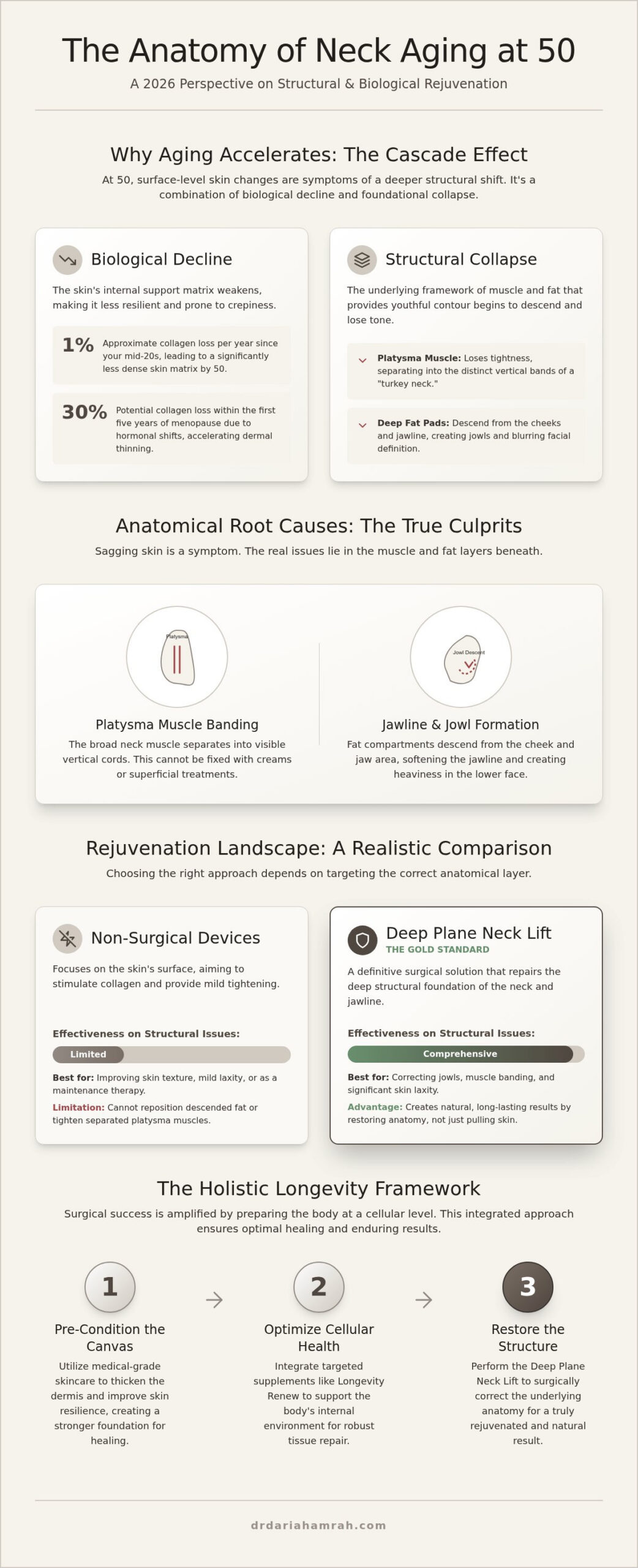
For many, reaching the age of 50 marks a significant shift in how the body maintains its physical architecture. In the context of neck rejuvenation for 50 year olds, we must look past the surface of the skin to understand the complex interplay between biological decline and structural collapse. Rejuvenation at this stage is not merely about erasing a few lines; it’s the intentional restoration of the neck’s foundational framework. While your 30s and 40s were likely focused on preventing fine lines, this decade demands a deeper focus on the structural scaffolding that defines your lower face and neck.
We often see a phenomenon known as structural collapse. This occurs when the deep fat pads that once provided youthful volume begin to descend, and the muscles, specifically the platysma, lose their tone. This creates a cascading effect where the jawline loses its crisp edge and vertical bands become visible. True skin longevity requires us to move away from temporary aesthetic fixes and instead focus on the internal health of the tissue. By 2026, the standard of care has shifted toward preparing the body at a cellular level before any physical intervention occurs.
The Biological Clock: Collagen and Elastin at 50
The biological reality of aging is often measured in the steady decline of essential proteins. Since your mid 20s, your skin has likely lost approximately 1% of its collagen every year. By the time you reach 50, this cumulative loss results in a skin matrix that is significantly less dense and resilient. Elastin fibers, which allow the skin to “snap back” after movement, also begin to degrade and fragment. This leads to the characteristic crepey texture that makeup often struggles to hide. Dermal thinning acts as a primary barrier to non-surgical success.
Hormonal Influence and Tissue Resilience
For women, the transition through perimenopause and menopause introduces a sharp decline in estrogen, a hormone critical for skin thickness and hydration. Research indicates that skin can lose up to 30% of its collagen in the first five years of menopause alone. This hormonal shift accelerates the loss of subcutaneous fat, leading to a hollowed appearance and a lack of support for the overlying skin. To counter these changes, we emphasize a holistic approach to neck rejuvenation for 50 year olds:
- Medical-grade skincare: Utilizing high-potency actives to thicken the dermis and improve surface resilience.
- Cellular support: Integrating targeted nutrition, such as Longevity Renew supplements, to optimize the internal environment for tissue repair.
- Structural assessment: Recognizing that skin laxity is often a symptom of deeper muscle and fat migration.
Preparing the tissue with medical-grade skincare is no longer optional; it’s a vital step in pre-conditioning the skin to ensure it has the biological strength to heal and maintain long-term results.
Anatomical Root Causes: Why “Turkey Neck” and Jowls Form
By age 50, what many perceive as “bad skin” is actually a failure of the support system beneath it. Surface-level sagging is merely the visible symptom of a deeper structural collapse. When we discuss neck rejuvenation for 50 year olds, we must look at the three-dimensional changes occurring in the muscle, fat, and glandular structures. It’s a common misconception that tightening the skin will solve the problem. In reality, addressing the skin without repairing the foundation is like trying to fix a sagging roof by only replacing the shingles.
The Platysma Muscle: The Foundation of the Neck
The platysma is a thin, broad muscle sheet that spans from the jawline down to the collarbone. As we age, this muscle loses its tone and begins to separate into distinct vertical cords. This separation is what creates “banding,” often referred to as a turkey neck. Because these bands are a muscular issue, topical creams cannot reach or repair the underlying fibers. To achieve a smooth, youthful contour, the muscle must be physically repositioned and tightened. This structural repair is the core focus of turkey neck surgery, which provides the internal scaffolding necessary for long-term results.
Jawline Integrity and the Descent of Jowls
The jawline’s definition is heavily influenced by the movement of facial fat. In your youth, fat pads are positioned high on the cheekbones, providing a lifted appearance. Over time, these pads descend toward the jawline, creating jowls that disrupt the smooth transition between the face and neck. This descent also contributes to deep marionette lines, which can make the lower face look heavy. Because the face and neck are anatomically linked, effective neck rejuvenation for 50 year olds often requires a lower facelift and neck lift combination to restore total harmony.
Another complicating factor is the prominence of the submandibular glands. These glands sit just beneath the jawline. When the surrounding tissues weaken, the glands can bulge, creating a “full” look that skin-tightening alone won’t fix. Understanding these deep-tissue failures allows for a more visionary approach to rejuvenation. If you’re ready to look beyond the surface, a comprehensive anatomical consultation can reveal the path to a truly restored profile.
Non-Surgical vs. Surgical Rejuvenation: A Realistic 2026 Comparison
Choosing the right path for neck rejuvenation for 50 year olds often feels like a choice between convenience and comprehensive results. In 2026, the market is flooded with “office-hour” procedures that promise surgical outcomes without the downtime. While Botox and dermal fillers play a role in softening dynamic lines or restoring minor volume loss, they eventually reach a point of diminishing returns. For a 50 year old patient, these tools are best viewed as maintenance rather than a solution for structural failure. Botox can relax active muscle cords, but it’s unable to lift a descending jawline or remove redundant skin.
Longevity provides the most striking contrast between these paths. Non-surgical interventions typically require maintenance every 6 to 12 months to sustain their effects. In contrast, a well-executed surgical restoration provides structural integrity that lasts 10 to 15 years. Relying solely on fillers to “lift” the neck often backfires. Adding volume to an already sagging area creates a heavy, unnatural appearance that lacks the crisp definition of a youthful profile.
Energy-Based Devices and Skin Resurfacing
Energy-based treatments like Ultherapy or radiofrequency are excellent for stimulating collagen in the early stages of laxity. Sciton laser resurfacing is particularly effective for improving skin texture and addressing the fine, crepey lines that topical creams ignore. These technologies are often used as a treatment for perioral wrinkles to ensure the skin around the mouth matches the renewed vitality of the neck. However, even the most advanced laser can’t reposition a separated platysma muscle.
The Surgical Threshold: When a Neck Lift is Necessary
How do you know when you’ve crossed the threshold from non-surgical maintenance to surgical necessity? We look for three clinical signs: prominent vertical platysmal bands that persist at rest, a significant loss of jawline definition due to descending fat, and “pinchable” excess skin that no longer responds to tightening devices. When these markers are present, surgery is the only viable path to restoring a sharp, defined contour. Attempting a “liquid neck lift” at this stage often leads to a distorted, overfilled look. For those seeking a result that reflects their internal vitality, the surgical gold standard offers a visionary leap forward, moving beyond surface-level camouflage to genuine structural restoration.
The Holistic Longevity Framework: Cellular Health for Surgical Success
Surgery is often viewed as a final destination, but in a visionary practice, it’s merely a strategic intervention. For effective neck rejuvenation for 50 year olds, we must shift our focus from the scalpel to the cell. Structural integrity is not just about the physical tightening of muscles; it’s about the biological resilience of the tissue being operated upon. If the underlying skin is thin, depleted, or poorly nourished, even the most skilled surgical technique will yield suboptimal results. This is why we prioritize a framework that prepares the body from the inside out, ensuring your investment in your appearance is protected by a foundation of health. We believe that a youthful neck should reflect an internal state of vitality.
Longevity Renew: Supporting the Body’s Healing Response
By 2026, the intersection of nutrition and aesthetics has become undeniable. We utilize proprietary Longevity Renew supplements to provide the specific micronutrients, such as bioavailable amino acids and antioxidants, required for robust collagen synthesis. These formulations are designed to modulate the body’s inflammatory response, which significantly reduces post-operative bruising and swelling. Ultimately, your cellular health dictates the final scar quality and the speed of your recovery. A well-nourished body heals with more precision and longevity, allowing for a more seamless transition to your restored profile.
Medical-Grade Skincare as a Surgical Adjunct
Surface preparation is equally critical. We recommend high-potency retinoids and stabilized Vitamin C to stimulate dermal thickening and improve the skin’s elastic properties before a neck lift surgery. Over-the-counter products often lack the concentration of active ingredients necessary to penetrate the deeper layers of the dermis, leaving the skin unprepared for the rigors of healing. These retail products frequently rely on “fluff” ingredients that provide temporary hydration but fail to induce the biological changes required for surgical success. Integrating Hydra-facials into your pre-surgical routine further optimizes results by promoting lymphatic drainage and clearing the skin of impurities. This multi-dimensional approach ensures that when we perform a procedure, we are working with the highest quality tissue possible.
To truly transform your profile, you must address the biological factors that contribute to aging. You can begin your journey toward structural restoration by exploring our comprehensive longevity protocols today.
Advanced Surgical Solutions: The Deep Plane Advantage
Traditional surgical methods often focus on the skin as the primary culprit of aging. This approach leads to the “windblown” or overly tight appearance that many patients fear. For those seeking truly transformative neck rejuvenation for 50 year olds, the Deep Plane Neck Lift offers a more sophisticated, visionary alternative. Rather than pulling the surface, this technique addresses the layers beneath the muscle. It’s about restoring the anatomical foundation to its original, youthful position. When we treat the neck as a three-dimensional structure rather than a two-dimensional surface, the results are naturally elegant and enduring.
Deep Plane vs. Traditional Neck Lifts
The technical brilliance of the Deep Plane approach lies in the release of the retaining ligaments. These ligaments act like anchors, holding tissues in their aged positions. By releasing them, a surgeon can reposition the deep tissues and the platysma muscle without any tension on the skin. This tension-free closure is the secret to avoiding the “operated-on” look and ensuring scars heal almost invisibly. For many patients, achieving total facial harmony means pairing this procedure with a deep plane facelift. This comprehensive “Longevity Facelift” ensures the jawline, neck, and mid-face are restored as a single, cohesive unit, reflecting your internal vitality.
What to Expect: Consult, Procedure, and Longevity
Embarking on a surgical journey requires a partnership with a board-certified facial cosmetic surgeon who views surgery through a multi-dimensional lens. Your initial consultation is a deep dive into your anatomy, lifestyle, and longevity goals. By 2026, advanced surgical techniques combined with the cellular pre-conditioning discussed earlier have refined the recovery experience. Most patients find they can return to social engagements within 10 to 14 days, though the internal structural settling continues to improve over several months.
The longevity of these results is a primary benefit. While non-surgical options require constant maintenance, a Deep Plane restoration typically lasts 10 to 15 years. Maintaining this investment involves a commitment to medical-grade skincare and continued cellular support. Choosing structural restoration is an empowering decision. It’s a commitment to a version of yourself that looks as vibrant and resilient as you feel. If you’re ready to move beyond temporary fixes, we invite you to explore how a visionary, structural approach to neck rejuvenation for 50 year olds can redefine your profile for the next decade and beyond.
Embracing a Visionary Approach to Structural Restoration
Restoring a youthful neck and jawline at 50 requires more than just masking the symptoms of age; it demands a fundamental return to structural integrity. We’ve explored how transitioning from surface-level treatments to deep plane techniques allows for a natural, tension-free repositioning of the underlying tissues. True success in neck rejuvenation for 50 year olds is built on a foundation of cellular health, where medical-grade skincare and internal supplements prepare your body for optimal healing. By 2026, the standard of care has evolved to prioritize biological resilience alongside surgical precision.
Dr. Daria Hamrah is a national leader in facial cosmetic surgery innovation, specializing in Deep Plane (Longevity) Facelift and Necklift techniques that focus on natural, long-term tissue health. This holistic framework ensures your results are not only striking but also enduring and reflective of your internal vitality. You deserve a profile that matches the energy you bring to the world every day. Schedule your consultation with Dr. Daria Hamrah to discuss your personalized neck rejuvenation plan. We look forward to guiding you through this transformative journey toward a more confident, restored version of yourself.
Frequently Asked Questions
Is 50 too young or too old for a neck lift?
Age 50 is frequently the optimal time for a neck lift. By this stage, structural changes like jowls and muscle banding are clearly defined, yet your skin still retains enough biological resilience to heal efficiently. Waiting too long can result in more complex procedures, while addressing these issues now allows for a more seamless restoration. It’s about intervening when the discrepancy between your internal vitality and your reflection becomes noticeable.
How long do the results of a neck rejuvenation treatment last?
The longevity of your results depends heavily on the chosen method. Surgical neck rejuvenation for 50 year olds using the Deep Plane technique typically lasts between 10 and 15 years. This is because we are repositioning the underlying architecture rather than just stretching the surface. Non-surgical options, such as Botox or energy-based devices, generally require maintenance every 6 to 12 months to sustain their aesthetic impact.
What is the difference between a neck lift and a platysmaplasty?
A neck lift is a comprehensive procedure that addresses skin, fat, and muscle to redefine the jawline. A platysmaplasty is a specific component of that surgery focused entirely on the platysma muscle. During a platysmaplasty, the vertical bands are sutured together to create a smooth, firm foundation. Most successful rejuvenations at 50 combine both to ensure the skin has a stable, tightened muscle structure to rest upon.
Can Botox alone fix a “turkey neck” at age 50?
Botox cannot physically repair a “turkey neck” once structural sagging has occurred. While it can temporarily relax active platysmal bands to soften their appearance, it doesn’t address redundant skin or descending fat pads. For a 50 year old, Botox is best used as a maintenance tool or a preventative measure. True restoration of a sagging profile requires a surgical approach that physically lifts and secures the underlying tissues.
What is the typical recovery time for a deep plane neck lift in 2026?
In 2026, patients undergoing a deep plane neck lift are typically ready for social engagements within 10 to 14 days. Advanced techniques and cellular pre-conditioning have streamlined the initial healing phase. While visible bruising and swelling subside quickly, internal tissue settling continues for several months. We emphasize a gradual return to activity to protect the structural integrity of the repair while your body integrates the new contours.
Will I have visible scars after neck rejuvenation surgery?
Scars are meticulously placed in natural creases around the ears and under the chin to remain virtually invisible. Because the Deep Plane technique places all the lifting tension on the deep tissues rather than the skin, the incision lines heal without being pulled or widened. This tension-free closure is essential for achieving a result that looks entirely natural and avoids the tell-tale signs of traditional “skin-only” surgery.
How do supplements like Longevity Renew help with surgery recovery?
Longevity Renew supplements provide the essential micronutrients your body needs to synthesize new collagen and repair damaged fibers. By optimizing your internal environment, these supplements help modulate inflammation and reduce post-operative bruising. High-quality cellular health is the secret to superior scar quality and a faster recovery. We view these supplements as a vital part of the holistic framework for long-term surgical success.
Can non-surgical treatments like Ultherapy replace a surgical neck lift?
While Ultherapy is an excellent tool for mild skin tightening and collagen stimulation, it cannot replace a surgical lift once significant laxity exists. Non-surgical devices work on the surface and upper dermis, but they lack the power to reposition separated muscles or remove excess skin. For most 50 year olds, these treatments are effective adjuncts to surgery rather than a substitute for the structural restoration provided by a neck lift.