
Tip rhinoplasty surgery can refine the lower part of the nose without changing the bridge. A true tip-only procedure focuses on the nasal tip and does not alter the nasal bones or upper bridge. Understanding that distinction can help you decide whether your goal is limited to the tip.
You may want to soften a rounded appearance, improve definition, or address asymmetry while keeping the rest of your nose familiar. The right approach depends on the tip’s cartilage and soft-tissue structure, as well as how it relates to your facial features.
This article explains what tip plasty can change, who may be suited to it, and how surgeons assess asymmetry. You’ll also learn what recovery can involve and why refinement takes time to emerge, giving you a clearer understanding of the procedure’s scope and realistic outcomes.
Key Takeaways
- A true tip-only procedure reshapes the nasal tip without changing the nasal bones or upper bridge, so defining the treatment area is an important first step.
- Tip sutures, cartilage adjustments, and grafts can address different structural features; the approach depends on what contributes to the tip’s shape or asymmetry.
- Changes to the tip can be subtle and structural, with cartilage and soft tissue both influencing definition and balance.
- Recovery involves a gradual return to activity, while swelling and refinement may continue for months as the tip heals.
- Understanding the difference between early healing and the developing result can help you set realistic expectations for the process.
Can You Have a Tip-Only Rhinoplasty?
Yes. Tip-only surgery can reshape the lower nose while leaving the nasal bones and upper bridge unchanged. Whether this approach fits your goals depends on the cartilage, skin, and soft tissue shaping your tip.
Open and closed surgical approaches
Open and closed approaches describe where the surgeon makes incisions to reach the nasal structures. An open technique uses an incision across the columella, connected to incisions inside the nostrils, providing direct visibility of the tip cartilage. A closed approach uses incisions inside the nostrils, without an external columella incision.
The distinction matters because access affects how the surgeon can see and adjust cartilage. Tip sutures can reshape or reposition lower lateral cartilage; grafts can add support or definition. The National Library of Medicine review describes closed preservation rhinoplasty as an option for thin skin, minor dorsal modifications, and simple tip deformities.
Open or closed access does not determine quality on its own. During consultation, ask which technique suits your anatomy and why. Discuss how the proposed adjustments could affect tip support, nostril appearance, and concerns involving the septum. A true tip-only procedure does not alter the nasal bones or upper bridge, so it cannot address changes required in those areas.
Costs, risks, and complications
In the United States, tip rhinoplasty costs vary by case. Factors include the surgical technique, complexity of the cartilage work, anesthesia, and facility arrangements. A national average or range should not be treated as your personal estimate.
Potential complications include bleeding, wound-healing problems, and changes to the tip’s contour. Smoking can reduce oxygen delivery to the skin and cause wound-healing complications. In a series of 1,033 rhinoplasties, 2% of patients had postoperative tip deformities, according to the National Center for Biotechnology Information. That study result describes a group, not an individual prediction.
Discuss anesthesia and facility arrangements as part of your planning. Tip plasty is usually performed under local anesthesia or light conscious sedation, and the operation itself may take one to three hours. A patient may spend up to six hours at the facility from arrival to departure. Surgeons may advise stopping aspirin, other anti-inflammatory medicines, or certain herbs because they can promote bleeding.
Consultation questions
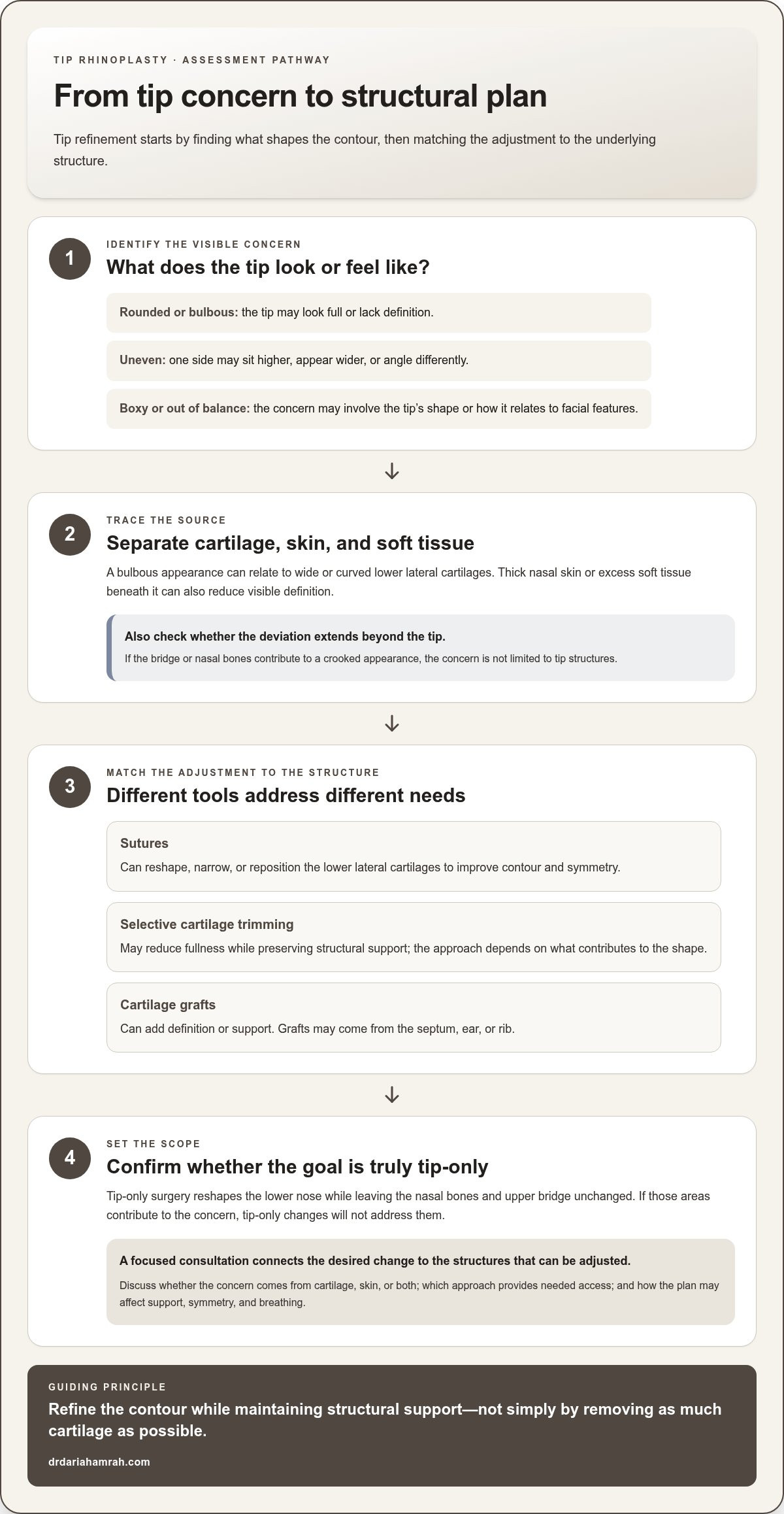
A focused consultation connects the change you want with the structures that can be adjusted. Ask: “Is my concern caused by cartilage, skin, or both?” “Would an open or closed approach provide the access needed?” “Will you use sutures, remove cartilage, or consider a graft?”
Also ask how the proposed technique may affect tip support, symmetry, and breathing. If you’re considering filler instead, ask what it can realistically change. Fillers cannot reduce cartilage or refine a bulbous tip, and they cannot correct drooping.
Finally, ask what anesthesia is planned, how long the facility visit may last, and which medicines or herbs to discuss beforehand. Ask how the facility prepares for the procedure and what support is available if a complication arises. These answers clarify the procedure’s scope and the reasoning behind the surgical plan.
Correction of nasal deviation and asymmetry
Nasal tip refinement surgery reshapes the cartilage and soft tissue that define the lower third of the nose. Patients may seek it to address a bulbous or boxy tip, improve symmetry, or bring the tip into better balance with their facial features.
A bulbous tip often appears rounded because the lower lateral cartilages are wide or curved. Thick nasal skin or excess soft tissue beneath it can also reduce definition. During tip rhinoplasty surgery, the surgeon may use sutures to narrow and reshape cartilage, or remove selected cartilage while preserving support. The technique depends on which structures cause the fullness.
Asymmetry can involve one side of the tip sitting higher, wider, or differently angled than the other. Tip sutures can reshape and reposition the lower lateral cartilages; grafts can add definition or support. Cartilage grafts may come from the septum, ear, or rib. A 29-year-old woman sought rhinoplasty to address nasal deviation and improve how her nose was proportioned to her face.
Not every deviation is limited to the tip. If the bridge or nasal bones contribute to a crooked appearance, tip-only changes will not address those structures. The plan begins by identifying where the deviation originates. A tip graft, for example, may improve definition, while broader structural changes may be needed if the upper nose also contributes to the imbalance.
During surgery, cartilage can be adjusted with sutures, selectively trimmed, or supported with a graft. For a bulbous tip, the surgeon may narrow or unify the lower lateral cartilage. Thick skin can still limit how clearly that framework shows. The goal is to refine the shape while maintaining structural support, not simply to remove as much cartilage as possible.
A good candidate has a specific concern, such as a rounded tip or uneven contour, and wants a change limited to that area. The underlying cartilage and skin matter because they influence which adjustments can create definition. A consultation can clarify whether the concern is truly tip-focused or also involves the bridge.
Tip plasty is usually considered cosmetic and generally is not covered by health insurance, even when performed alongside medically necessary surgery. Functional nasal surgery may be treated differently when it addresses breathing problems; coverage depends on the procedure and the plan.
When choosing a surgeon in the United States, review their training, experience with nasal tip procedures, and examples of comparable results. Ask how they assess asymmetry, preserve support, and distinguish a tip concern from deviation involving the bridge or septum.
If your goal is to understand how a personalized plan can address nasal shape, explore nasal surgery options as a next step.
Long-term results and realistic expectations
After nasal reshaping, the visible contour changes gradually as swelling settles and tissue heals. The nasal tip often takes longer to refine than the bridge, so its early appearance is not the final result.
Swelling and the results timeline
Tip swelling can persist for months or even years, and final results may not be visible for at least a year after surgery. Thick skin can slow refinement because swelling in the tissue covering the cartilage takes time to resolve. An uneven appearance in the early weeks may look more balanced as swelling decreases.
Results continue to develop over 2-6 weeks after surgery, while tip refinement after tip-only rhinoplasty may continue for up to 12 months. Swelling can take six months to two years to subside. These timelines describe different stages: early visible change, ongoing healing, and gradual settling of the nasal tip.
Long-term surgical results
Long-term results reflect both the reshaping performed and how tissue heals around the cartilage. A refined tip can look different as swelling fades, so judging the outcome from early photographs may misrepresent the eventual contour. Comparing images taken at consistent angles and in consistent lighting helps track changes more accurately.
Examples in the research include rhinoplasty photographs taken 9 months after surgery, showing a refined tip and narrowed nostril base, and images taken 7 years after surgery. These examples illustrate that photographs can document results at different stages, not a guaranteed outcome or a timeline for every patient.
Patience matters most when the tip still looks full. The nasal tip’s soft tissue can hold swelling after the bridge appears more settled, especially with thicker skin. At 10 weeks, a photograph may show a designed supra tip break, but that image represents one patient’s healing stage rather than a universal benchmark.
Think of recovery as a sequence rather than a single reveal. At 2 months, one patient’s before-and-after photographs showed a more refined tip after open rhinoplasty. Other postoperative images show results at 11 months or 18 months. Differences between those examples reflect distinct procedures and healing, so they shouldn’t be compared as identical milestones.
For a useful progress review, note the date of each photograph and compare the same facial angles. Track changes in tip fullness, projection, and symmetry rather than focusing on one close-up. At the one-year mark, the result may be clearer, although subtle tissue changes can continue beyond that point.
Realistic expectations focus on the planned structural change, not perfection in every expression or viewing angle. Tip reshaping can improve definition and balance, while natural facial asymmetry remains part of your appearance. Allowing the full healing period gives the tissue time to settle before you assess the lasting contour.
Recovery and activity restrictions
After tip surgery, recovery involves visible early healing and a gradual return to exercise. Understanding these stages helps you plan work, support at home, and daily activities around your healing.
Early recovery and return to work
Early recovery covers the first days after surgery, when swelling, bruising, and rest shape the routine. Recovery is approximately 7-10 days, and bruising under the eyes may be visible. Patients should rest at home during the first week. Some feel ready to work from home by day 3 or 4, while returning to work or school commonly takes 1 to 2 weeks.
A nasal splint may be worn for about 1 week after tip-only rhinoplasty. Non-dissolvable stitches are usually removed 5-7 days after surgery at a follow-up appointment; dissolvable sutures typically dissolve within a week or two. These milestones can help you plan time away and organize follow-up care.
Healing timeline and activity restrictions
Activity restrictions protect healing tissue while the nose settles after cosmetic plastic surgery. Light exercise may resume 2 weeks after tip rhinoplasty. Heavy lifting and intense physical exercise should be avoided for 4-6 weeks. A gradual return helps protect the healing nose as you rebuild your usual routine.
Some guidance recommends limiting intense physical activity for at least three weeks. These timelines describe a staged return, not permission to resume every activity at once. Follow the recovery plan for your procedure, including open rhinoplasty, because the surgical approach and your healing needs inform activity decisions.
Arrange practical support before surgery. Have someone drive you home and stay with you for at least 24 hours after the procedure. During the first week, prioritize rest; light chores and housework may begin a few days after surgery. Avoid rushing tasks that could disturb your nose or interrupt recovery.
Work and school schedules depend on the demands of each role. Tip rhinoplasty patients can usually return to work or school in 1 to 2 weeks. A desk-based schedule may be manageable sooner than work involving lifting, physical exertion, or potential contact with the nose. Building flexibility into your calendar allows time for healing and follow-up.
Exercise timing also supports a steady return to activity. Light exercise can resume 2 weeks after tip rhinoplasty, while heavy lifting and intense activity remain restricted for 4-6 weeks. Consider how a specific activity fits the staged plan, especially if it involves exertion or a risk of impact.
Healing and appearance follow separate timelines. Tip swelling can continue after bruising improves, so early recovery does not show the final cosmetic result. Tissue needs time to settle after procedures that reshape cartilage. Keep follow-up appointments and follow your activity guidance as the nasal tip gradually refines.
Definition and scope of tip-only rhinoplasty
A true tip-only rhinoplasty reshapes the lower nose without changing the nasal bones or upper bridge. This is the key boundary: the procedure can target the tip’s appearance, but cannot correct concerns caused by structures outside it. Clarifying the treatment area helps you describe the change you want and understand what the procedure is designed to address.
The nasal tip’s shape comes from cartilage, skin, and soft tissue. Tip sutures can narrow, unify, reshape, or reorient the lower lateral cartilage. Selective cartilage removal may reduce excess bulk along its upper border while preserving enough structure for support. The plan depends on which tissues contribute to the appearance you want to refine.
Tip-only surgery can address concerns such as a rounded or poorly defined tip, or a tip that appears uneven. It may also change the tip’s orientation. These adjustments affect the relationship between the tip, nostrils, and the rest of the nose. They do not automatically include nostril-base changes, bridge reshaping, or correction of the nasal bones.
Grafts can add support or definition rather than remove tissue. Peck onlay and shield grafts are examples used for tip refinement. Graft material may come from the nasal septum, ear, or rib, then be placed over the lower lateral cartilage. This differs from cartilage removal: the choice depends on whether the desired improvement calls for added structure or less excess.
Skin thickness also influences the procedure’s scope and visible result. Excess soft tissue beneath thick nasal skin may be removed to thin the covering over the cartilage, while avoiding injury to the dermis and underlying blood vessels. However, reducing tissue is not the same as changing the cartilage framework. A plan may address either or both contributors.
Use a consultation to distinguish your aesthetic goal from the anatomical change. Describe the specific view that concerns you, such as a rounded tip in profile or uneven definition from the front. Then ask which structures would change, whether the nostril base is included, and whether the proposed procedure leaves the bridge and bones untouched.
Recovery is part of the scope, not a sign that the procedure changes more of the nose. Tip swelling can persist after early healing, and refinement may continue for up to 12 months after tip-only rhinoplasty. A true tip-only operation is most relevant when the goal is confined to the lower nose; broader concerns require discussion of broader changes.
To connect your goals with the structures involved, discuss rhinoplasty goals as a next step.
Dr. Daria Hamrah: Deep Plane Facelift (Longevity Facelift)
Dr. Daria Hamrah offers rhinoplasty for patients considering changes to nasal shape, while the Deep Plane Facelift (Longevity Facelift) is for broader facial rejuvenation goals. These procedures address different concerns: tip-focused surgery concerns the nose, while facelift planning considers facial rejuvenation more broadly. A discussion can help clarify your priorities and whether your goals involve one area or a wider facial plan.
Dr. Hamrah also offers Botox and Hydra-facials as non-surgical options for facial care. Start the conversation with your priorities, the changes you want to explore, and the treatment approach that fits them.
To discuss your facial goals, contact Dr. Daria Hamrah or visit drdariahamrah.com.
Take the Next Step With Clarity
Your next step can be a conversation about what you want to change, what you want to preserve, and how those priorities fit together. For tip rhinoplasty surgery, clearly describing your goal gives the consultation a useful starting point. The right plan depends on your individual anatomy and the outcome you’re seeking.
Dr. Daria Hamrah offers rhinoplasty, the Deep Plane Facelift (Longevity Facelift), and Botox. These services address different aesthetic concerns, so the discussion can focus on the area and approach that matter to you. Bring questions about your goals and use the conversation to understand your options without feeling pressured to decide immediately.
When you’re ready to explore that conversation, contact Dr. Daria Hamrah. A thoughtful next step begins with your priorities and gives you space to make an informed choice.
Frequently Asked Questions
What Is Tip Plasty?
Tip plasty is surgery focused on reshaping the lower part of the nose. It may address concerns such as a rounded contour, limited definition, or a tip that points downward. The precise change depends on the cartilage and soft tissue involved. For example, improving tip definition may involve reshaping the cartilage framework rather than changing the bridge or nasal bones.
How is nasal tip surgery done?
Nasal tip surgery adjusts the structures that shape the lower end of the nose. A surgeon may use sutures to reposition cartilage, trim selected cartilage, or add a graft when extra support or definition is needed. Access may be through incisions inside the nostrils or an open approach. The planned adjustments depend on whether the concern involves width, projection, rotation, or contour.
What is a bulbous tip and what causes it?
A bulbous tip looks rounded and has limited definition. Wide or rounded lower lateral cartilage can create this appearance; thick skin or excess soft tissue beneath the skin may also contribute. For instance, a tip can appear full because of its cartilage framework, its tissue covering, or both. Identifying the source matters because each structure calls for a different surgical adjustment.
What is nose tip refinement?
Nose tip refinement means making a targeted change to the tip’s shape, definition, or position. It may involve adjusting cartilage, using sutures, or adding a graft to support the contour. Think of the tip as a framework beneath a soft covering: changing the framework affects its shape, while skin thickness influences how clearly that shape appears. Refinement describes a goal, not one fixed technique.
What is the surgery to raise the tip of the nose?
A surgeon can raise or rotate a drooping nasal tip using tip rhinoplasty techniques that reposition and support the cartilage. Sutures may reorient the lower lateral cartilage; a graft may provide extra support when needed. The surgical plan considers the tip’s starting position and its relationship to the nostrils. The aim is to change the tip’s orientation, not simply make it look smaller.
What is tip rhinoplasty and what nasal features can it change?
Tip rhinoplasty is surgery focused on the lower third of the nose. It can address tip width, shape, definition, projection, rotation, and some asymmetry. When the procedure is truly tip-only, it does not change the nasal bones or upper bridge. If your concern also involves the bridge, it falls outside the scope of tip-only surgery and calls for a broader discussion of the change you want.
How is tip rhinoplasty performed, and how does it differ from full rhinoplasty?
Tip rhinoplasty modifies cartilage and related soft tissue in the lower nose using an open or closed surgical approach. Full rhinoplasty can address additional structures, including the bridge or nasal bones, when those areas are part of the goal. For example, someone seeking only a refined tip has a different scope from someone seeking changes to both the tip and bridge.
What is recovery like after tip rhinoplasty, and when are results visible?
Early recovery can include swelling and bruising, while the tip’s contour continues to develop as tissue heals. Some patients return to work or school within 1 to 2 weeks, depending on their recovery and daily demands. Swelling can obscure the result, so an early appearance isn’t a reliable final assessment. Tip refinement may continue for up to 12 months after surgery.