
Could making your nostrils narrower make your nose look less balanced? With rhinoplasty for wide nostrils, the goal isn’t simply to reduce width. It’s to understand how the nostril base, openings, nasal tip, and bridge relate to one another, then consider possible changes in the context of your whole face.
If you’re concerned that narrowing could look overdone, leave visible scars, or affect breathing, those are important questions to raise. A thoughtful plan starts with your anatomy and goals, not a standard measurement or one-size-fits-all result.
This article explains what can influence the appearance of nostril width and how surgeons weigh refinement against facial balance and nasal function. You’ll learn how focused alar base refinement differs from broader rhinoplasty, what can shape decisions about surgical approach, and what to discuss during a consultation. Dr. Daria Hamrah, a board-certified facial cosmetic surgeon, provides rhinoplasty care planned around each patient’s anatomy and priorities. Understanding the options can help you have a more informed conversation about a natural-looking result that feels in proportion to your features.
Key Takeaways
- Nostril width is understood in context: the nasal base, openings, and surrounding facial features all influence how the nose appears.
- Rhinoplasty for wide nostrils may involve focused attention to the nasal base, while broader changes to the bridge or tip are separate considerations.
- Compare focused refinement with broader rhinoplasty by considering your goal, the structures involved, and how each option may relate to your facial balance.
- Use your goals, breathing concerns, expectations, and readiness for recovery to guide a thoughtful discussion about candidacy.
- A consultation with Dr. Daria Hamrah can connect your goals with your anatomy, facial balance, and functional priorities.
What makes nostrils look wide, and when might rhinoplasty help?
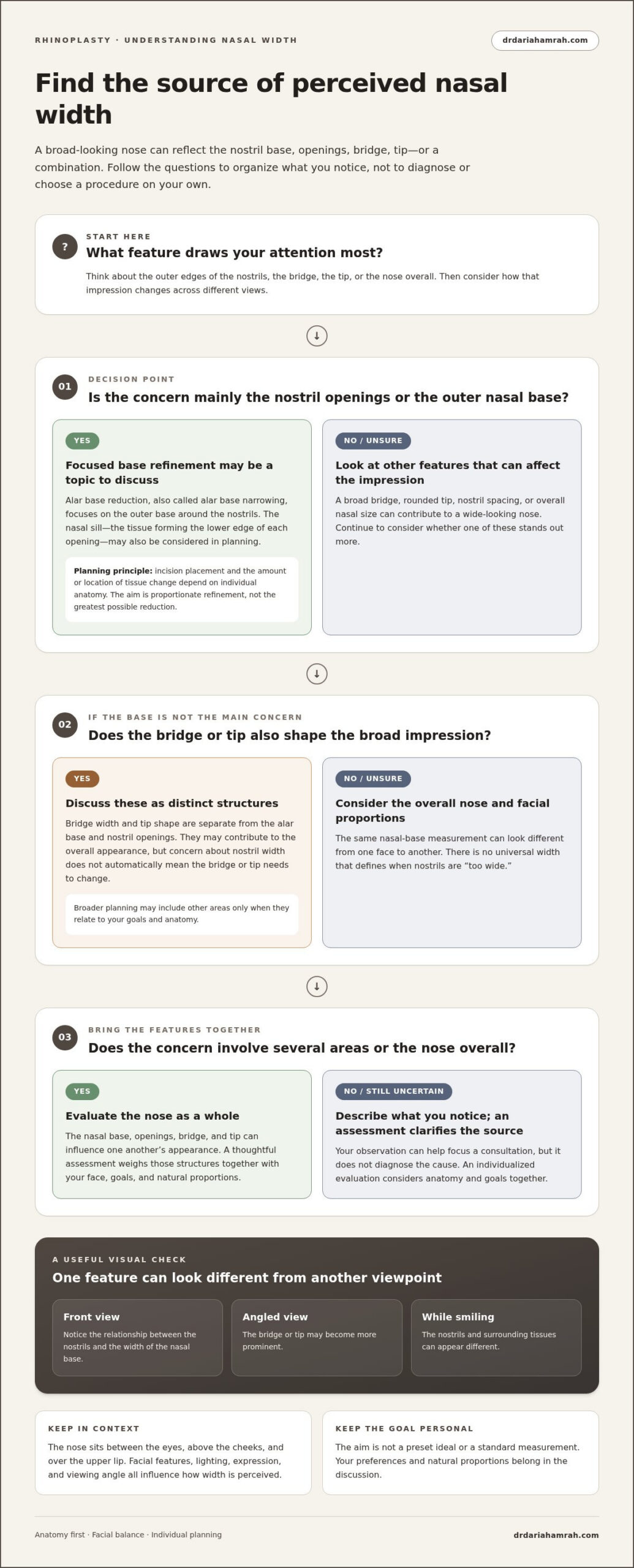
A wide-looking nose isn’t always caused by wide nostrils. The appearance may come from the nasal base, the shape or spacing of the nostril openings, a broad bridge, a rounded tip, or a combination of features. These details matter because refining one area can change how the others are perceived. Rhinoplasty planning starts with anatomy and facial balance, not a single measurement or a preset ideal.
There’s no universal width that defines when nostrils are “too wide.” The concern is personal and depends on how the nose relates to the rest of your face, as well as what you hope to change. Rhinoplasty may be worth discussing when the nasal base or nostril shape consistently draws your attention and you want to understand whether a change could fit your features. An assessment helps distinguish that concern from bridge width, tip shape, or overall nasal size.
How the nasal base and nostrils shape the appearance of width
The alar base is the outer framework around each nostril, where the sides of the nose meet the cheek area. Its position and shape, along with the width and contour of the openings, influence how broad the nose appears from the front. Nostril spacing also affects the visual impression: openings that sit farther apart may make the base seem wider, even when the opening itself isn’t the main concern.
Viewpoint changes the picture. A frontal view shows the relationship between the nostrils and the width of the base, while an angled view can make the bridge or tip more prominent. Smiling can also alter the appearance of the nostrils and surrounding tissues. To describe what concerns you, notice which features stand out in different views rather than relying on a single photograph. Rhinoplasty, commonly known as a “nose job,” can address various concerns, including wide nostrils.
Why facial proportions matter more than a single measurement
The nose sits visually between the eyes, above the cheeks, and over the upper lip. Its width is perceived in relation to these features, so the same nasal-base measurement can look different on different faces. Lighting, expression, and viewing angle can influence perception too. A measurement alone can’t determine whether a nose looks balanced or what change would suit someone.
Your preferences and identity belong in the discussion. The aim isn’t to prescribe one ideal nose shape, but to understand which feature you’d like to address while respecting your natural proportions. This overview of rhinoplasty and facial harmony places nostril concerns within the larger picture of nasal structure and balance.
A useful starting point is to identify what you notice most: the outer edges of the nostrils, the width of the bridge, the shape of the tip, or the nose’s overall size. This observation won’t diagnose the cause, but it can make a consultation more focused. An individualized evaluation considers your anatomy and goals together to determine whether nostril refinement is relevant or whether another feature is shaping the concern.
How rhinoplasty can address wide nostrils without treating every nose the same
Once the source of perceived width is clearer, the next question is whether a change to the nasal base is relevant. Alar base reduction, sometimes called alar base narrowing, is one surgical consideration for nostril width. It focuses on the outer base of the nose rather than automatically changing the bridge or tip. It isn’t the right approach for every concern, and the procedure’s name alone can’t determine whether it suits a particular anatomy.
Planning involves looking at the nasal base, nostril openings, and the structure of the nose as a whole. Dr. Hamrah considers how these parts relate to one another and to your goals. A change that appears limited on paper can affect the overall impression of the nose, so the aim is proportionate refinement, not the greatest possible reduction. The Rhinoplasty Society offers general information about the field and nasal surgery through its patient resources on rhinoplasty.
Alar base reduction and the nasal sill
The alar base is the outer portion of the nose surrounding the nostril openings. The nasal sill is the small area of tissue forming the lower edge, or floor, of each opening. Together, these structures influence the shape and width of the nostrils from the front and below.
If narrowing is considered, incision placement and the amount or location of tissue change depend on the individual surgical plan. The goal is to refine the base in proportion to the nostrils and the rest of the face, rather than to narrow it as much as possible. An assessment is needed to evaluate what approach, if any, fits your anatomy.
When bridge or tip changes may be considered separately
A broad bridge and a rounded tip can contribute to an overall impression of nasal width, but they are different features from the alar base and nostril openings. A nose may appear broad because of one area or several. That distinction matters: a person focused on nostril width doesn’t automatically need changes to the bridge or tip.
In a consultation, describe what draws your attention and discuss whether other structures affect the balance you’re seeking. Rhinoplasty for wide nostrils may involve focused consideration of the nasal base, while broader planning may address additional areas only when they relate to your goals and anatomy. A technique or result can’t be selected responsibly from a written description alone.
Consider what you want to preserve as well as what you’d like to change. Dr. Daria Hamrah, a board-certified facial cosmetic surgeon, discusses your goals, nasal anatomy, and facial balance as part of an individualized rhinoplasty consultation. Learn about Dr. Hamrah’s rhinoplasty care and prepare questions for that discussion.
Focused nostril refinement or broader rhinoplasty: how to weigh the options
The choice isn’t simply between “less surgery” and “more surgery.” It’s about matching the scope of a plan to the structures that contribute to your concern and the changes you actually want. A focused plan may address the nasal base, while broader rhinoplasty planning can consider the base alongside the bridge or tip. Neither approach is inherently better for everyone.
Use this comparison to organize your questions. It’s a guide to the conversation, not a way to choose a procedure without an examination.
| Planning approach | Primary goal and scope | Questions to discuss |
|---|---|---|
| Focused nostril refinement | Consider changes to the nasal base or nostril appearance without necessarily altering the bridge or tip. | Is the nasal base the main source of my concern? What aspects of my nostril shape and facial proportions should guide the plan? |
| Broader rhinoplasty | Consider several nasal structures when more than one area contributes to the concern or desired changes. | Which structures are relevant to my goals? How might a change in one area affect the overall balance of my nose? |
In either case, proportion and identity are part of the planning. Narrowing the nostrils too much could make them look out of step with the rest of the nose or face. A restrained plan considers not only the amount of width but also the shape of the openings and how the nose relates to your features. These are planning priorities, not guaranteed outcomes. After assessing your anatomy and goals, Dr. Hamrah can explain potential trade-offs.
What a focused nostril procedure can and cannot address
A focused procedure is intended to address the nasal base or the appearance of the nostrils. It doesn’t necessarily change bridge shape or create more tip definition. If your concern is mainly at the base, discussing a limited scope can clarify what you hope to change and what you prefer to preserve. Suitability depends on an examination and your priorities, not on the procedure’s name alone.
How to think about open and closed rhinoplasty
Open and closed describe surgical access, not how many areas should be changed. In a closed approach, incisions are made inside the nostrils. An open approach includes a small incision on the columella, the tissue between the nostrils, and can provide greater access for complex reshaping. Neither approach is best for every patient; the planned work and surgeon’s assessment guide the choice. Whether the nostrils should be narrowed is a separate question.
For a consultation about rhinoplasty for wide nostrils, consider explaining what you notice from the front and angled views, what you’d like to preserve, and whether you have concerns about breathing or facial balance. Those details can help frame a discussion of scope, access, and proportion without presuming that every nasal feature needs alteration.
How to assess candidacy, expectations, and functional considerations
Considering surgery starts with more than deciding that you’d like narrower nostrils. Candidacy depends on your health, nasal anatomy, goals, and an individualized clinical evaluation. Use this reflection framework to prepare for a focused conversation about whether rhinoplasty for wide nostrils aligns with your priorities.
- Goals: What would you like to look different from the front and from an angled view? Identify the specific feature that concerns you and what you hope to preserve.
- Anatomy: Consider whether your concern seems related to the nostril openings, the nasal base, the bridge, or the tip. An examination helps clarify which structures contribute to the appearance.
- Functional questions: Think about your breathing, any nasal obstruction, and whether you’ve had previous nasal procedures or injuries. Share these details, along with relevant medical history, during evaluation.
- Expectations: Ask what changes may be realistic for your anatomy and how existing asymmetry could factor into planning. Surgery can’t be planned around a promise of perfect symmetry or a copied ideal.
- Recovery readiness: Consider the time and support you may need to follow individualized postoperative guidance. Discuss what recovery involves for your specific plan rather than relying on another person’s experience.
Questions to clarify before considering surgery
Before a consultation, write down what you notice in different views and what has prompted you to consider a change. Separate your own preference from pressure to match a narrow beauty standard. You can also ask how natural asymmetry may affect planning, what the proposed changes are intended to address, and what limitations your anatomy may place on those changes.
Be specific, but stay open to clinical input. Wanting the nostrils to appear less prominent doesn’t automatically mean the nasal base is the only factor. A careful assessment connects your description with the structures that can be evaluated in person.
Why breathing and recovery belong in the conversation
Aesthetic planning should consider nasal function as well as appearance. Tell Dr. Hamrah about breathing concerns, previous nasal surgery, injuries, and relevant medical conditions or medications. These details help inform the clinical evaluation and discussion of an appropriate plan. Functional priorities deserve attention even if your main reason for seeking care is cosmetic.
Recovery experiences vary, and postoperative instructions should be specific to your procedure and health needs. Discuss what support you may need and how to plan around your responsibilities. Don’t treat someone else’s recovery or a general timeline as a prediction for yours. The consultation is a chance to understand both the intended changes and the care involved afterward.
Dr. Daria Hamrah is a board-certified facial cosmetic surgeon who provides rhinoplasty care. Discuss your goals, anatomy, breathing considerations, and readiness for recovery in a rhinoplasty consultation.
What to expect when discussing wide nostrils with Dr. Daria Hamrah
After considering the anatomy, possible approaches, and your priorities, a consultation can help bring those pieces together. Dr. Daria Hamrah is a board-certified facial cosmetic surgeon whose care includes rhinoplasty. The discussion is an opportunity to describe what concerns you, understand how your nasal features relate to one another, and consider whether a change aligns with your goals. It isn’t a promise of a particular degree of narrowing or a predetermined result.
For rhinoplasty for wide nostrils, the assessment considers nostril shape and the nasal base alongside facial proportions and functional priorities. Your goals guide the conversation, while clinical evaluation helps determine what may be appropriate for your individual anatomy.
Topics to bring into a rhinoplasty consultation
Prepare a few notes before your visit. Describe what you notice in frontal and angled views, and explain what you hope to change as well as the features you want to preserve. Be candid about breathing concerns, relevant medical history, and any previous nasal procedures or injuries.
Useful questions can keep the conversation specific:
- Which parts of my nasal anatomy contribute to the appearance I’m concerned about?
- How might a proposed change relate to my facial proportions and nostril shape?
- Would the plan focus on the nasal base, or are other structures relevant to my goals?
- How would my breathing concerns or previous nasal procedures factor into the assessment?
- What limitations or trade-offs should I understand before deciding?
These questions aren’t a checklist for selecting a procedure on your own. They help you share what matters and understand the reasoning behind an individualized recommendation. It’s also appropriate to discuss natural asymmetry and the limits of surgical change, especially if your expectations are based on a particular image or ideal.
A considered next step for your rhinoplasty goals
A consultation is a conversation, not a commitment. It can connect your personal goals with an evaluation of your nasal anatomy, facial balance, and functional priorities. You can take time to reflect on the information, ask follow-up questions, and decide whether the proposed direction feels right for you.
Dr. Hamrah’s rhinoplasty care is planned around the individual rather than a universal standard of nostril width. If you’re ready to discuss your concerns and understand what an assessment involves, explore rhinoplasty care with Dr. Daria Hamrah.
Take the Next Step Toward a Thoughtful Plan
Exploring rhinoplasty for wide nostrils doesn’t require you to arrive with a fixed procedure in mind. Begin with a clear account of what feels out of balance, what you hope to preserve, and what questions remain. A careful conversation can help turn those priorities into a more informed decision, without pressure to pursue a change that doesn’t feel right for you.
Dr. Daria Hamrah’s rhinoplasty care offers an opportunity to discuss your goals and individual facial features through a clinical, patient-centered lens. Whether you’re ready to consider surgery or want to understand your options, learning more can be a meaningful first step.
Explore rhinoplasty care with Dr. Daria Hamrah and take the time you need to make a considered decision that feels true to you.
Frequently Asked Questions
Can rhinoplasty make wide nostrils smaller?
Yes, rhinoplasty may include surgical refinement of the nasal base in selected cases, but it isn’t automatically appropriate for every wide-looking nose. The potential scope and degree of change depend on your anatomy, the shape of the nostrils, and your goals. During an examination, discuss what you hope to change and what you want to preserve. Planning should consider how the nasal base relates to the rest of your features, without promising a specific result.
Can wide nostrils be narrowed without surgery?
Non-surgical treatments don’t remove or reposition nostril tissue, so they can’t physically narrow the nostril base. In selected situations, treatments such as fillers may alter the appearance of other nasal contours, but that is different from surgical nostril refinement and doesn’t reduce the base itself. If you’re weighing options, describe the change you’re seeking to Dr. Hamrah and discuss what each approach can and can’t address.
Will nostril reduction affect breathing?
It may, depending on your anatomy and the changes being considered, so breathing should be part of the assessment. The nose has structural and functional roles, and an aesthetic plan shouldn’t be considered in isolation from nasal function. If you notice congestion, airflow differences between nostrils, or trouble breathing, mention when these occur and whether they’re constant. Dr. Hamrah can evaluate those concerns in the context of your individual surgical plan.
Will rhinoplasty for wide nostrils leave visible scars?
Scar visibility depends on the incision plan, your individual healing, and how you follow aftercare instructions. If an incision is placed near the nostril base, it may be noticeable during early healing and often becomes less conspicuous over time. Scars vary, and no one can guarantee that they’ll be invisible. During consultation, ask where incisions may be placed for your plan and what scar changes to expect as healing progresses.
Is nostril narrowing permanent?
Surgery changes tissue structure and is intended to create a lasting change, but appearance can evolve as healing progresses and with aging. Individual anatomy also influences how the nose settles over time. A lasting change isn’t a guarantee that the nose will look exactly the same indefinitely. Ask how your anatomy and proposed procedure may shape long-term expectations, and how healing will be assessed during follow-up care.
How long does swelling last after rhinoplasty for wide nostrils?
Swelling changes throughout recovery, and its pattern varies with the individual and the procedure performed. Early healing and subtle refinement don’t follow one universal schedule, so a general timeline can’t predict your experience. Follow your surgeon’s postoperative instructions, and avoid judging the outcome based on changes during early recovery. At consultation, ask what healing may involve for your specific plan and which changes should prompt you to contact the practice.
Is wide-nostril rhinoplasty performed under general anesthesia?
Not in every case; anesthesia planning depends on the overall procedure, your health, and the clinical setting. The proposed surgical approach and anesthesia plan should be discussed as part of individualized planning, rather than assumed from the procedure name. Share your medical history, medications, prior experiences with anesthesia, and any concerns you have. Your care team can explain the plan for your situation and address questions before you make a decision.