
Female rhinoplasty aesthetics focus on proportion, not a single ideal nose. A softer bridge, refined tip, or subtle tip rotation may complement feminine features, but the right balance depends on the face as a whole. The aim is a nose that feels harmonious rather than conspicuously changed.
It’s understandable to focus on the nose when considering rhinoplasty: its position can influence how the rest of the face is perceived. Yet a feature that looks delicate on its own may not suit every face, and a very small or sharply reshaped nose can look operated on rather than natural.
This article explains how nasal shape can affect perceived attractiveness, how feminine aesthetic goals may differ from masculine ones, and why facial balance matters more than following a template. You’ll also learn what choices can support a natural-looking result, including how preserving proportion and considering breathing function contribute to thoughtful rhinoplasty planning.
Key Takeaways
- Consider how the nose relates to the face as a whole; isolated changes can disrupt overall harmony.
- Learn how feminine and masculine aesthetic goals may differ without treating either as a fixed template.
- Understand why breathing function and facial balance both matter in rhinoplasty planning.
- Explore how subtle refinement and preserved proportions can help avoid an overly operated appearance.
- See which nose shapes and refinements women commonly request, and why personal features should guide the approach.
Rhinoplasty and perceived facial attractiveness
Rhinoplasty can change how facial features are perceived, but attractiveness depends on the relationship between features, not the nose alone. A study of women’s before-and-after photographs offers one way to understand that relationship.
Facial Structure and Aesthetic Goals
Facial structure is the arrangement of features, including the nose, eyes, cheeks, and chin, considered together. It matters because a change that suits one face may look out of place on another. For example, reducing a nasal bridge should be considered alongside the profile and surrounding features, not as an isolated target. This helps keep the aesthetic goal focused on balance while respecting the person’s existing proportions.
Beauty Ratings and Facial Balance
A visual analogue scale asks evaluators to rate perceived beauty from 1 to 10. In one study, 25 medical students rated photographs of 30 women, aged 25-50, shown from three angles. Each image appeared for 10 seconds, and postoperative photographs were taken at least 6 months after surgery. The average rating rose from 5.38 before surgery to 5.79 afterward. The study authors found postoperative photographs significantly favorable in 10 of 11 categories (p < 0.00001). Those categories were symmetry, youthfulness, facial harmony, likeability, trustworthiness, confidence, femininity, attractiveness, approachability, and intelligence. Ratings describe observers’ impressions, not a universal measure of beauty. Facial balance helps explain why: the nose’s shape and prominence affect how nearby features are seen, while personal preferences still vary.
Primary and revision rhinoplasty: Primary rhinoplasty is the first nasal operation; revision rhinoplasty addresses changes after an earlier operation. Prior surgery can alter the structures being reshaped, so the plan, risks, and cost depend on the individual’s anatomy and the scope of correction.
Insurance coverage: Coverage depends on the health plan’s terms and the documented reason for surgery. A breathing-related concern may be treated differently from a request focused only on appearance.
Cost in the United States: Female rhinoplasty cost depends on the surgical plan, complexity, and whether revision work is involved. The price is provided after a quote request.
Preparation and recovery: Preparation includes reviewing health history, goals, and medications with the surgical team. Recovery involves following the individualized care plan and attending follow-up visits. Healing progresses over time, so early appearance is not the final assessment.
Risks and complication rates: Potential complications include bleeding, infection, healing concerns, anesthesia-related problems, or changes in breathing. The relevant risks depend on health factors and the planned changes.
Before-and-after photos and simulations: Compare photographs taken from matching angles, in similar lighting, and with similar facial expressions, such as front and profile views. Treat a digital simulation as a planning aid, not a promise of the final result.
Differences in male and female nasal aesthetics
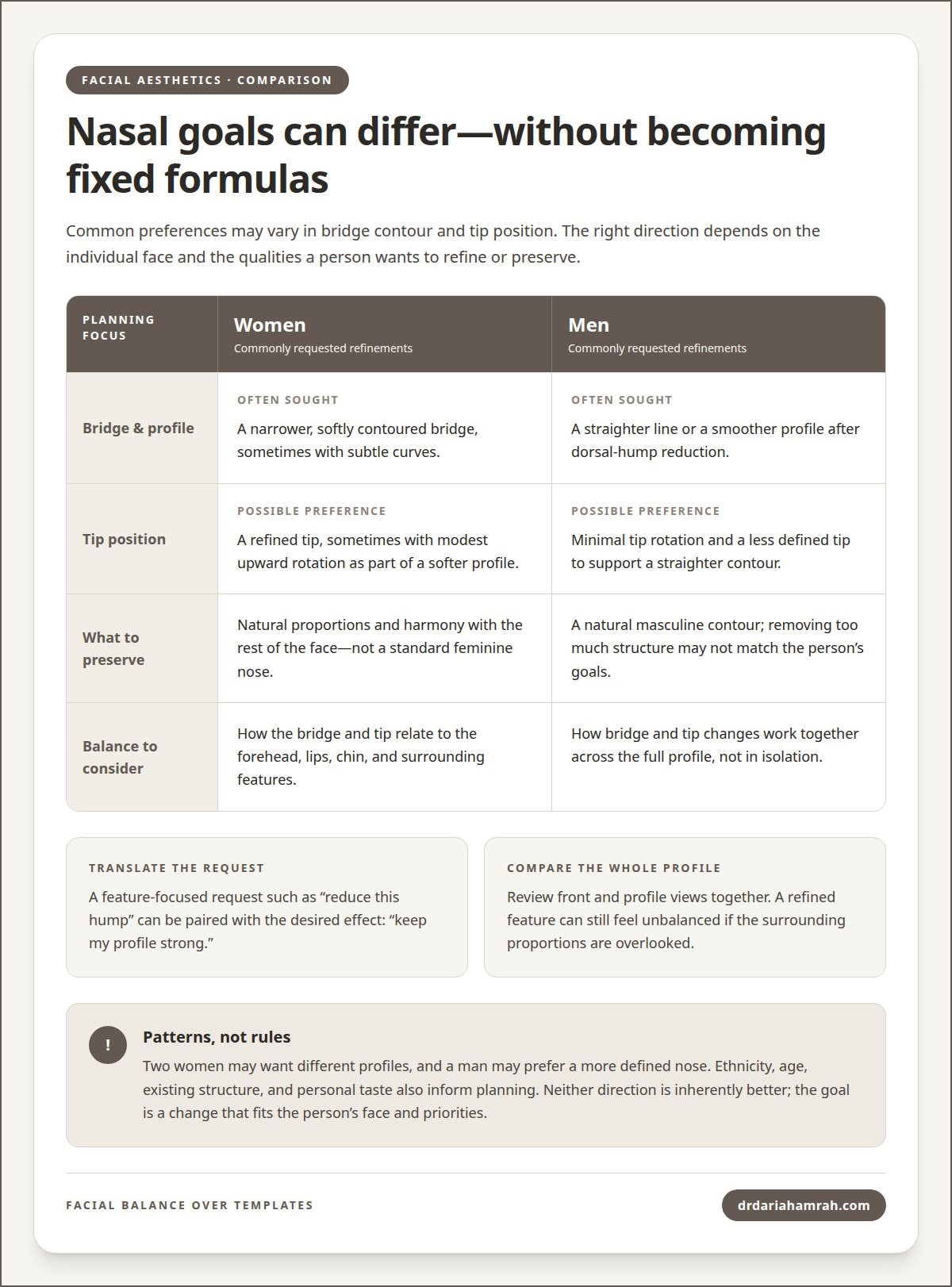
Male and female rhinoplasty goals often differ in contour, definition, and tip position, but they aren’t fixed formulas. For example, a woman may prefer a narrower, softly contoured bridge, while a man may favor a straighter line. The appropriate direction depends on the individual face, not gender alone.
For women, commonly requested refinements include a more delicate appearance, subtle curves, and a refined nasal tip. Some also seek a narrower bridge or increased tip rotation. These adjustments can change how the nose relates to the forehead, lips, and chin. The goal is not to reproduce a standard feminine nose, but to understand which features matter to the person and how they fit together.
Men seeking reduction of a dorsal hump often want a smoother profile without an overly refined or feminized result. A straighter bridge and minimal tip rotation may support that preference. Tip refinement or hump reduction can preserve a natural masculine contour when surrounding facial features remain part of the plan. Removing too much structure may create a delicate appearance that does not match the patient’s goals.
Tip position illustrates the difference clearly. A woman might request modest upward rotation as part of a softer profile; a man may prefer little rotation and a less defined tip. Neither choice is inherently better. What matters is how the change affects the whole profile. Changing the tip while overlooking the bridge, for example, can create an unbalanced impression, even if each feature looks refined on its own.
These preferences are patterns, not rules. Two women may want very different profiles, and a man may prefer a more defined nose. Ethnicity, age, existing structure, and personal taste also inform planning. A helpful discussion separates the requested change from the desired effect: “reduce this hump” describes a feature, while “keep my profile strong” communicates the contour the patient wants to preserve.
- For a softer profile: discuss bridge width, subtle curves, and tip refinement together.
- For a straighter profile: clarify how much hump reduction still preserves the desired contour.
- For either goal: compare front and profile views so changes are considered across the face.
These distinctions help turn broad aesthetic language into specific priorities. A clear plan can identify which features to refine, which qualities to preserve, and how each proposed change affects the overall profile. Exploring facial proportions in surgical planning can help frame those priorities around the person’s own features rather than a gendered template.
Patient selection and surgical techniques
Rhinoplasty planning connects a person’s goals with nasal structure and breathing. A request to smooth a bridge, for example, still calls for consideration of profile balance, airflow, age, and ethnicity. These factors shape patient selection and the surgical approach. A strong plan defines what should change and what should remain intact.
Cosmetic and functional rhinoplasty: Cosmetic rhinoplasty focuses on appearance, such as refining a tip or changing a bridge. Functional rhinoplasty addresses breathing concerns, though aesthetic and functional goals can overlap in one plan.
Choosing a qualified surgeon in the United States: Look for appropriate specialty training, board certification, and experience with nasal surgery. Ask how the plan will address your goals, breathing function, and facial proportions.
Choosing a plan involves more than deciding whether you want a smaller nose. A useful consultation clarifies the concern, such as a visible dorsal hump, a crooked appearance, or difficulty breathing. The surgeon considers the nose from the front and in profile, then relates those observations to your broader facial structure. Age and ethnicity also inform the context for proportions and aesthetic goals.
Function deserves direct attention. Rhinoplasty planning should consider breathing alongside appearance, rather than treating airflow as an afterthought. A person seeking bridge refinement may also report obstruction, while someone with a prior nasal fracture may have both structural and aesthetic concerns. Nasal history can therefore shape the evaluation and the goals discussed before surgery.
Technique depends on the structures being addressed and the intended change. In redistributive approaches, existing nasal structures are repositioned to shape the result; non-resective approaches avoid relying solely on removing tissue. These terms describe different planning principles, not a universal choice for every patient. The surgical method should match the anatomy and goals identified during assessment.
A study of primary rhinoplasties in women used open procedures with redistributive and non-resective techniques. That describes the study’s approach, not a rule that every patient needs open surgery. Technique names alone don’t explain whether a plan suits a particular nose. The reasons for selecting an approach should relate to the person’s structure and desired changes.
- Clarify the goal: distinguish a specific feature, such as a hump, from the overall profile you want.
- Discuss function: include breathing concerns and relevant history, including a prior fracture.
- Review the plan: understand how the chosen technique relates to facial proportions and nasal structure.
A thoughtful selection process connects each proposed change to a clear purpose. Reducing a hump while preserving the bridge’s overall character, for example, may serve a different goal than changing both the bridge and tip. Considering function, age, ethnicity, and structure together gives the discussion a fuller foundation before surgical choices are made.
Avoiding an overly operated appearance
A natural-looking rhinoplasty refines the nose to complement the face, rather than impose one standard shape. Both women and men commonly seek results that don’t look surgical or overly done. Smoothing a visible bridge irregularity while retaining the nose’s recognizable character, for example, can feel more cohesive than pursuing dramatic change. What matters is how the refined nose relates to the person’s features.
A useful starting point is to describe the desired effect, not just a feature to remove. “Make my nose smaller” gives little guidance about what should remain. “Soften this profile but preserve its character” sets a clearer direction. This language helps distinguish a specific concern, such as a prominent bridge, from broader preferences about facial balance and identity.
Subtlety also depends on restraint across connected features. A very narrow bridge, sharply defined tip, or profile changed in several places can draw attention to the nose. Focusing on one priority, such as refining the tip while maintaining the bridge’s overall shape, can keep the result consistent with surrounding features. Each proposed adjustment should have a clear purpose.
Before settling on a plan, consider these practical questions:
- What should stay recognizable? Identify a feature you value, such as your profile’s natural line.
- Which change matters most? Prioritize one concern, such as a bridge irregularity or a bulky-looking tip.
- How will the change read across the face? Consider how the nose relates to the cheeks, lips, and chin.
- Does the goal sound like you? Replace a generic ideal with words that describe your own preferences.
These questions help turn broad aesthetic language into a focused discussion. A digital preview, if used, is best treated as a way to discuss direction, not a guarantee of the final appearance. For instance, a preview can help clarify whether a softer bridge still preserves the profile you want. The discussion should connect each suggested change to a specific feature and intended effect.
Natural results don’t mean making no visible change. They mean avoiding a cookie-cutter outcome and keeping refinements in proportion to the face. If a proposed alteration seems to erase a quality you value, revisit the goal before proceeding. Distinguishing “what I want changed” from “what I want preserved” gives planning a more personal foundation.
Both male and female rhinoplasty patients commonly seek natural-looking results that do not appear surgical or overly done. Rhinoplasty results should refine the nose to complement the patient’s other facial features rather than create a cookie-cutter result. In that sense, natural-looking refinement is not a single nose shape to copy: it is an outcome guided by the patient’s features, without making the nose appear surgical or overly done. The central standard stays consistent across preferences: complement the face, rather than substitute a formula for the individual. The preference is for refinement that belongs with the face, not a result that looks imposed.
What nose shapes and rhinoplasty techniques are commonly requested by women?
Women commonly request a delicate-looking nose with subtle curves that complement their facial features. Typical goals include refining the tip, narrowing the bridge, or increasing tip rotation while maintaining natural proportions. These are preferences, not a single ideal. A narrower bridge and refined tip, for example, should be considered together, since changing one can affect how the other appears. Thoughtful female rhinoplasty aesthetics treats these requests as individual goals, not a preset design.
Tip refinement means shaping the nasal tip to create a more defined or balanced appearance. The request can mean different things: someone might want a softer tip, while another person prefers a clearer outline. Likewise, “narrower bridge” identifies a feature but not the desired effect. Clarifying whether the goal is a softer front view or a more delicate overall impression makes the conversation more precise.
Bridge width, tip shape, and rotation work as a connected set of features. A subtle curve along the bridge can look different depending on tip position; increased rotation changes the profile’s visual line. Rather than treating each request as an isolated adjustment, consider how it would appear from the front, profile, and three-quarter views. Those perspectives help describe the intended shape without relying on a single photograph or angle.
Useful planning starts with priorities. Name the feature that concerns you most, then explain what you want to preserve. For example, “refine the tip, but keep my profile recognizable” communicates both a desired change and a boundary. If the bridge is the main concern, describe whether you want it narrower, smoother, or simply less prominent. These distinctions make female rhinoplasty aesthetics more personal and help focus the discussion.
- Bridge: Describe the width or contour you want to change, such as softening a noticeable line.
- Tip: Explain whether you want refinement, a more defined shape, or a softer appearance.
- Rotation: Describe how the tip should relate to your profile, rather than asking for a fixed shape.
- Proportion: Consider how each change relates to your other features from multiple views.
A common goal is a refined result that still looks consistent with the person’s face. “Smaller” isn’t automatically the same as “more harmonious.” A dramatic reduction can change the nose’s relationship to other features, while a targeted adjustment can preserve more of its original character. Clear priorities keep the plan anchored in the individual’s proportions rather than a copied template.
Bring concise examples of what you like and dislike, then explain the specific feature behind each response. A profile image might show the bridge line you prefer, while a front view helps describe tip width. Use these examples to communicate direction, not to request an identical nose. To discuss how your goals relate to your own features, schedule a rhinoplasty consultation.
Dr. Daria Hamrah: Deep Plane Facelift (Longevity Facelift)
Dr. Daria Hamrah’s Deep Plane Facelift (Longevity Facelift) focuses on facial rejuvenation, natural results, and long-term tissue health. For concerns centered on nasal shape or proportion, her rhinoplasty is the relevant next step. A discussion can connect your priorities, such as bridge refinement or tip shape, with the features you want to preserve.
The facelift and rhinoplasty address different areas, so the right conversation depends on your goals. Consider the Deep Plane Facelift when your concerns involve broader facial rejuvenation; consider rhinoplasty when your focus is the nose. Dr. Daria Hamrah also offers Botox and Hydra-facials for other facial-care goals.
To discuss your facial goals and possible next steps, contact Dr. Daria Hamrah.
Make Your Next Step Personal
Before making a decision, give yourself space to define what feels right for you. Write down the change you’re considering, the features you want to preserve, and what a natural result means in your own words. This reflection can help keep the conversation focused on your priorities rather than someone else’s idea of an ideal nose.
Apply the same care when considering female rhinoplasty aesthetics: your goals should make sense alongside your facial identity and overall well-being. Bring questions about how a proposed change may affect your features, what the plan involves, and how appearance and breathing are considered together. You don’t need to arrive with a perfect description. A thoughtful discussion can help clarify what matters most.
If you’re ready to explore your options, contact Dr. Daria Hamrah to begin a conversation about your goals. Take the next step at your own pace, with a clear sense of what you hope to achieve.
Frequently Asked Questions
What are common aesthetic goals for female rhinoplasty?
Common goals involve making a specific feature feel more in keeping with the patient’s preferences, rather than pursuing a standard look. Before discussing changes, consider which outcome matters most in daily life: feeling comfortable in profile photographs, for example, or seeing a softer transition from bridge to tip. Naming that priority helps distinguish the result you hope to notice from features you want to keep unchanged.
How do facial proportions and anatomy influence rhinoplasty planning for women?
Facial proportions and nasal anatomy help shape which changes are appropriate to consider. A bridge adjustment, for example, can affect the nose’s relationship to the forehead and tip, while nasal structure also matters when breathing concerns are present. Age and ethnicity provide further context for planning. Sharing your nasal history and describing both appearance and breathing goals gives the discussion more useful detail than focusing on one feature alone.
How do primary and revision rhinoplasty differ in results, risks, and cost?
Primary rhinoplasty is the first nasal operation; revision rhinoplasty addresses changes after an earlier operation. Prior surgery can alter nasal structures, so the plan, risks, and cost depend on the individual’s anatomy and the scope of correction.
What are the risks and complication rates of rhinoplasty?
Potential complications include bleeding, infection, healing concerns, anesthesia-related problems, or changes in breathing. Risks depend on health factors and the planned changes.