EP50 – Beauty, Aging, and the Truth Nobody Wants to Hear with Dr. Ben Talei
“My success is defined by me looking at my photos and saying I cannot get any more improvements anywhere on any millimeter of this photo. Or can I? And I keep going.” — Dr. Ben Talei
In this episode, Dr. Daria Hamrah sits down with Dr. Ben Talei for the second time. Dr. Talei is a facial plastic surgeon based in Beverly Hills, a surgical educator, fellowship director, and the creator of Cupid Lips, one of the most well known lip enhancement brands in aesthetic medicine. Their first conversation was one of the top three most listened to episodes in the history of this podcast. This time, they go even deeper. They cover what separates a good facelift from a great one, why the technique debate is the wrong conversation to be having, how social media and AI are reshaping what patients expect, how your face actually ages in three dimensions, what cellular science tells us about the future of anti-aging, and what patients should stop doing immediately.
Subscribe on: APPLE PODCASTS | SPOTIFY | YOUTUBE | IHEART
Why the Facelift Debate Has Gotten It All Wrong [10:07]
There is a conversation that has been going on in the aesthetic surgery world for years. Deep plane facelift versus a more surface level lift. Which one is better? And the honest answer is that the question itself is the problem.
Dr. Talei put it in a way I have not been able to stop thinking about. He said the real question is not which technique you use. The real question is much simpler. Do you care about how the face actually aged? Or do you just want to lift it?
If you care about how it aged, you are going to ask completely different questions. You are going to look at a face and want to understand what happened. What layer did things shift in? Was it the skin drooping, or was it the deeper tissue changing? Was it volume loss creating that change, or was it gravity pulling at the tissue over time? Those questions lead you to very different answers than just picking a technique and applying it to every person who walks through the door.
The Traditional Approach: Lifting Without Understanding
Why This Matters: Most surgeons are trained to focus on what they can see and fix it. The problem is that when you skip understanding why the face changed, you end up with a result that looks lifted but does not look younger. There is a big difference between those two things.
Dr. Talei’s Insight: “The debate is do you care about how the face aged or do you not? If the answer is yes, then your goal would be to figure out how that drooping actually happened. In what layer did this happen? What kind of movement caused this? What kind of three-dimensional change? If you do not care, then I am just going to lift them. They will look better if they are lifted. That is in general the logic behind most of what we call surface level lifting.“
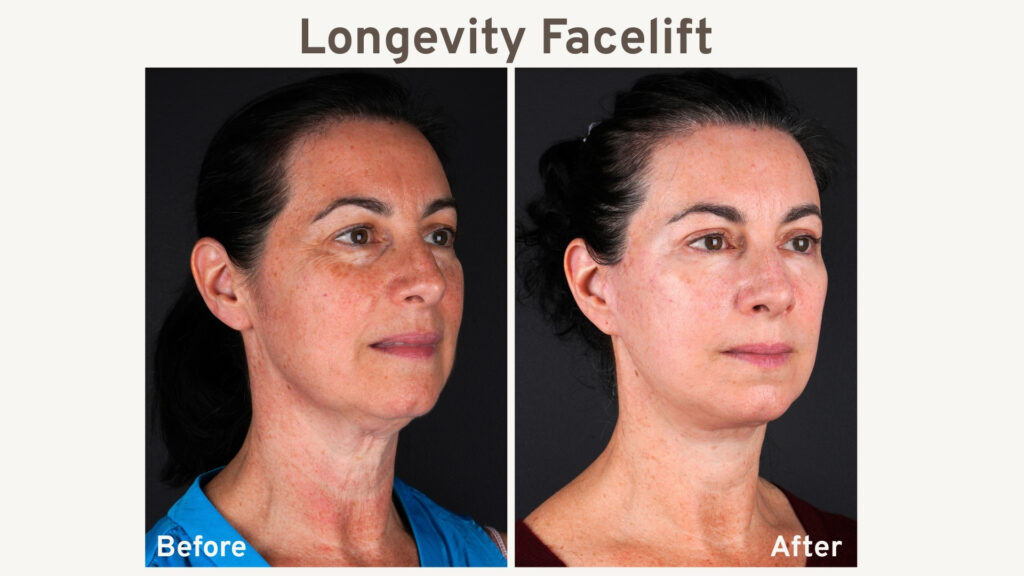
Before and after photos from Dr. Daria Hamrah’s Longevity Facelift cases showing natural rejuvenation. View more results at drdariahamrah.com/longevity-facelift/
source: https://drdariahamrah.com/longevity-facelift/
Why This Conversation Still Matters in 2026
Why This Matters: As of this year, a peer reviewed article was still being published claiming there is no meaningful difference between different types of facelifts. And yet anyone who looks at before and after photos from surgeons at different ends of that spectrum can see very clearly that the results are not the same. The things that make results exceptional are not easy to measure in a study. You cannot put a number on whether the cheek looks three-dimensional or whether the eyes look younger. But every patient knows when they see it.
Dr. Hamrah’s Perspective: Debunking these myths matters. Not for ego or competition, but because patients deserve to know what is actually possible. When the standard of what counts as a good result gets raised, everyone benefits.
What a Great Facelift Actually Does: The Surgeon’s Eye [16:10]
Here is something that surprises most people. A great facelift surgeon is not thinking about the lift. They are thinking about reversal.
Dr. Talei’s own story is a good example of how this understanding develops. Early in his career he was doing what he had been trained to do, and he thought his results were good. Then he saw better results and he could not unsee them. That curiosity drove years of refining his understanding of how the face ages and what each millimeter of tissue is actually doing.
That kind of continuous learning and honest self-evaluation is what separates surgeons who get better every year from those who plateau. It requires looking at your own work critically, staying curious, and being willing to change when you see something that challenges what you thought you knew.
The Surgeon Matters More Than the Technique
That kind of continuous learning and honest self-evaluation is what separates surgeons who get better every year from those who plateau. It requires looking at your own work critically, staying curious, and being willing to change when you see something that challenges what you thought you knew.
Why This Matters: The name of the technique a surgeon uses tells you almost nothing about the result you will get. Two surgeons can both perform what they call a deep plane facelift and get completely different outcomes. The difference is what they understand about the face, how they see aging, and what they are actually trying to accomplish. Continuous learning and innovation are the only things that keep a surgeon at the top of this field.
Dr. Talei’s Insight: “It’s about their vision and understanding of the face. When they can see things and understand things, not just in your face but in everyone’s faces with aging, they will be able to fix them to the greatest extent possible using their knowledge of anatomy. Based on that, they will say in this area I am placating, in this area I am releasing, in this area I am lifting. Whatever they need to do to maximize the reversal of aging.”
Dr. Hamrah’s Perspective: I went through this exact evolution myself. I thought my results were great because they met the standard I had been taught. Then I saw better results and I could not unsee them. That is when the real learning started.
Why Your Face Changes in Three Dimensions [24:04]
When people think about facial aging, they picture skin getting loose and drooping down. That is part of it. But it is a very small part of the picture.
The face is built in layers, roughly five of them. Think of it like a very sophisticated layered system where each level can shift, slide, and change independently. The outer layers move differently from the inner ones. Some areas are attached to deeper structures and stay more fixed. Others can glide freely. Over time, each of those layers changes at its own pace.
When you lose volume in the deeper layers, the outer skin suddenly has more surface area than what is underneath it. That creates drooping, but it is not the same as just loose skin. It is a three-dimensional collapse that requires a three-dimensional solution.
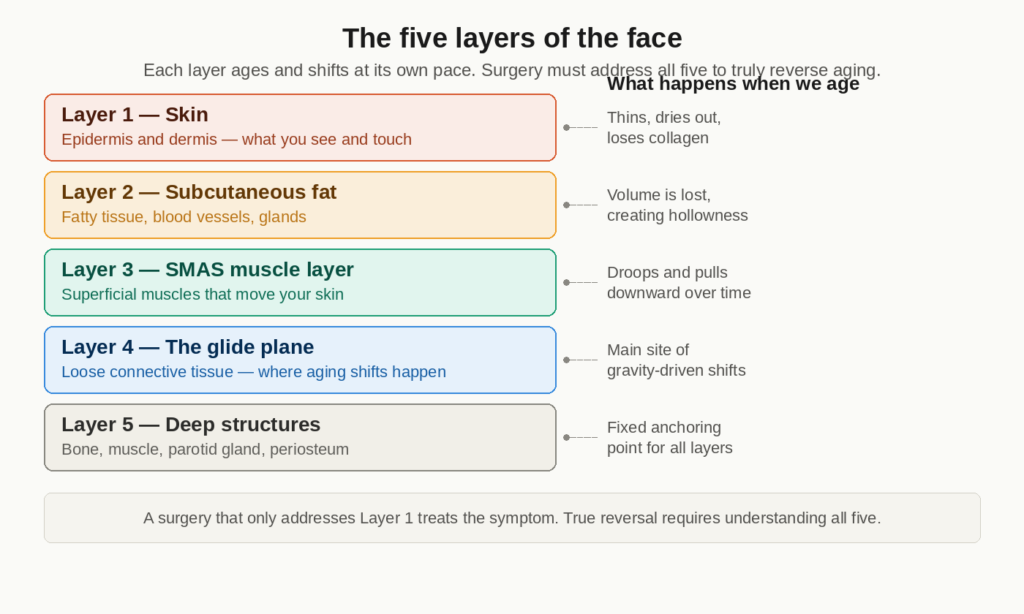
Understanding What Your Face Is Actually Made Of
Why This Matters: Before choosing any surgeon or procedure, it helps to understand what is actually happening beneath the surface. Facial aging is not one thing. It is a series of changes happening at different depths at different rates. A treatment that addresses one layer cannot fully address what is happening in the others. Understanding layered facial anatomy is what allows a surgeon to design a procedure specific to each patient.
Dr. Talei’s Insight: “What we see in the face is not massive skin excess on most people. It is three-dimensional changes that compound on each other. And so you see these bigger visual changes. I was getting bigger results with less movement when I made smaller corrections in three dimensions rather than big movements in just two. And for me that was logically more of a reversal of aging.”
Hyperelasticity: Why Some Faces Age Faster Than Others
Why This Matters: Not everyone ages at the same pace, and it is not all about lifestyle. Some people are born with tissues that contain a different balance of collagen and elastin, the structural proteins that give skin its firmness and bounce. When these tissues are more elastic than they should be, the face tends to droop and sag earlier and to a greater degree. This is called hyperelasticity. It creates a real challenge in surgery because the tissue has less natural support and will not hold tension as well over time.
Dr. Talei’s Insight: “Hyper elastic tissues have different connections, different amounts of elastin, different amounts of collagen, different contents. So it’s more stretchy tissues overall. And those tend to exaggerate any rate of aging that we see. And there’s nothing you can do for that tissue quality. You can’t change those ratios. That’s what they’re born with. That’s their genetic makeup.”
Dr. Hamrah’s Perspective: This is one of the reasons I am so interested in the cellular science side of aging. If we can improve tissue quality before surgery through better nutrition, optimized health, and potentially through cellular interventions, we may be able to improve what is possible even for patients with inherently more elastic tissue.
What You Are Actually Paying For: The Truth About Pricing in Cosmetic Surgery [35:59]
There is outrage on social media every time someone shares the cost of a premium facelift. The comment sections fill up with people asking how a surgeon can justify charging that much. And I want to address this directly because I think it reveals a misunderstanding that patients deserve to have cleared up.
Cosmetic surgery is an elective field. Nobody needs a facelift to survive. And because of that, surgeons set their own prices based on their expertise, their results, and the kind of experience they provide. There is nothing unethical about that. It is the same reason a pair of pants from a high end designer costs ten times more than a pair from a discount store. Both will cover your legs. They are not the same product.
What concerns me more than the price is the confusion between surgeries that happen to share the same name but produce very different results. When someone compares prices without comparing results, they are not making an informed decision.
The Ethics of Cosmetic Surgery
Why This Matters: Cosmetic surgery gets accused of exploiting people’s insecurities. The honest answer is that the desire for change exists before the surgeon does. Patients come to us because something has been bothering them and they want help with it. Our job is to evaluate honestly who we can help and who we cannot. The ethical line is crossed when a surgeon operates on someone they know will not benefit, or when they create a problem just to sell a solution. Ethical considerations in cosmetic surgery are vital for patient trust. That trust is the foundation of everything we do.
Dr. Talei’s Insight: “Ferrari doesn’t create the desire. The desire exists which is why we exist. In essence, when you look at the evolution of it, the patient created us. It’s not the other way around where we created a need. Now if someone came to us who’s beautiful and fantastic and our intervention can’t help them or is not going to help how they feel about something basic, or their problems are more deeply rooted than something aesthetic, then yes there would be a problem there.”
Dr. Hamrah’s Perspective: I think of what we do as closer to what a self-confidence doctor does. We help people feel the way they want to feel about how they look. That is not the same as taking advantage of them. But it requires honesty, ethics, and the wisdom to know when the answer should be no.
Social Media, AI, and the Pressure to Look Perfect [43:13]
This is a topic I think about constantly, both as a surgeon and as someone who watches his own patients come in increasingly shaped by what they see on screens.
Forty years ago, most people had very limited access to images of themselves. You saw yourself in a mirror under decent lighting in the morning. That was mostly it. Today, people see themselves in Zoom calls, in Instagram stories, in wedding videos, in selfies taken from every possible angle in every possible light. And the worst images, the ones taken from below, in harsh lighting, at an unflattering angle, are the ones that tend to stick.
This has created a situation where patients come in asking us to make their worst photo look like their best photo. And that is a fundamentally impossible standard to meet.
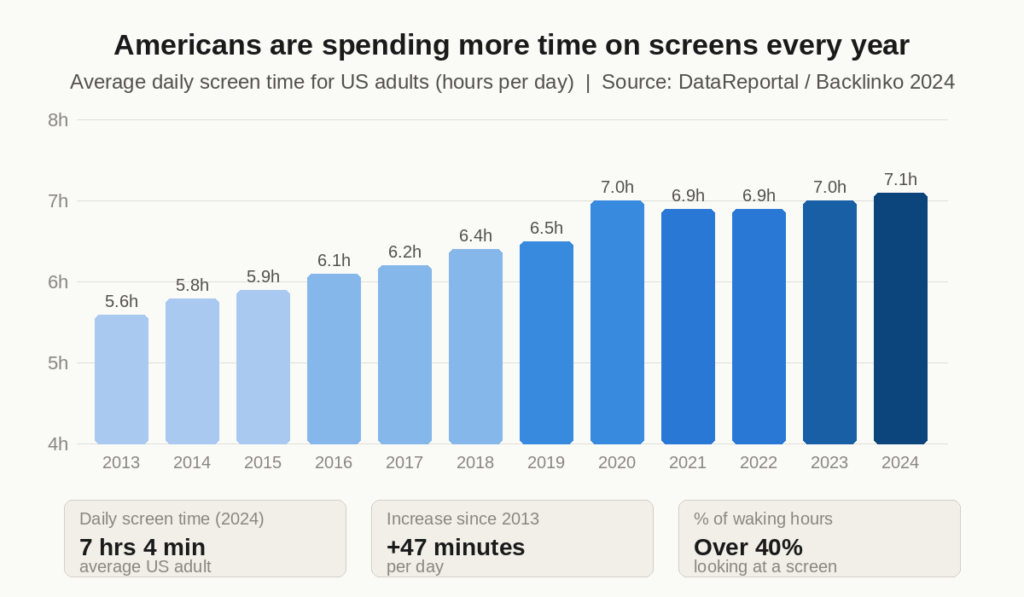
Source: DataReportal / Backlinko Screen Time Statistics 2024 — https://www.demandsage.com/screen-time-statistics/
On top of that, AI has made it possible to filter and alter images so realistically that patients now bring in photos of what they want to look like that were never photographs of real people to begin with. They are AI generated ideals.
The Good and the Bad
Why This Matters: More awareness of what is possible in aesthetic medicine is genuinely good for patients. They are more informed, they seek help sooner when they notice something bothering them, and they have access to a global pool of surgeons and results to compare. But that same awareness has also raised expectations beyond what any surgery can achieve. A filtered social media photo and a surgical result are two different things, and it is our job as surgeons to be honest about that difference. Social media and AI have increased patient awareness but also created significant confusion.
Dr. Talei’s Insight: “In one way, it kind of sucks for patients because they see those photos and they want you to take their worst photo ever and then make it look like their best photo ever. Whether it’s filtered or not, they just want to make it look like the best photo ever. So in a way, it kind of has increased self-awareness and judgment. Not so great for people. In other ways, it’s helped out a ton because they’re able to go find help for it when they need it now because it’s all over the place.”
Dr. Hamrah’s Perspective: AI is going to keep improving, and some of its applications in our field are genuinely exciting. Dr. Talei has already built a calculator using AI that shows patients a realistic preview of what a specific lip lift result could look like using his exact technique. That is a genuinely useful tool. But AI that generates impossible ideals and passes them off as achievable results is something we have to push back on directly with our patients.
External Source: Average Screen Time Statistics 2024
The Crevasse Technique: A Small Move That Changes Everything [1:01:18]
One of the most practically useful parts of this conversation was talking about something Dr. Talei published called the Crevasse technique. I have been using it in my own practice for about two years and I want to explain why it matters to patients.
In a facelift, one of the hardest areas to improve has always been the lower neck, the area between your chin and your collarbone. It tends to improve with surgery but never quite reaches the definition patients hope for.
What the Crevasse technique does is take tissue that was oriented vertically, hanging downward, and redirects it horizontally, tucking it back into the position it once held. The result is a much cleaner lower neck, a sharper jawline, and a more defined angle where the jaw meets the neck just below the ear.
I started using it expecting it to improve the jaw angle. What I discovered was that it improved the entire lower neck, all the way down to the collarbone area. A small, simple technique with a big impact. But you have to be able to see the problem before you can appreciate the solution.
Why the Angle of the Jaw Changes Everything
Why This Matters: The angle of the jaw, that corner just below your earlobe, is one of the first features to soften and disappear as you age. When it is restored, the entire neck and lower face looks significantly younger. Patients almost never ask for it by name, but it is something everyone notices when it is right. The Crevasse technique significantly improves the lower neck and jawline by transferring volume horizontally rather than vertically.
Dr. Talei’s Insight: “I want to show the ramus, show the gonial angle, lift the hyoid all the way up, horizontalize this entire area behind it, and create a parallel between the mandible and the hyoid mastoid line. It is a centimeter of cubic movement. That is it.”
Note for readers: The ramus is the upward vertical part of the jaw bone. The gonial angle is the corner where the jaw turns, just below the ear. The hyoid is the small bone at the top of the throat. Together they define the youthful shape of the neck and jaw.
Can We Slow or Reverse Aging at a Cellular Level? [1:07:23]
This part of the conversation is where things get exciting. And it is where I have been spending a lot of my own research time.
Here is what we know. People age at dramatically different rates. Two people who are the same age can look 20 years apart. We used to say that was just genetics. But science has now shown us that about 90% of how we age is controlled not by the genes we are born with, but by how those genes are turned on and off over time by our environment, our habits, and our choices.
That area of science is called epigenetics. And it tells us that the timeline is not fixed. The quality of your skin, the strength of your connective tissue, the way your body heals after surgery, all of those things can be influenced by what you do every day.
What Epigenetics Means for Aging and Surgery
Why This Matters: If most of how you age is shaped by lifestyle and environment rather than fixed genetics, that changes everything. It changes how we should be preparing patients before surgery. It changes how we should support their recovery. And it changes how long we can realistically expect their results to last. Cellular and epigenetic factors play a major role in aging, with real potential for intervention.
Dr. Hamrah’s Insight: “We have data from twin studies showing how dramatically and drastically epigenetics changes based on lifestyle, diet, nutrition, sun exposure, smoking, stress, all of those things. So different things can happen even to twins throughout the aging process of their lifetime. And part of that is skin quality and connective tissue quality. If that is true, that means there should be ways to either slow that process down.”
Dr. Talei’s Insight: “Preventing cancer is much easier than curing cancer. I devoted two years of my career in cancer research and I got frustrated. I thought, why don’t we just try to prevent it. Because preventing is much easier than trying to cure it.”
External Source: Epigenetic Aging and the Hallmarks of Aging — National Institutes of Health
A Concept Dr. Hamrah Brought to the Conversation: Yamanaka Factors
This is something I introduced during our conversation, not Dr. Talei, because it connects directly to the cellular biology background I come from and the research I have been doing over the past several years.
In 2006, a Japanese scientist named Shinya Yamanaka discovered four specific proteins that can press a kind of reset button on a cell. An old cell exposed to these proteins begins to behave like a much younger cell again. He won the Nobel Prize in Medicine for this in 2012. Companies backed by major private investors are now working on ways to use very small amounts of these proteins to selectively make aging cells younger without the risk of uncontrolled cell growth. Research is still in early stages but the direction is clear and the investment behind it is serious.
Dr. Talei’s response when I raised this was measured but open. He agreed that directed, small scale cellular reprogramming is plausible and already happens in some form, noting that even a hair transplant essentially reprograms a follicle to produce skin instead of hair. His bigger point was that he would want to see long term prospective studies before drawing conclusions, which is the right scientific instinct.
Dr. Hamrah’s Perspective: “There is no quick fix. The only way to get the biggest return is to prepare your skin well in advance so that when you have a procedure done, your results are even better. And then go back on your skincare so the results are maintained. Your best investment is your skincare.”
External Source: The Nobel Prize in Physiology or Medicine 2012 — awarded to Shinya Yamanaka for the discovery of induced pluripotent stem cells
Post-Op Recovery: Hyperbaric Oxygen and LED Light Therapy [1:25:00]
Patients ask me about both of these constantly. Here is what the science says and what Dr. Talei has seen in practice.
Every facelift causes some degree of reduced blood flow to the skin while healing. That is unavoidable. Hyperbaric oxygen works by flooding your body with oxygen at higher than normal pressure, which can help tissues that are working hard to recover. A 2023 peer reviewed case control study published on the NIH confirmed that patients who received hyperbaric oxygen therapy after facelift surgery showed improvements in wound healing duration and complication rates compared to those who did not. At 1.8 to 2 atmospheres over five or more sessions starting right after surgery, Dr. Talei sees patients heal a little faster with less of the minor congestion that can appear in the first few weeks. He does not require it for all patients but recommends it for those who want to do everything possible to support their recovery.
External Source: Assessing the Efficacy of Hyperbaric Oxygen Therapy on Facelift Outcomes — NIH/PubMed Central, 2023
What About LED Light Therapy at Home?
Why This Matters: LED and red light panels are being marketed heavily as anti-aging tools for home use. The honest answer is that their benefits depend almost entirely on the wavelength of light being used. True infrared light has a longer wavelength that can actually reach the tissue beneath the skin. Most consumer devices are in the visible red spectrum, not true infrared. They are not harmful and may provide a mild benefit. LED and infrared therapies can aid healing and skin quality with minimal risks, but the results are more modest than the marketing often suggests.
Dr. Talei’s Insight: “If they’re going to really use infrared, you have to have it contact your body pretty much because otherwise the amount of energy put in is not going to be strong enough to actually penetrate through the dermis. Blue light for acne doesn’t make much sense. But it’s not harmful at all. So they can go ahead and use it. It doesn’t matter. It’s not ultraviolet. It’s just blue.”
External Source: Photobiomodulation and Low-Level Light Therapy for Skin Rejuvenation — NIH/PubMed Central
Rapid Fire: What to Start and What to Stop Immediately [1:33:03]
One procedure Dr. Talei does more of today than five years ago: Ptosis repair. This is a correction of drooping upper eyelids where the muscle that lifts the lid has weakened, not just loose skin. More surgeons are learning to see and address it properly now.
One procedure he does less of today: Lip lifts. He still performs them, but his understanding of who is and is not a good candidate has become more refined, which means more people are screened out before surgery.
Most underrated anti-aging intervention: Nanofat. A refined form of fat transfer where tiny amounts of fat are processed to extract the regenerative cells inside and injected into areas where skin quality has declined. It has been available for over a decade and most patients have never heard of it.
Most overrated anti-aging intervention: Bio-stimulators. These are injectable products that claim to stimulate collagen production. Dr. Talei’s concern is that stimulation and actual regeneration are two very different things, and the marketing of these products often blurs that distinction in a way that misleads patients.
One thing every patient should stop doing immediately: Trying to fix every small concern on their face with fillers. Fillers are a useful tool for specific, targeted corrections. When used too broadly and too often, they change the shape of the face in ways that are very difficult to reverse, and they make surgical correction harder later on.
The Bottom Line [1:37:04]
Here is what I want every patient who is thinking about a facelift or any facial rejuvenation to take from this conversation.
The surgeon’s eye matters more than anything else. Not the name on the door, not the price, not the technique described in the marketing. What matters is whether the surgeon can actually see everything that has changed in your face and understand why it happened. If they can do that, they can reverse it. If they cannot, it does not matter what they call the procedure.
Dr. Talei’s definition of success is one I have adopted for myself. He does not stop when a patient is happy. He stops when he looks at the photos and cannot find a single millimeter left to improve. That standard is not common. But it is the one worth holding out for.
And beyond the surgery, the science of cellular aging tells us something important. The choices you make every day, what you eat, how much you sleep, how you manage stress, are not just good habits. They are directly shaping the quality of your tissue, how well you heal, and how long your results will last. That is not a side note. That is the foundation.
Key Takeaways
- Understanding facial anatomy is the most important thing that separates surgeons who get great results from those who do not. The technique they use is a distant second.
- Debunking the myths around facelift techniques matters because patients make real decisions based on misleading information. When those myths are cleared up, better outcomes follow.
- The evolution of facelift techniques has always been driven by surgeons who were not satisfied with good enough. Continuous learning and a commitment to improvement are what keep a surgeon relevant and their patients in excellent hands.
- Social media and AI have increased patient awareness of what is possible in aesthetic medicine, but they have also created expectations that no surgery can meet. A great consultation addresses this honestly from the start.
- Surgeon skill and understanding of anatomy are more important than any specific technique. Two surgeons performing the same named procedure will get very different results if one understands the face deeply and one does not.
- Pricing in cosmetic surgery reflects expertise, experience, and the level of result you can expect. Comparing prices without comparing results is not a meaningful comparison.
- Ethical practice in cosmetic surgery means being honest about who you can help, who you cannot, and why. Patient trust depends on that honesty.
- The Crevasse technique transfers tissue from a vertical to a horizontal direction, significantly improving the lower neck, jawline, and jaw angle. It is a small and teachable correction with a large impact.
- Facial aging is a three-dimensional process involving changes in volume, shifts between tissue layers, and gravitational effects at multiple depths. Treating it as a two-dimensional problem produces two-dimensional results.
- Cellular and epigenetic factors play a major role in how fast you age and how well you heal. Improving lifestyle and cellular health is not just about how you feel. It directly affects surgical outcomes and how long results last.
- Layered anatomy of the face determines how tissue moves and ages. Understanding each layer and what it does is what allows a surgeon to design a procedure specific to each patient rather than applying the same solution to everyone.
- Hyperelastic tissues, where the skin and underlying structures have less structural support than normal, create real challenges for long-term surgical results. Science is now exploring whether cellular reprogramming could eventually improve tissue quality in these patients.
- Lifestyle factors including diet, sleep, sun exposure, stress, and smoking all influence how your genes express themselves over time. The good news is that most of aging is within your influence, not fixed at birth.
- LED and infrared light therapies are low risk tools that can support skin quality and recovery. True infrared requires close contact with the skin to be effective. Consumer red light panels are safe but have more modest benefits than their marketing often suggests.
Frequently Asked Questions
What is a deep plane facelift and is it better than other types?
A deep plane facelift works at a deeper layer of the face than a more surface level lift. Whether it produces better results depends almost entirely on who is doing it and how well they understand facial anatomy. The technique name is far less important than the surgeon’s vision and skill.
How do I choose the right surgeon for a facelift?
Ask them what they see when they look at your face specifically. A surgeon who can describe what has changed and explain what they plan to address at each level is a very different person from one who just shows before and after photos and describes their technique in general terms. Listen for understanding, not just confidence.
How has social media changed what patients expect from surgery?
Patients now see themselves constantly in unflattering light and from bad angles. They also see AI filtered versions of faces that were never real to begin with. The result is that expectations have risen in ways that sometimes exceed what surgery can achieve. A good surgeon is honest about this from the first consultation.
Will a facelift look natural?
A facelift that addresses three-dimensional aging rather than simply pulling the skin tight will look natural. What looks unnatural is a result where the skin has been tightened in one direction without addressing the volume changes and structural shifts underneath. The goal is for people to say you look great, not to wonder what you have done.
What is hyperelasticity and does it affect surgery?
Hyperelasticity refers to tissue that has less structural support than average, with different amounts of collagen and elastin giving it a more stretchy quality. It tends to age faster and is harder to hold in place surgically. If you have this tissue type, it is worth discussing with your surgeon how they plan to account for it and what you can do to support your tissue quality before and after surgery.
What is nanofat and is it right for me?
Nanofat is a refined form of fat transfer where the fat is processed until only the tiniest regenerative components remain. These are injected just under the skin in areas where the quality of the skin itself has declined, such as under the eyes or around the mouth. Good candidates are people with thinning skin, fine texture changes, or a transparency in the skin that skincare products cannot address.
Does hyperbaric oxygen help after surgery?
Based on peer reviewed research and Dr. Talei’s direct clinical observation, it does appear to support faster healing and reduce minor congestion in the early weeks after surgery. Five sessions at around 1.8 to 2 atmospheres starting shortly after the procedure is what he recommends for patients who want to support their recovery. It is not essential, but it is a reasonable addition.
How do I know if I have been overusing fillers?
Signs include consistent puffiness in the face, fullness in areas that should have definition, heaviness around the cheeks or jaw that was not there before, or a general feeling that you no longer look quite like yourself in photos. If any of those apply, an honest consultation with a surgeon is the right next step.
Sign up for our newsletter
Follow Dr. Daria Hamrah
Join a community of over 445K people who prioritize longevity, optimal health, and cellular wellness. As a leading expert in facial cosmetic surgery and anti-aging medicine, Dr. Hamrah shares insights on aging, surgical and non-surgical solutions, and how to make informed choices for your health, beauty, and overall well-being.