
If you’re chasing a younger reflection by simply pulling your skin tighter, you’re fighting a losing battle against both physics and biology. True rejuvenation isn’t about surface tension; it’s about restoring the internal architecture that time has shifted. It’s understandable why you might feel anxious when faced with conflicting surgical terms and the very real fear of looking “operated on.” You deserve a result that mirrors your internal vitality without the telltale signs of a clinical intervention.
This guide demystifies the critical debate of the deep plane vs smas facelift to help you choose a path toward enduring, natural beauty. By the end of this clinical overview, you’ll understand why the Deep Plane, or Longevity Facelift, has become the gold standard in 2026 for those seeking results that last fifteen years. We’ll examine the anatomical release of ligaments and the importance of a vertical vector to ensure your transformation looks like a more vibrant version of yourself, not a different person entirely.
Key Takeaways
- Learn how the evolution of facial surgery ensures your results look like a refreshed version of yourself rather than a surgical mask.
- Compare the structural longevity of the deep plane vs smas facelift to understand why repositioning ligaments provides a more enduring 10-15 year result.
- Master the concept of the “vertical vector” to see how lifting tissue upward, rather than backward, prevents the unnatural windblown look.
- Identify the specific anatomical signs that make you an ideal candidate for a Deep Plane (Longevity) Facelift over traditional methods.
- Discover how an integrated approach involving cellular nutrition and Longevity Renew supplements supports your body’s biological resilience during recovery.
The Evolution of Facial Rejuvenation: SMAS vs. Deep Plane Techniques
Facial rejuvenation has undergone a profound metamorphosis over the last few decades. In the early days of plastic surgery, a “lift” was often literal; surgeons simply pulled the skin tighter and trimmed the excess. This two-dimensional approach ignored the complex, three-dimensional reality of how we age. As we look at the clinical landscape in 2026, the discussion around the deep plane vs smas facelift has shifted from mere aesthetic preference to a deep commitment to structural integrity. The modern standard isn’t about looking “different” or “tighter.” It’s about restoring the biological architecture of the face so that you age with grace and resilience.
The Limitations of Traditional SMAS Tightening
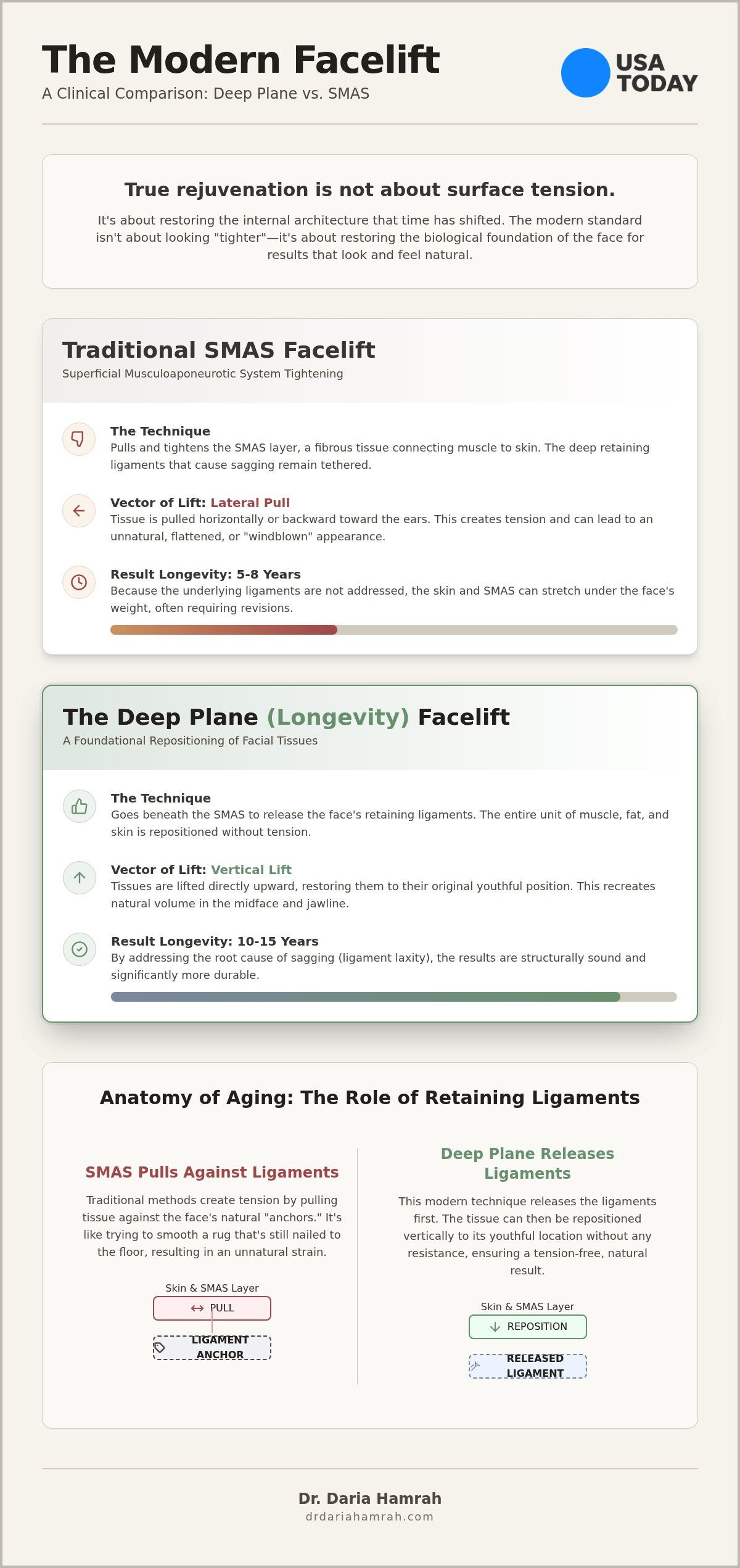
The SMAS technique was once the pinnacle of facial surgery. It involves tightening the Superficial Musculoaponeurotic System, which is the fibrous layer of tissue that connects your facial muscles to your skin. While this was a major step forward from skin-only lifts, it has inherent biological costs. Because the SMAS remains tethered by deep retaining ligaments, tightening it often requires a “lateral pull” toward the ears. This can result in several issues:
- The Windblown Look: Artificial tension on the skin creates a flattened, “swept” appearance that lacks natural depth.
- Frequent Revisions: Because the underlying ligaments are still sagged, the skin eventually stretches under the weight of the face; this often leads to a need for touch-ups within 5 to 8 years.
- Visible Scarring: Excessive tension on the incision lines can cause scars to widen or distort the ear’s natural shape.
The Deep Plane Revolution: A Structural Reimagining
The Deep Plane approach, which I’ve pioneered as the Longevity Facelift, represents a fundamental reimagining of the procedure. Instead of pulling against the face’s natural anchors, we enter the space beneath the SMAS layer to release the retaining ligaments themselves. This allows the entire composite of muscle, fat, and skin to be repositioned as a single, tension-free unit. It’s a shift from merely managing the surface to mastering the foundation.
We utilize a vertical vector, lifting the tissues directly upward to where they resided in your youth. This doesn’t just “tighten” the face. It restores the natural volume of the midface and sharpens the jawline without any visible signs of surgery. By addressing the root cause of sagging, which is ligament laxity, we create a foundation for results that typically endure for 10 to 15 years. It’s a more sophisticated, visionary way to view transformation; one that prioritizes your future well-being as much as your current confidence.
Anatomical Precision: Understanding the SMAS Layer and the Deep Plane
To truly grasp the distinction in the deep plane vs smas facelift debate, we must look beneath the surface at the face’s internal architecture. Your face isn’t just skin; it’s a complex system of layers. The SMAS, or Superficial Musculoaponeurotic System, acts as the structural scaffolding. It’s a continuous, fibrous envelope that connects your facial muscles to your skin. While traditional surgery often focuses on pulling this layer, modern excellence requires a deeper understanding of the space beneath it. The Deep Plane is the anatomical space where true facial repositioning occurs without skin distortion. Gaining clarity on the deep plane vs smas facelift is the first step toward a successful, natural transformation.
By operating within this specific plane, we access the true foundation of facial aging. We aren’t just stretching the surface. We’re moving the entire structural unit back to its original position. This approach respects your biology and ensures that the results feel as natural as they look.
The Role of Retaining Ligaments in Facial Aging
Think of retaining ligaments as the “anchors” of your face. These tough bands of tissue tether your skin and SMAS to the underlying bone. Over time, these anchors stretch and weaken, leading to the familiar descent of the cheeks and jawline. In a standard SMAS procedure, these ligaments remain intact. The surgeon pulls the tissue against these fixed points, which often creates unnatural tension. It’s like trying to smooth a rug that’s still nailed to the floor. By contrast, the Deep Plane technique involves the precise release of these ligaments. Once freed, the tissue can be repositioned vertically without any resistance. This release is the secret to a tension-free, refreshed result that doesn’t scream “surgery.”
Composite vs. Layered Techniques
Traditional facelifts often use a layered approach. This means the skin is separated, or “undermined,” from the SMAS layer. While common, this separation can disrupt the delicate blood vessels that nourish your skin. The Deep Plane method utilizes a “composite flap.” We lift the skin and the SMAS together as a single, cohesive unit. This preserves the vital blood supply between the layers, which is essential for biological resilience. Maintaining this connection results in several benefits:
- Superior Skin Quality: Your skin stays hydrated and vibrant because its natural nourishment remains intact.
- Faster Recovery: Less trauma to the tissues means swelling and bruising often resolve more quickly.
- Structural Integrity: The face retains its natural thickness and “bounce” rather than looking thinned or tight.
If you want to understand how this anatomical precision can redefine your aging journey, take a closer look at the Longevity Facelift to see how we prioritize your long-term vitality.
Comparing Results: Longevity, Natural Aesthetics, and the Windblown Risk
When evaluating the deep plane vs smas facelift, the most significant differentiator for patients is the visual truth of the final result. Everyone wants to look refreshed, but nobody wants to look operated on. The traditional SMAS technique often relies on a lateral pull, which moves tissue horizontally toward the ears. This can create the dreaded windblown appearance, where the mouth looks wide and the skin appears unnaturally tight. In contrast, the Deep Plane approach utilizes a vertical vector. By lifting the facial structures straight up, we mirror the exact path that aging took in reverse, ensuring you still look like yourself, just fifteen years younger.
Longevity is the other side of the coin. A SMAS procedure typically offers a 5 to 8 year window of rejuvenation. Because the underlying ligaments aren’t released, the skin eventually stretches under the weight of the descending tissues. The Deep Plane, or Longevity Facelift, provides a more permanent structural shift. Because we’re repositioning the foundation rather than just the surface, these results typically endure for 10 to 15 years. This isn’t just about a longer-lasting look; it’s about a more graceful aging process where the transitions between the jawline and neck remain seamless and natural without visible stepping.
Why Deep Plane Results Endure
The science of tissue memory plays a vital role in surgical endurance. When we release the deep structures, they reset to their new position without the constant tug-of-war against original ligaments. This lack of tension is also why we avoid common surgical tell-tales like widened scars or the Pixie Ear distortion, where the earlobe is pulled downward by skin tension. By restoring mid-face volume and softening nasolabial folds from within, we achieve a structural lift that remains stable over a decade. It’s a visionary approach that prioritizes your biological resilience.
Aesthetic Outcomes: Softness vs. Sharpness
Aesthetic success is defined by softness, not just sharpness. Over-tightening in a SMAS procedure can lead to a hollowed, skeletal appearance as the fat pads are compressed or shifted unnaturally. My approach with the Longevity Facelift focuses on the malar fat pads. We vertically reposition these cheek tissues to restore that youthful heart-shaped face. This creates a natural fullness that mimics the biological resilience of younger skin. By focusing on volume restoration rather than just skin removal, we ensure your transformation feels authentic and vibrant.
Recovery and Candidacy: Which Procedure Aligns with Your Goals?
Choosing the right surgical path involves balancing your aesthetic desires with the practicalities of your daily life. A common misconception persists that a deeper surgical approach necessarily dictates a more grueling recovery. In 2026, clinical experience shows the opposite is often true. When evaluating the deep plane vs smas facelift, the primary difference in recovery isn’t the duration of downtime, but the biological quality of the healing process. Because the Longevity Facelift avoids putting tension on the skin, the inflammatory response is often more controlled than in procedures that rely on surface-level pulling.
Ideal candidates for a Deep Plane (Longevity) Facelift usually exhibit significant mid-face descent, deep nasolabial folds, or heavy jowling. These individuals require structural repositioning to achieve a natural look. Conversely, a traditional SMAS or even a Mini-Facelift might still be a viable option for younger patients in their late 30s or early 40s who only require minor proactive adjustments. A comprehensive consultation remains the most critical step. We must assess your tissue elasticity and bone structure to determine which technique will best support your biological resilience over the next decade.
The Recovery Timeline
During days 1 to 7, our priority is managing minor swelling and protecting the newly repositioned structural scaffolding. Interestingly, deep plane patients often experience less bruising than those undergoing a traditional SMAS lift. This occurs because we perform significantly less skin undermining, which preserves the delicate network of blood vessels and lymphatics. By the two-week milestone, most patients feel socially ready to return to work or attend dinner engagements. While the internal tissues continue to settle, the external appearance is typically refreshed and vibrant without obvious signs of a surgical intervention.
Preparing Your Body for Surgical Success
Your recovery starts at the cellular level long before you enter the operating room. We don’t view surgery as an isolated event, but as a collaborative effort between the surgeon’s skill and the patient’s internal health. We prepare the “canvas” of your skin with medical-grade skincare to optimize the dermis before the first incision is made. Additionally, we utilize Longevity Renew supplements to reduce systemic inflammation and provide the building blocks necessary for collagen synthesis. By focusing on structural health from the inside out, we ensure your transformation is supported by a foundation of vitality.
If you’re ready to discover which approach aligns with your vision for the future, you can schedule a comprehensive consultation to begin your journey.
The Longevity Facelift: Dr. Hamrah’s Integrated Approach to Structural Health
True rejuvenation is a symphony. It requires the delicate coordination of surgical precision, cellular support, and a deep understanding of facial harmony. The Longevity Facelift isn’t merely a surgical technique; it’s a comprehensive philosophy that views the face as a living, breathing ecosystem. While the technical debate of the deep plane vs smas facelift focuses on where the incision goes, my approach focuses on how your entire biology responds to the transformation. We’re not just moving tissue. We’re optimizing your body’s internal environment to support your results for the next fifteen years.
This integrated model bridges the gap between traditional aesthetics and modern wellness. By combining the structural mastery of the Deep Plane technique with medical-grade skincare and Longevity Renew supplements, we address aging from every possible angle. Your surgical outcome is only as strong as your cellular health. When you choose a path that prioritizes structural integrity over surface tension, you’re investing in a version of yourself that remains vibrant and authentic as you age.
Beyond the Scalpel: A Holistic Vision
Total facial harmony often requires looking beyond a single procedure. A beautifully repositioned jawline can be further enhanced by the subtle refinement of a rhinoplasty or the refreshed look of a blepharoplasty. These procedures work in tandem to create a balanced, multi-dimensional aesthetic that never looks “worked on.” Long-term vitality also depends on consistent maintenance. Integrating non-surgical treatments like laser skin resurfacing or Hydra-facials ensures your skin’s surface remains as resilient as the underlying structures we’ve restored. Structural integrity is the ultimate secret to aging gracefully; it’s the foundation that allows everything else to shine.
Consulting with a Specialist
Your journey toward a naturally rejuvenated future begins with a partnership. Choosing a board-certified facial cosmetic surgeon is about more than just checking credentials; it’s about finding a mentor who understands your unique anatomy and lifestyle goals. Every face tells a different story, and your surgical plan should be as unique as your DNA. During a personalized consultation, we’ll peel back the layers of terminology to reveal a plan that focuses on your long-term confidence and biological resilience. It’s time to move beyond temporary fixes and embrace a visionary approach to your own vitality.
Schedule your consultation with Dr. Daria Hamrah to discover your personalized longevity plan.
Mastering the Art of Natural Aging
Choosing between a deep plane vs smas facelift is a decision that impacts your reflection for years to come. While surface-level tightening offers a temporary fix, true rejuvenation requires restoring the face’s internal architecture. By releasing the deep retaining ligaments and lifting tissue vertically, we ensure a result that looks like a more vibrant version of yourself, not a different person entirely. This structural mastery provides the foundation for results that typically endure for 10 to 15 years.
As a Board-Certified Facial Cosmetic Surgeon and pioneer of the Longevity Facelift, I’m committed to a holistic surgical and wellness approach. We don’t just focus on the operating room; we prioritize your biological resilience through cellular nutrition and advanced skin science. You deserve a transformation that respects your anatomy and enhances your long-term vitality. It’s time to invest in a version of yourself that feels as youthful as your spirit.
Begin Your Transformation: Book a Longevity Facelift Consultation
Your journey toward lasting confidence and a refreshed future starts with a single, visionary step.
Frequently Asked Questions
Is a deep plane facelift more dangerous than a SMAS facelift?
A deep plane facelift isn’t more dangerous; in many ways, it’s biologically safer than traditional methods. By operating beneath the SMAS layer, we preserve the natural blood supply between the skin and muscle. This reduces the risk of skin necrosis, a complication more common in layered SMAS techniques. While it requires advanced anatomical knowledge, a board-certified specialist ensures the procedure is a secure path toward structural rejuvenation.
How much does a deep plane facelift cost compared to a SMAS facelift in 2026?
In 2026, a deep plane facelift typically requires a higher investment than a SMAS procedure. This reflects the increased surgical time, which often ranges from four to six hours, and the specialized expertise required to navigate deep facial anatomy. While the initial investment is greater, the annualized value is often superior. Patients benefit from results that last up to 15 years, whereas traditional SMAS results often require revisions much sooner.
Will I have visible scars with a deep plane facelift?
You won’t have the visible, widened scars often associated with older techniques. Because we release the retaining ligaments, the skin is draped over the face without any tension. In a traditional SMAS lift, pulling the skin creates tension that can stretch incisions. With the deep plane approach, incisions are meticulously hidden around the ear’s natural contours and hair-bearing areas, healing into nearly invisible lines that respect your privacy.
What is the best age to consider a deep plane vs smas facelift?
The ideal timing for a deep plane vs smas facelift depends more on your biological architecture than your birth year. Most patients seek a deep plane lift between their late 40s and mid-60s when ligament laxity becomes prominent. Younger patients with early-stage sagging might still benefit from a SMAS approach. However, if you notice significant mid-face descent or heavy jowls, the structural repositioning of a deep plane lift offers the most natural outcome.
Can I achieve deep plane results with non-surgical treatments like fillers or threads?
Fillers and threads cannot replicate the structural restoration of a surgical lift. Non-surgical treatments are excellent for prejuvenation or minor volume loss, but they don’t address the root cause of aging: stretched retaining ligaments. Over-using fillers to lift often leads to an unnatural, puffy appearance. Only a surgical release and repositioning can restore the vertical vector of youth without adding artificial bulk to your facial features.
How long does the swelling last after a deep plane facelift?
Most visible swelling subsides within 10 to 14 days, allowing you to return to social activities with confidence. While your internal tissues continue to heal at a cellular level for several months, the initial recovery is surprisingly efficient. Because we preserve the lymphatic system and blood supply through minimal skin undermining, the body’s inflammatory response is often more manageable. Most patients report feeling camera-ready by the end of the third week.
What is the Longevity Facelift and how does it differ from a standard facelift?
The Longevity Facelift is my signature integrated approach that combines the Deep Plane technique with a focus on long-term biological health. Unlike a standard facelift that only addresses surgical mechanics, this method incorporates medical-grade skincare and Longevity Renew supplements. We treat the face as a multi-dimensional ecosystem. This synergy ensures your results aren’t just a temporary change, but a lasting investment in your structural integrity and overall vitality.