
The most successful recovery isn’t just about how you look in the mirror after two weeks; it’s about how your tissues heal at a cellular level over the next decade. You’ve likely seen the frozen, windblown results of traditional lifts and feared the same fate for yourself. It’s frustrating to find generic advice when you’re looking for a precise deep plane facelift recovery time that respects your unique physiology. You deserve to know exactly when you’ll feel socially presentable without the anxiety of permanent numbness or structural failure.
This guide masters the timeline of your rejuvenation journey by merging clinical precision with a holistic philosophy. We’ll move beyond surface-level healing to explore how structural integrity and targeted cellular support, such as Longevity Renew supplements, accelerate your return to vitality. You’ll gain a clear, day-by-day expectation of your appearance and the strategies needed to optimize your long-term results. We’re going to walk through everything from the initial inflammatory phase to the final, refined glow of a well-lived life. By understanding the biology of the deep plane technique, you can move forward with the confidence that your results will be as enduring as they are natural.
Key Takeaways
- Discover how the Deep Plane (Longevity) Facelift achieves natural results by focusing on structural integrity rather than simply pulling the skin.
- Gain a precise understanding of the deep plane facelift recovery time, including the exact window when you can expect to be socially presentable.
- Learn the science of cellular recovery and why internal support through Longevity Renew supplements is vital for your external surgical outcome.
- Explore the long-term milestones of tissue remodeling to understand when your final, refined results will reach their peak definition.
The Biology of the Longevity Facelift: Why Deep Plane Recovery is Different
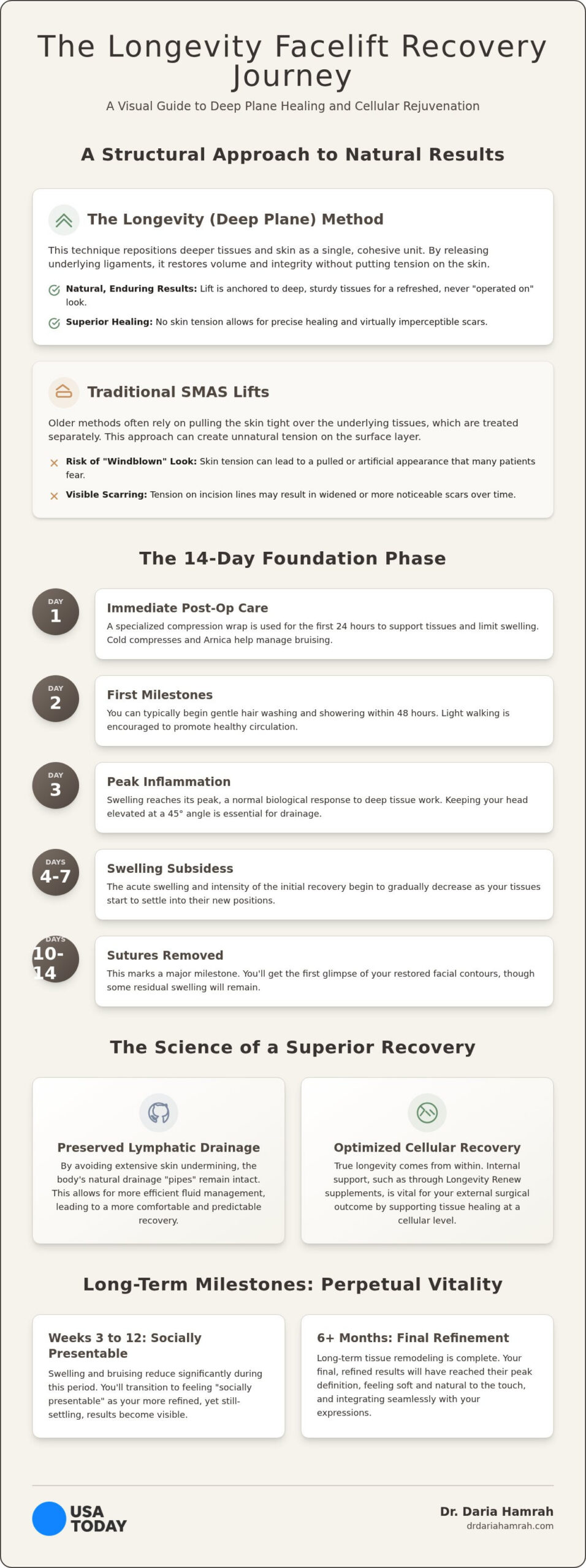
True facial rejuvenation is a structural endeavor, not a surface-level correction. The Longevity Facelift, or deep plane facelift, operates on the principle of biological integrity by repositioning the deeper tissues as a single, cohesive unit. Instead of pulling the skin tight, this technique releases the underlying ligaments to restore volume where it has naturally shifted over time. By treating the SMAS and skin as one layer, we eliminate the artificial tension that often characterizes older surgical methods. This fundamental shift in approach significantly influences the deep plane facelift recovery time, as your body isn’t fighting against unnatural pull during the healing process. When incisions aren’t under stress, they heal with greater precision, leading to scars that are virtually imperceptible.
The deep plane space is the natural gliding layer of the face, a specialized anatomical plane that allows for fluid movement between the mobile facial muscles and the fixed underlying structures.
Anatomy of the Deep Plane vs. SMAS Recovery
Traditional SMAS lifts often rely on skin tension to achieve a lift, which can lead to widened scars or a “windblown” appearance that many patients fear. In contrast, the deep plane technique works beneath the ligamentous attachments to secure the lift to the underlying structural foundation. This allows the results to settle harmoniously with your natural bone structure. You’ll find that your features don’t look “operated on” but rather like a refreshed version of your younger self. Because the tension is placed on deep, sturdy tissues rather than delicate skin, the surface remains soft and natural throughout the entire healing journey.
The Role of Lymphatic Drainage in Early Healing
Swelling is an inevitable part of any surgical journey, but its behavior in the deep plane is unique. Because the technique involves deeper dissection, initial swelling occurs within the internal tissues rather than just beneath the skin surface. Understanding the nuances of fluid management is key to mastering your deep plane facelift recovery time. The deep plane approach is specifically designed to preserve more natural lymphatic pathways than superficial lifts. By avoiding extensive skin undermining, we keep the body’s drainage “pipes” intact. This preservation helps the body re-establish fluid equilibrium more efficiently, typically within the first few weeks, leading to a more comfortable and predictable recovery process.
The 14-Day Foundation Phase: Managing Acute Inflammation
The first 14 days of your deep plane facelift recovery time represent the most critical period for tissue stabilization and inflammation control. During this phase, your body works hard to integrate the structural changes made during the Longevity Facelift. By day three, you’ll reach the peak of inflammation, which is a natural biological response to the deep tissue repositioning. Keeping your head elevated at a 45 degree angle during this window is essential to encourage fluid drainage and minimize pressure on the surgical site.
As you move into days four through seven, the acute swelling begins its gradual descent. You’ll notice the initial intensity of the recovery period softening as your tissues start to settle into their new, youthful positions. By the end of the second week, typically between days 10 and 14, we remove the sutures. This is often the first moment you catch a glimpse of your restored facial proportions, even if some residual swelling remains. That sensation of tightness you feel isn’t the skin being pulled, but rather the deep structural support of the Longevity Facelift taking hold.
Immediate Post-Operative Care Milestones
The first 24 hours are defined by the use of a specialized compression wrap. This garment provides gentle, consistent pressure that limits edema and supports the newly repositioned tissues. To manage bruising effectively, we recommend a clinical protocol of cold compresses and the homeopathic support of Arnica. While you’ll feel the need to refresh, you can typically begin gentle hair care and showering within 48 hours, provided you follow specific guidelines for cleansing near the incision lines. For personalized advice on your specific healing path, you can always consult with our specialized team to ensure every step is optimized.
Activity Restrictions and Physical Integrity
Rest is paramount, but it shouldn’t mean total immobility. Light walking around your home is encouraged from the very first day to maintain healthy circulation and prevent complications. However, you must strictly avoid any movements that strain the neck or jawline during this fortnight. This means no heavy lifting, no strenuous exercise, and no sudden twisting of the head. We suggest designing a “recovery nest” using wedge pillows to keep your head elevated while you sleep. This protects the structural integrity of the lift and ensures that your body can focus entirely on cellular repair without the interference of physical stress.
Weeks 3 to 12: Transitioning to Socially Presentable
By the third week, the most visible signs of surgery begin to fade. This is the stage of your deep plane facelift recovery time where you transition from “healing patient” to “socially presentable.” We define this milestone as the point where residual bruising is minimal enough to be camouflaged with medical-grade concealer. While you may still feel some internal firmness, your facial proportions are returning to a balanced state that appears natural to the casual observer. You’re no longer hiding; you’re emerging with a refreshed, vitalized aesthetic.
It’s common to enter what we call the “awkward phase” around week four or five. During this time, you might notice subtle, asymmetrical swelling that only you can see in the mirror. Don’t let this discourage you. It’s a biological sign of the deeper tissues settling into their permanent positions. You may also experience “pins and needles” or itching sensations. These aren’t setbacks. They’re positive indicators of nerve awakening and the restoration of sensation across the midface and jawline. Your body is re-establishing its sensory network as the structural lift becomes a permanent part of your anatomy.
Professional and Social Re-entry
Returning to the professional world requires a blend of physical preparation and mental confidence. By week three, most patients feel comfortable attending in-person meetings or taking video calls. To ease this transition, consider these strategies:
- Camouflage: Use a high-pigment, medical-grade concealer to mask any faint yellowing or remaining redness near the ears.
- Strategic Styling: Wear your hair down or in soft waves to provide a natural frame for the face while the final traces of swelling resolve.
- Social Scripts: You don’t owe anyone a surgical history. Crediting your refreshed look to a “great vacation” or a renewed focus on cellular health is a perfectly valid social strategy.
Resuming Physical Excellence
Protecting the structural integrity of your lift means pacing your return to fitness with care. While movement is medicine, intensity must be earned. Following the 4-week rule allows you to transition from light walking to moderate cardio, such as using an elliptical or brisk outdoor strolls. However, wait until the 6 to 8-week mark before returning to heavy lifting, running, or high-intensity interval training. Avoid saunas, steam rooms, and hot yoga until tissue remodeling is advanced. Excessive heat can dilate blood vessels and trigger a resurgence of swelling, potentially prolonging your deep plane facelift recovery time and taxing your biological resilience.
Optimizing the Longevity Facelift: The Science of Cellular Recovery
The success of your surgical journey depends as much on your internal biology as it does on the surgeon’s precision. While the Longevity Facelift provides the structural foundation, your cellular health acts as the engine that drives the healing process forward. To minimize your deep plane facelift recovery time, you must view your body as a high-performance system that requires specific fuel to rebuild its architecture. This is why we shift our focus from the external incisions to the microscopic environment where tissue remodeling actually occurs. Micronutrients like Zinc and Vitamin C act as catalysts for wound closure by facilitating the enzymatic reactions necessary for rapid tissue repair.
A proactive approach to nutrition ensures that your body has an abundant supply of the building blocks required for structural integrity. High-quality protein intake is essential for collagen synthesis, while consistent hydration maintains the elasticity of the deep plane tissues as they settle. By optimizing these biological variables, you empower your system to resolve inflammation more efficiently and lock in the natural, tension-free results of your procedure.
The Longevity Renew Supplement Protocol
We utilize a targeted approach to supplementation to support every phase of your recovery. Our proprietary Longevity Renew supplements are designed to target inflammation at the cellular level, effectively reducing the duration of post-surgical swelling. This protocol begins with a pre-surgical loading phase to saturate your tissues with antioxidants, followed by intensive post-surgical support to neutralize oxidative stress. These nutrients don’t just speed up the initial healing; they support skin elasticity and biological resilience long after your incisions have completely faded. By addressing the biochemical needs of your tissues, we help you return to your social and professional life with a sense of renewed vitality.
Medical-Grade Skincare and Incision Maintenance
As you transition out of the acute healing phase, your skincare routine must evolve to protect your investment. We guide you through the move from specialized surgical ointments to active, medical-grade skincare that promotes long-term skin quality. Sun protection is a non-negotiable factor during this time. UV exposure can cause hyperpigmentation in fresh scars, making them visible when they should be discreet. Applying a high-zinc physical block protects the integrity of the incision lines while your tissues continue to remodel. To learn more about how we integrate these holistic elements into your care plan, you can explore our Longevity Renew protocol for comprehensive recovery support.
Long-Term Milestones: From 6 Months to Perpetual Vitality
Reaching the six month mark is a transformative moment in your surgical journey. This is the stage where the final, subtle micro-swelling dissipates, allowing your jawline and midface to reach their peak definition. While the most intensive part of the deep plane facelift recovery time occurs in the first month, your body continues to refine the results through a process of deep tissue remodeling. You’ll likely find that your appearance at one year is even more harmonious and natural than it was at three months. This happens because the repositioned tissues have fully integrated with your natural bone structure, losing the initial post-surgical stiffness and gaining a soft, rested vitality.
The Longevity Facelift acts as a profound reset of the aging clock. It doesn’t stop time, but it places you on a significantly different trajectory. By addressing the structural foundation of the face rather than just the surface, we provide a result that can last 10 to 15 years. Adopting a longevity mindset means viewing this procedure as a powerful foundation that you can protect and enhance through consistent, high-level care. You aren’t just looking better for a season; you’re investing in a version of yourself that will age with greater grace and resilience.
The One-Year Reveal
At the twelve month anniversary, you experience the true reveal of your transformation. Your incisions have matured completely, transitioning from faint pink lines to virtually invisible marks hidden within the natural contours of your ears and hairline. There is a powerful psychological shift that occurs during this phase. As you look in the mirror, you no longer see a patient in recovery; you see a vitalized version of yourself that feels consistent with your internal energy. This is the point where the structural integrity of the lift is fully locked in, providing the enduring quality that defines the deep plane technique.
Maintaining Your Structural Investment
Your surgery provides the architecture, but your ongoing lifestyle provides the maintenance. To preserve the brilliance of your results, we recommend a multi-dimensional approach to wellness. While the lift handles the structural sagging, complementary treatments like Botox address dynamic expression lines, and Sciton lasers refine the surface texture and pigment. Consistent use of medical-grade skincare is essential to preserve the health of the skin envelope. By future-proofing your results with these targeted interventions, you ensure that your investment continues to pay dividends in confidence and vitality for decades to come.
Your Path to Lasting Structural Vitality
Choosing a surgical path is a significant investment in your long-term confidence. By focusing on the structural integrity of the Longevity Facelift, you’ve moved beyond surface-level changes to embrace a truly refreshed version of yourself. We’ve explored how managing acute inflammation and supporting your system with Longevity Renew supplements can optimize your deep plane facelift recovery time. You now understand that healing is a proactive biological process rather than a passive waiting period.
Dr. Daria Hamrah, a Board-Certified Facial Cosmetic Surgeon and specialist in the deep plane facelift technique, is dedicated to guiding you through this transformative experience. As the developer of the Longevity Renew supplement line, he integrates medical precision with holistic support to ensure your results look natural for decades. You don’t have to navigate this journey alone; expert mentorship is available to help you achieve your aesthetic goals with safety and intent. Every step of this process is designed to honor your unique anatomy and long-term well-being.
Schedule your Longevity Facelift consultation with Dr. Hamrah today to begin your customized rejuvenation plan. Your future self is waiting to meet you with renewed energy and enduring beauty.
Frequently Asked Questions
How much time do I need to take off work for a deep plane facelift?
Most patients require a minimum of 10 to 14 days away from professional duties to allow the initial swelling to subside. If your role involves remote work, you might feel ready to resume tasks sooner using strategic lighting. However, for those in client-facing positions, understanding the deep plane facelift recovery time helps you plan for a confident return. Waiting until the two-week mark ensures you feel socially presentable.
Is the recovery from a deep plane facelift more painful than a traditional one?
Patients often report less discomfort during a deep plane facelift recovery time compared to traditional skin-only lifts. This occurs because the technique avoids placing tension on the skin surface, which is where many pain receptors are located. Instead, the structural repositioning is secured in the deeper, less sensitive layers. Most individuals describe the sensation as a feeling of fullness or tightness rather than any acute pain.
When can I wear makeup after my Longevity Facelift?
You can typically resume wearing makeup once the sutures are removed, which occurs between day 10 and day 14. It’s essential to use high-quality, mineral-based products that allow the skin to breathe while camouflaging any residual yellowing or bruising. We recommend avoiding the incision lines themselves for the first few weeks to prevent irritation. This timeframe aligns perfectly with your transition back into social and professional environments.
Will I have visible scars after my deep plane facelift recovery?
Visible scarring is extremely rare because incisions are strategically placed within the natural contours of the ear and hairline. Because the deep plane technique eliminates tension on the skin, the scars heal as fine, flat lines that become virtually invisible within six to twelve months. Consistent use of medical-grade skincare and diligent sun protection during the first year is vital to ensure optimal pigment maturation and structural integrity.
What happens if I have residual numbness after 3 months?
Residual numbness at the three-month mark is a common part of the biological healing journey and rarely a cause for concern. As the nerves in the midface and jawline re-establish their connections, you may experience intermittent tingling or itching sensations. This process of sensory restoration can take six to twelve months to complete. We monitor your progress closely to ensure your recovery follows a healthy, predictable trajectory.
Can I speed up my facelift recovery with supplements?
Targeted supplementation is a cornerstone of our holistic approach to accelerating the healing process. Our Longevity Renew supplements are specifically formulated to support collagen synthesis and reduce oxidative stress at a cellular level. By loading these nutrients before surgery and continuing them through the recovery phase, you provide your body with the essential catalysts needed for efficient tissue repair. This internal support often results in a more comfortable transition.
When is it safe to travel or fly after a deep plane facelift?
Most patients are cleared for short-haul air travel approximately two weeks after their procedure. It’s crucial to wait until the initial inflammatory phase has passed to avoid the increased swelling that can occur with cabin pressure changes. For longer international flights, we often suggest waiting three to four weeks to ensure your circulatory system has stabilized. Always stay hydrated and move your legs frequently during travel to maintain healthy blood flow.
How long does the “tight” feeling last after surgery?
The sensation of tightness is most prominent in the first month but can persist in a subtle form for several months. This feeling is a positive indicator that the deep structural support of the lift is intact and the tissues are remodeling around their new foundation. As the internal swelling resolves and the tissues soften, this sensation gradually fades into a feeling of natural, vitalized firmness. It’s the hallmark of a lift built to last.