
True rejuvenation isn’t about how much skin a surgeon can pull. It’s about how much structural integrity they can restore from within. If you’ve spent hours in front of the mirror wondering, “am i a candidate for a deep plane facelift,” you’re likely searching for something more than a temporary fix. It’s natural to feel anxious about looking “windblown” or “operated on.” You want to look like yourself, only more vibrant and rested. This guide will help you move past the confusion of traditional techniques by identifying the specific clinical signs and anatomical requirements that define the ideal Longevity Facelift patient.
We’ll explore why your facial ligaments hold the key to your results. We’ll also discuss how your biological vitality influences your recovery and what it means to choose a procedure that honors your cellular health for years to come. By the end, you’ll have a clear understanding of your unique anatomical needs and the confidence to choose a path that supports long-term vitality. Understanding your candidacy is the first step toward a transformation that feels as natural as it is enduring. You deserve a solution that prioritizes your health as much as your aesthetic goals.
Key Takeaways
- Identify the specific anatomical markers, such as midface descent and heavy jowls, that help you determine: am i a candidate for a deep plane facelift?
- Understand why repositioning the muscle and fat layers as a single unit prevents the “windblown” look and restores youthful volume to the cheeks.
- Learn the difference between SMAS and Deep Plane techniques to see which surgical depth aligns with your skin elasticity and structural needs.
- Recognize the vital role that biological readiness and cellular health play in ensuring a safe recovery and long-lasting facial restoration.
- Discover how the Longevity Facelift approach combines surgical excellence with a comprehensive plan for maintaining your results through advanced wellness.
What Is a Deep Plane Face Lift and How Does It Differ?
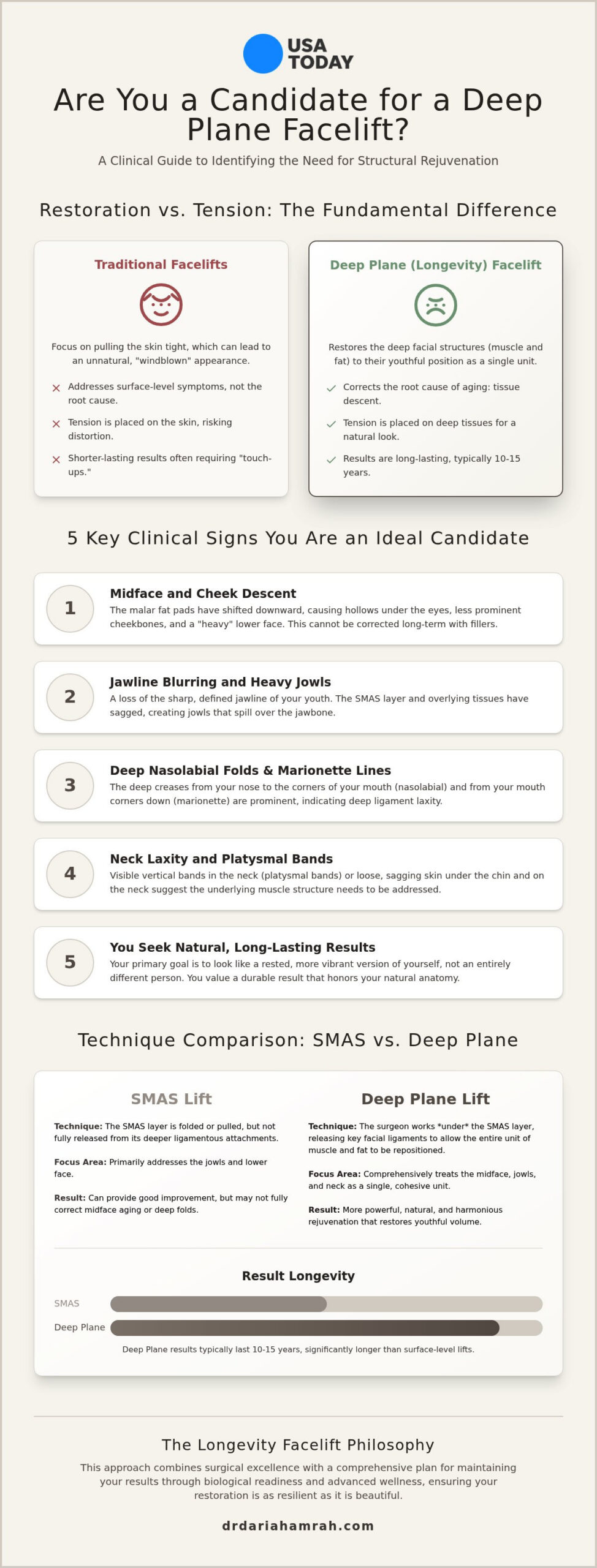
Understanding What Is a Deep Plane Face Lift requires looking beneath the surface. Traditional facelifts often focus on pulling the skin tight. This frequently leads to a distorted, artificial appearance. In contrast, the Deep Plane Facelift, also known as the Longevity Facelift, treats the face as a cohesive structure. By repositioning the entire muscle and fat layer as a single unit, we achieve restoration rather than mere tension. This method has become the 2026 gold standard because it addresses the root cause of aging: the downward slide of deep tissues. When you ask yourself, “am i a candidate for a deep plane facelift,” you’re likely seeking a result that looks like you, just years younger.
The Anatomy of the Deep Plane
Think of your face like a well-made bed. The skin is the top sheet; the SMAS (Superficial Muscular Aponeurotic System) is the heavy quilt; and the deep plane is the mattress. While other surgeries might just smooth the quilt, a deep plane approach adjusts the mattress itself. This space exists between the SMAS and the deeper muscles of facial expression. Within this space, retaining ligaments act as sturdy anchors that hold everything in place. When these anchors weaken over time, the face sags. By releasing and resetting these ligaments, we provide a foundation that supports the face naturally. The deep plane is the anatomical foundation of facial support.
Why ‘Longevity’ is the Core of the Technique
If you’re wondering, “am i a candidate for a deep plane facelift,” you probably value results that endure. Because we move the deeper structural layers rather than just the skin, the “windblown” look is entirely avoided. Tension is placed on the deep tissues, not the surface. This structural shift typically lasts 10 to 15 years, which is significantly longer than surface-level lifts that often require “touch-ups” much sooner. Dr. Hamrah views this as more than just a technical procedure; it’s a commitment to your long-term vitality. By focusing on cellular health and structural integrity, we ensure your body is biologically ready to sustain these results. This holistic vision ensures that your restoration is as resilient as it is beautiful.
5 Key Clinical Signs You Are an Ideal Candidate
Identifying whether you require a Longevity Facelift involves observing how gravity has repositioned your facial architecture. While traditional procedures focus on surface-level wrinkles, the deep plane approach is designed for those with significant structural descent. If you’re looking in the mirror and asking, “am i a candidate for a deep plane facelift,” start by observing how your features have shifted away from your bone structure. This shift often manifests as a loss of definition in the midface and a blurring of the jawline. It’s about the movement of the foundation, not just the wear on the wallpaper.
According to the American Academy of Facial Plastic and Reconstructive Surgery on deep plane facelifts, the growing demand for this technique stems from its ability to provide comprehensive, natural rejuvenation. Beyond midface issues, ideal candidates often exhibit deep nasolabial folds and marionette lines. These folds are rarely solved by skin tightening alone; they require the release of the underlying ligaments. Additionally, the presence of platysmal bands or a “double chin” suggests that a combined face and neck lift may be necessary to restore a youthful profile. These markers indicate that the deeper structural layers have lost their resilience.
The Midface and Cheek Descent
The malar fat pad is the primary volume source for your cheeks. Over time, this pad shifts downward, leaving the upper cheeks hollow and creating a “heavy” look in the lower face. You can identify this by noticing if your cheekbones seem less prominent while your nasolabial folds have deepened. Many patients try to fix this with fillers, but adding volume to a descended fat pad often leads to a puffy, unnatural appearance. A structural assessment by a surgeon is far more effective than a simple “pinch test” of the skin. If you want to see how your specific anatomy might benefit, you can schedule a structural assessment to evaluate your malar fat pad positioning.
Jawline Integrity and Neck Laxity
Jowling is perhaps the most telltale sign of SMAS-level descent. When the lower facial tissues lose their support, they spill over the mandibular line, obscuring the sharp transition between the face and neck. This laxity is often tied to the platysma muscle in the neck, which can separate and form vertical bands. A crisp jawline is the hallmark of a successful deep plane candidate. By lifting the deep tissues vertically, we clear the jowls and redefine the mandibular border without the tension associated with older surgical methods. This restoration creates a clean, elegant silhouette that looks entirely natural.
Deep Plane vs. SMAS: Choosing the Right Technique for Your Anatomy
Choosing between a SMAS and a Deep Plane approach isn’t about finding a “better” surgery; it’s about matching the technique to your unique biological needs. A SMAS facelift manipulates the superficial muscle layer, often pulling it horizontally to smooth the skin. While effective for some, it relies heavily on skin tension. If you’re asking, “am i a candidate for a deep plane facelift,” you might have noticed that your skin feels thinner or more fragile. In these cases, a Deep Plane approach is superior because it works underneath the muscle layer. This removes the risk of a “pulled” look by shifting the entire facial structure as one unit. By working beneath the SMAS, we avoid the “windblown” effect that occurs when skin is asked to do the work of the muscles. Structural ligament laxity, not chronological age, is the true metric for candidacy. This approach honors your internal health by preserving the natural blood supply to the skin, which is often compromised in more superficial techniques.
When SMAS Is Not Enough
Many patients seek our expertise after a previous SMAS lift has reached its limit or failed to provide the desired vertical lift. When facial tissues are heavy or have significant volume descent, surface-level manipulation simply isn’t enough to counteract gravity. A traditional SMAS lift can sometimes leave the midface looking flat while pulling the mouth corners unnaturally. The Longevity Facelift excels here by focusing on vertical repositioning. By addressing the descent at a deeper level, we restore the heart-shaped contour of youth. This is especially vital for candidates who have lost significant volume in their midface and require a more robust, structural restoration that surface-level lifts cannot provide.
The Benefit of Ligament Release
The true secret to a natural, long-lasting result lies in the release of the facial retaining ligaments. These ligaments act as tethers that keep tissues locked in a descended position. Unless these tethers are released, any lift will be fighting against the body’s own internal resistance. Determining “am i a candidate for a deep plane facelift” often comes down to whether these internal anchors need to be reset to allow for a true transformation. Releasing these anchors allows for a significant, tension-free lift that looks entirely natural. This process also reduces post-operative tension on the incision lines, which often leads to finer, less noticeable scarring. Ligament release is the key differentiator for candidates seeking the enduring quality and structural integrity of a true Longevity Facelift.
Physical Health and Biological Readiness for Facial Restoration
True facial restoration requires more than just a skilled surgeon. It demands a body that’s biologically prepared for the journey. When you ask, “am i a candidate for a deep plane facelift,” you’re looking beyond your reflection and into your overall vitality. Your internal health determines how well your tissues respond to repositioning and how efficiently they heal at a cellular level. We don’t just look at your skin; we evaluate your biological resilience. This ensures that the results of your Longevity Facelift are supported by a foundation of health that can sustain them for a decade or more.
Smoking remains one of the most significant barriers to candidacy. Nicotine constricts blood vessels, which starves healing tissues of the oxygen they desperately need. To be considered a safe candidate, you must be entirely nicotine-free for at least 4 to 6 weeks before and after your procedure. Similarly, chronic conditions like hypertension or diabetes must be meticulously managed. Stable blood pressure and controlled blood sugar levels are non-negotiable for surgical safety. We also look for weight stability. Significant fluctuations after surgery can cause tissues to shift, potentially compromising the structural integrity we’ve worked so hard to restore.
The Role of Nutrition and Supplements
Dr. Hamrah views your lifestyle as an integral part of the surgical plan. Cellular health is the prerequisite for optimal healing, which is why we emphasize nutritional preparation. High intake of protein, Vitamin C, and Zinc is essential for collagen synthesis and tissue repair. To bridge any nutritional gaps, we integrate Longevity Renew supplements into your pre-operative routine. These are specifically formulated to prepare your body for the stress of surgery and to accelerate the recovery process. By optimizing your internal environment, we empower your body to heal with greater efficiency and strength.
Psychological Readiness and Expectations
A positive recovery starts with a clear mind. Realistic expectations are vital for anyone wondering, “am i a candidate for a deep plane facelift.” The goal of the Longevity Facelift is to help you look like a refreshed, vibrant version of yourself, not like a different person entirely. Candidates who understand this distinction often report higher satisfaction and better recovery outcomes. A positive outlook isn’t just a state of mind; it’s clinically linked to lower cortisol levels, which directly benefits your immune response and healing speed. We invite you to schedule your consultation to discuss how we can align your health and goals for a successful transformation.
The Longevity Facelift: Dr. Hamrah’s Vision for Enduring Results
Dr. Hamrah’s Longevity Facelift represents a paradigm shift in facial rejuvenation. It is the culmination of years spent refining the deep plane technique to prioritize biological resilience and structural harmony. While you may still be asking, “am i a candidate for a deep plane facelift,” this proprietary approach moves beyond the operating room. It integrates surgical excellence with a comprehensive plan for long-term aesthetic maintenance. This ensures that the results don’t just look natural today; they remain vibrant for a decade or more. Patients from across the country seek out this specialized expertise because they recognize that true beauty is rooted in the intersection of science and wellness. Our goal is to provide a result that honors your history while securing your future vitality.
A Holistic Approach to Surgery
We view the surgical procedure as one component of a larger ecosystem of health. The Longevity Facelift combines deep tissue repositioning with medical-grade skincare and Longevity Renew supplements. This multi-dimensional strategy addresses aging from every angle, from the deep ligaments to the surface epidermis. We focus on structural integrity rather than just removing skin. By optimizing your skin’s health and your body’s internal recovery mechanisms, we create a result that is both durable and radiant. This commitment to comprehensive care is why our practice has a national reach. Patients travel from various states to access a level of expertise that treats the patient as a whole person rather than a collection of surgical sites. We believe that a successful transformation requires a visionary plan that extends far beyond the day of surgery.
Your Consultation Journey
The first step in answering “am i a candidate for a deep plane facelift” is a detailed clinical facial analysis. During this consultation, Dr. Hamrah evaluates your unique skeletal structure, soft tissue distribution, and skin quality. This isn’t a one-size-fits-all assessment. It’s an educational journey where you learn how your specific anatomy influences the surgical plan. We discuss your goals, your lifestyle, and your biological readiness to ensure a bespoke experience. This thorough preparation is what builds the trust necessary for a transformative journey. Dr. Hamrah acts as a mentor through this process, guiding you toward the best decisions for your long-term confidence. If you are ready to explore your options, you should Schedule your consultation with Dr. Daria Hamrah today to begin your path toward enduring restoration.
Embracing a Future of Structural Vitality
Choosing a surgical path is a significant decision that requires a deep understanding of your own anatomy and biological readiness. We’ve explored how the release of facial ligaments and the vertical repositioning of deep tissues create a result that is both natural and enduring. If you’ve been asking, “am i a candidate for a deep plane facelift,” the answer lies in the intersection of your structural needs and your commitment to cellular health. Dr. Daria Hamrah, a Board-Certified Facial Cosmetic Surgeon and specialist in the proprietary Longevity Facelift technique, views your transformation as a holistic journey.
By integrating comprehensive cellular-health focused recovery plans with surgical excellence, we ensure your results are built on a foundation of long-term vitality. You don’t have to settle for the limitations of traditional methods when a visionary approach to restoration is available. It’s time to prioritize your confidence and your future well-being with a plan tailored specifically to your unique features. Take the first step toward facial restoration-Book your consultation with Dr. Hamrah. Your journey toward a refreshed, vibrant version of yourself begins with a single, purposeful step.
Frequently Asked Questions
What is the best age to have a deep plane facelift?
Ideal candidates are typically between 40 and 60 years old. However, chronological age is less important than your anatomical needs. If you notice midface descent or heavy jowls early, you might ask, “am i a candidate for a deep plane facelift” in your late 30s. We evaluate the laxity of your facial ligaments and the depth of your nasolabial folds to ensure the procedure addresses structural changes at the right biological moment.
How long does a deep plane facelift actually last compared to other types?
A deep plane facelift typically lasts 10 to 15 years, which is significantly longer than the results of a traditional SMAS lift. This longevity is due to the repositioning of the entire muscle layer as a single unit. A study found that patients reported looking an average of 11.9 years younger after this procedure. By releasing the deep retaining ligaments, we create a structural restoration that resists gravity more effectively than surface-level techniques.
Is the recovery for a deep plane facelift more painful?
Most patients report that the recovery is surprisingly manageable and often less painful than a surface-level lift. Because we avoid placing tension on the skin, you won’t experience the sharp pulling sensation associated with older techniques. Instead, you’ll feel a sense of tightness and see some swelling during the first week. We support your healing process with Longevity Renew supplements and a personalized recovery plan to optimize your cellular health and comfort.
Can a deep plane facelift be combined with other procedures like a brow lift?
Yes, we frequently combine the Longevity Facelift with other procedures to achieve a balanced, comprehensive result. Common additions include a Browlift for a refreshed upper face or a Blepharoplasty to address tired-looking eyes. Some patients also choose a Rhinoplasty or Laser skin treatments during the same session. Combining these procedures allows for a single recovery period while ensuring that every facial feature harmonizes with your newly restored structural integrity.
Will I have visible scars after a deep plane facelift?
Scars are meticulously hidden within the natural contours of your ears and hairline. Because the deep plane technique places all the lifting tension on the underlying muscles, there is virtually no tension on the skin incisions. This lack of pull allows the skin to heal with very fine, almost invisible lines. Our focus on cellular health and medical-grade skincare further ensures that your body has the necessary nutrients to minimize scarring effectively.
How do I know if I need a facelift or just more dermal fillers?
Fillers are designed to replace lost volume, but they cannot lift sagging tissues. If you find yourself needing more filler to achieve the same look, you may be experiencing structural descent. Overusing fillers often leads to a puffy, unnatural appearance. When you wonder, “am i a candidate for a deep plane facelift,” look for heavy jowls or midface sagging. These issues require structural repositioning that only a surgical restoration can provide.
What are the specific risks associated with deep plane surgery?
All surgeries carry risks, including hematoma, infection, or temporary numbness. In deep plane surgery, the proximity to facial nerves requires a high level of surgical expertise. While nerve injury is a rare risk, choosing a board-certified specialist who understands deep facial anatomy is critical for safety. We mitigate these risks through meticulous surgical techniques and a comprehensive pre-operative plan that optimizes your biological readiness and cellular health before you enter the operating room.
How soon can I return to work after a Longevity Facelift?
Most patients are ready to return to professional and social activities within 2 to 3 weeks. By this point, major swelling has subsided, and any residual bruising can typically be camouflaged with light makeup. Your specific timeline depends on your body’s natural healing rate and your adherence to our recovery protocols. Using Longevity Renew supplements and following our cellular-health focused plan can help speed up the process, ensuring a steady and efficient return to your routine.