
What if the secret to a youthful neck isn’t found in the elasticity of your skin, but in the structural integrity of the muscle hidden beneath it? Many people find themselves hiding behind scarves or high collars, frustrated that expensive serums haven’t delivered the results they promised. If you’ve been considering turkey neck surgery, you likely want a change that feels authentic, not “over-pulled” or artificial.
It’s understandable to feel hesitant about surgery when you’ve seen results that look frozen or strained. You want to look like a more vibrant version of yourself, not a different person entirely. True rejuvenation isn’t about stretching the surface; it’s about repairing the biological foundation that supports your features and ensures long-term resilience.
This article explains how platysmaplasty addresses the root cause of aging by tightening the platysma muscle to eliminate vertical bands and restore a defined jawline. You’ll discover how this structural approach provides a natural look that lasts, moving far beyond the limitations of non-surgical trends. We’ll also look at how focusing on longevity and cellular health can transform your recovery and your long-term surgical outcomes.
Key Takeaways
- Discover why the platysma muscle serves as the essential internal scaffolding for a youthful profile and how its restoration eliminates vertical bands.
- Learn why effective turkey neck surgery prioritizes the anatomical foundation of the neck to create a defined jawline that ages with natural grace.
- Explore the “corset” technique, a surgical approach that uses discreet incisions to provide a firm, lasting base for the lower face.
- Understand the critical role of tissue health and pre-surgical optimization in achieving results that reflect long-term vitality rather than a temporary fix.
- Compare the benefits of isolated muscle repair versus a comprehensive neck lift to identify the most strategic solution for your aesthetic goals.
What is Platysmaplasty? Understanding the Anatomy of Turkey Neck Surgery
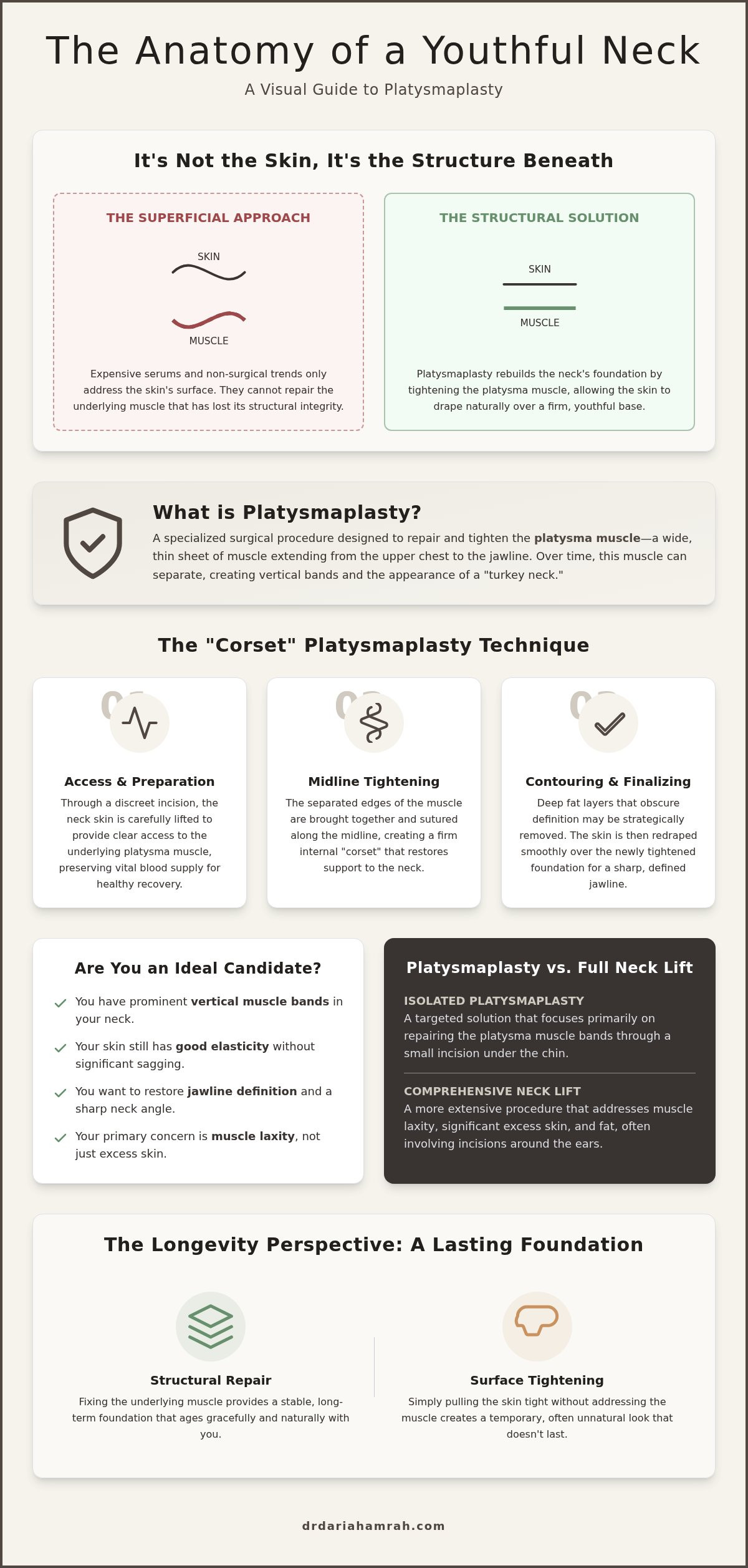
A youthful neck isn’t just about smooth skin; it’s about the architecture underneath. When patients research What is a Platysmaplasty, they’re looking for a solution that addresses the anatomical foundation of the neck rather than just the surface. Platysmaplasty is a specialized surgical procedure designed to repair and tighten the platysma muscle. It serves as the core component of effective turkey neck surgery. Think of your neck as a building. If the internal frame begins to bow, simply repainting the exterior won’t fix the structural lean. You must address the scaffolding to ensure the results are both beautiful and enduring.
Many people mistake muscle laxity for simple skin sagging. While medical-grade skincare is vital for cellular health, it cannot reach the deep muscle layer. When the structural integrity of the platysma is compromised, it creates a cascading effect of shadows and folds. Restoring this muscle provides a natural, refreshed appearance because it repositions the tissues where they biologically belong. This isn’t about pulling the skin tight. It’s about restoring the internal support system so the skin can drape naturally over a firm, youthful base.
The Role of the Platysma Muscle
The platysma is a wide, thin sheet of muscle extending from the upper chest to the jawline. It’s unique because it isn’t anchored to bone like most other facial muscles. Over years of movement and gravity, this sheet can split or lose its tension. This separation creates the vertical “platysmal bands” that often define the aging neck. As these bands pull away from each other, the soft tissue in the center loses its support. This biological shift leads directly to the “turkey neck” appearance that many patients find frustrating despite their overall health and fitness.
Who is the Ideal Candidate?
Not everyone with neck concerns requires the same surgical path. The best candidates for a focused platysmaplasty are individuals who have prominent vertical bands but still possess resilient skin elasticity. It’s a precise solution for those wanting to restore jawline definition without a full facelift. Genetics often play a significant role. Some younger patients experience early muscle separation despite having vibrant skin. We evaluate the cervicomental angle, which is the slope where the neck meets the chin. A sharp, well-defined angle is the ultimate goal of turkey neck surgery, providing a silhouette that reflects vitality and health.
The Clinical Process: How Platysmaplasty Repairs the Neck Foundation
Understanding the “how” behind a surgical transformation is just as vital as the “why.” Modern techniques for turkey neck surgery have evolved far beyond simple skin tightening. Today, the focus is on the structural repair of the neck foundation, ensuring that every internal suture serves a functional purpose. The goal is to rebuild the neck from the inside out, creating a silhouette that remains stable and natural for years to come. This process involves a meticulous combination of muscle repositioning and the strategic removal of deep fat layers that obscure your natural definition.
Precision is the hallmark of this approach. By addressing the deeper facial layers, surgeons can ensure the neck and jawline age in harmony with the rest of the face. This cohesive rejuvenation prevents the “mismatched” look that often occurs when only the surface is treated. Preparing your body for this transformation begins with a deep understanding of your unique anatomy; you can explore these options further through a personalized consultation to see what fits your lifestyle.
The Corset Platysmaplasty Technique
The “corset” technique is widely considered the gold standard for restoring a sharp, youthful neck angle. It follows a logical, three-step progression:
- Step 1: Precise Undermining. The surgeon carefully lifts the neck skin to gain clear access to the underlying platysma muscle. This is done with extreme care to preserve the blood supply and ensure healthy tissue recovery.
- Step 2: Midline Tightening. The edges of the separated muscle are brought together and sutured along the midline. This creates a firm, internal “corset” that pulls the tissues upward and inward.
- Step 3: Structural Anchoring. Once the muscle is tightened, it’s anchored to provide a permanent lift. This eliminates the vertical bands discussed in previous sections and provides a smooth, flat base for the skin to rest upon.
Precision Scar Management
Fear of visible scarring is a common concern for many patients. To mitigate this, incisions are placed with strategic intent in natural skin creases. Most are hidden discreetly under the chin or tucked behind the ears, where they become virtually invisible once healed. The way these incisions are closed is just as important as where they’re placed. Tension-free closure is the primary factor in preventing hypertrophic scarring. By ensuring the skin isn’t pulled tight at the incision site, the body can heal with minimal inflammation, resulting in a refined and subtle mark that fades beautifully over time.
Platysmaplasty vs. Full Neck Lift: Choosing the Right Path
The decision between a targeted platysmaplasty and a more extensive neck lift surgery depends entirely on your unique anatomical needs. While both procedures fall under the umbrella of turkey neck surgery, they address different biological realities. A standard Neck Lift (Platysmaplasty) focuses primarily on midline muscle repair, whereas a full lift often incorporates lateral muscle tightening and skin excision. Understanding where you fall on this spectrum is the first step toward a result that looks natural and ages with grace.
When Platysmaplasty is a Standalone Solution
For many patients, the primary concern isn’t excess skin but rather the “bowstring” effect of vertical muscle bands. If you have resilient skin tone and minimal sagging, an isolated platysmaplasty might be the most strategic choice. This targeted approach offers a shorter surgical window and a more efficient recovery period. It often includes submentoplasty, which combines muscle repair with the removal of deep submental fat to reveal a sharp, crisp jawline. Skin-only lifts often fail because they ignore the underlying muscle laxity. Without this structural repair, the skin will eventually stretch and sag again, leading to an early relapse of the very concerns you sought to fix.
The Synergy of the Deep Plane Approach
When aging affects the midface and jowls alongside the neck, a standalone procedure might leave the transition between the face and neck looking disjointed. This is where the synergy of a deep plane facelift becomes invaluable. By addressing the SMAS (Superficial Musculo-Aponeurotic System) layer, we can create a seamless, continuous lift from the collarbone to the temples. The SMAS is the fibrous network that connects your facial muscles; repositioning it allows us to lift the deeper tissues as a single unit.
This comprehensive method ensures that the weight of the cheeks doesn’t continue to press down on the newly restored neck foundation. It creates a unified architectural change that respects your natural movement. Rather than just fixing a “turkey neck,” we’re restoring the entire lower third of the face for cohesive rejuvenation. For patients whose concerns extend beyond the neck alone, a lower facelift and neck lift treats the face and neck as a single, continuous unit of anatomy to restore structural harmony and long-term jawline definition. This holistic view ensures that your results aren’t just a temporary tightening but a long-term investment in your biological resilience and facial harmony. Patients who pursue this comprehensive approach often find it beneficial to also explore treatment for perioral wrinkles, as restoring the lower face as a unified system includes addressing the structural collapse that causes vertical lip lines alongside neck and jawline concerns.
The Longevity Perspective: Why Structural Repair Beats Tightening
A successful outcome isn’t measured just in the weeks after surgery, but in the decades that follow. While many industry sources suggest that results from turkey neck surgery typically last between ten and fifteen years, the quality of those years depends entirely on the surgical philosophy employed. If a procedure relies solely on skin tightening, it’s essentially fighting a losing battle against biology. Skin is an elastic organ; it’s designed to stretch. When tension is placed on the surface alone, the inevitable result is an early relapse and a look that feels forced or artificial.
True longevity is achieved by securing the platysma muscle to the underlying fascia. This creates a stable biological anchor that supports the neck’s anatomy from within. By prioritizing structural integrity over surface-level tension, we allow the neck to age with natural grace. This approach doesn’t just “fix” a problem; it reimagines the neck’s foundation to support enduring vitality. If you’re ready to move beyond temporary fixes and invest in your long-term confidence, you can start your journey with a longevity-focused consultation today.
Avoiding the Windblown Effect
The “windblown” or “over-pulled” look is a significant concern for many patients. This unnatural appearance usually happens when tissues are pulled horizontally toward the ears. In contrast, a structural approach utilizes vertical vectors. We lift the muscle and deep tissues upward, which mimics the way your face and neck naturally resisted gravity in your youth. This technique preserves the natural mobility of your head and neck. You won’t feel “stiff” or “frozen” when you turn your head; instead, your work remains invisible because it respects your body’s natural movement patterns.
Cellular Support for Surgical Outcomes
Surgery provides the architectural change, but cellular health determines how well that change is maintained. Results are most resilient when the skin remains thick and collagen levels are optimized. This is where the intersection of modern surgery and medical-grade skincare becomes critical. By focusing on tissue health before and after your procedure, we ensure that the skin draping over your new foundation remains vibrant and resilient. This holistic strategy recognizes that a beautiful neck is the product of both expert surgical precision and a commitment to internal biological health. We view turkey neck surgery as one vital piece of a much larger, multi-dimensional plan for your overall well-being. The same principles of skin longevity and structural integrity that guide neck rejuvenation also apply to advanced treatment for perioral wrinkles, where collagen support and cellular resilience are equally essential for lasting, natural-looking results.
The Hamrah Philosophy: Integrating Platysmaplasty into a Longevity Plan
Dr. Hamrah’s signature approach transcends traditional aesthetics by viewing the lower face as a dynamic system of tissues that require a multi-dimensional strategy. He doesn’t view turkey neck surgery as a standalone event, but as a pivotal chapter in a lifelong journey toward vitality. This philosophy prioritizes facial harmony and structural integrity, ensuring that any surgical intervention feels like a natural extension of your own biology. By focusing on the intersection of science and wellness, we move beyond the “quick fix” to create a foundation for enduring confidence.
Preparation is just as critical as the procedure itself. We emphasize pre-surgical optimization to prepare your body for cellular-level healing. Think of it as preparing the soil before planting a seed; the environment must be healthy for the results to flourish. This involves a comprehensive review of your lifestyle, nutrition, and skin health. Our goal is to ensure your tissues are resilient and your inflammatory response is balanced before we ever begin the surgical process. This thoroughness is what separates a standard procedure from a longevity-focused transformation.
Recovery and the Longevity Protocol
The first 14 days after your procedure are a vital window for structural stabilization. During this time, the focus shifts to managing swelling and supporting the newly repaired platysma muscle. We utilize medical-grade skincare to enhance the surface texture of the neck, ensuring the skin remains hydrated and vibrant as it settles over the new foundation. Longevity Renew supplements specifically target post-surgical inflammation to streamline the body’s natural repair mechanisms. By supporting your recovery at a cellular level, we help you return to your routine with results that look refreshed and feel authentic.
Your Journey Toward Lasting Confidence
Restoring a youthful, healthy neck profile has a profound psychological impact that often extends far beyond the mirror. A defined jawline often acts as a visual anchor for the entire face, reflecting a sense of vigor and internal health. Because the anatomy of the neck is incredibly complex, involving delicate nerves and vascular structures, choosing a board-certified specialist is essential. You need a practitioner who views surgery through a visionary lens, balancing technical precision with a deep understanding of human aging. If you are ready to explore a more thoughtful, structural approach to rejuvenation, Schedule your longevity consultation with Dr. Daria Hamrah today.
Reclaiming Your Profile Through Structural Integrity
True rejuvenation happens when we stop fighting the surface and start supporting the biological foundation. You’ve discovered how platysmaplasty acts as the internal scaffolding for the neck, repairing the platysma muscle to eliminate vertical bands and restore a crisp jawline. This structural approach is the gold standard for turkey neck surgery, ensuring that your results look authentic and age naturally with your features. By prioritizing tissue health and vertical lifting over simple skin tightening, you avoid an artificial appearance and invest in lasting facial harmony.
Dr. Daria Hamrah, a board-certified facial cosmetic surgeon and specialist in the Deep Plane Longevity Facelift, focuses on this natural, structural restoration to help you achieve long-term vitality. Beyond the technical repair, our holistic protocol supports your cellular recovery for a seamless journey toward your aesthetic goals. It’s time to stop settling for temporary fixes and start building a foundation that reflects your inner energy. Book Your Structural Neck Assessment with Dr. Hamrah to discover how a specialized, anatomical approach can redefine your profile and your confidence.
Frequently Asked Questions
What is the difference between a neck lift and a platysmaplasty?
A platysmaplasty is a specialized surgical technique that specifically targets and repairs the platysma muscle. While it’s a core component of turkey neck surgery, a comprehensive neck lift might also involve removing excess skin or addressing the deeper SMAS layers. If your primary concern is vertical muscle banding without significant skin sagging, an isolated platysmaplasty provides a more focused solution. It’s about restoring the internal scaffolding rather than just pulling the surface.
How long do the results of a platysmaplasty last?
Results from a structurally sound muscle repair are designed to endure for a decade or more. Because the procedure anchors the muscle to the underlying fascia, it provides a stable foundation that resists the pull of gravity more effectively than skin-only procedures. Your biological resilience and commitment to medical-grade skincare also play vital roles in maintaining these outcomes. By prioritizing internal integrity, you ensure that your neck ages with natural grace over the long term.
Will I have visible scars after my neck muscle repair?
Incisions are strategically placed in natural skin creases to ensure they remain virtually invisible once healed. Most are tucked discreetly under the chin or behind the ears. Dr. Hamrah utilizes a tension-free closure technique, which is the primary factor in preventing thick or raised scars. By ensuring the skin isn’t pulled tight at the incision site, your body can focus on clean, refined healing that leaves no obvious trace of surgical intervention.
What is the typical recovery time for a platysmaplasty procedure?
Most patients feel comfortable returning to desk work and light daily routines within one to two weeks. While initial swelling and bruising typically subside during this period, the internal tissues continue to heal for several months. You’ll likely receive clearance for strenuous exercise and heavy lifting around the four to six-week mark. Following a specific longevity protocol, including proper nutrition and supplements, can significantly support your body’s natural repair mechanisms during this transition.
Can platysmaplasty be performed under local anesthesia?
Yes, an isolated platysmaplasty can often be performed under local anesthesia with intravenous sedation. This approach allows for a comfortable experience while minimizing the recovery time associated with general anesthesia. The choice of anesthesia depends on the complexity of your specific turkey neck surgery and your personal health history. During your consultation, we’ll determine the safest and most effective method to ensure you feel relaxed and empowered throughout the entire process.
Is platysmaplasty effective for removing a double chin?
Platysmaplasty is highly effective when combined with submental fat removal to address a double chin. While the muscle repair eliminates vertical bands, removing excess fat reveals the underlying muscular definition. This dual approach restores a sharp, youthful cervicomental angle. It’s not just about removing weight; it’s about sculpting the transition between the chin and neck to create a silhouette that reflects vitality and a healthy, active lifestyle.
At what age should I consider platysmaplasty for neck bands?
There isn’t a single “right” age, as genetics and lifestyle factors play a significant role in neck aging. Many patients begin to notice vertical bands in their late 40s or early 50s. However, some individuals experience muscle separation much earlier due to hereditary factors. Addressing these structural concerns sooner rather than later often allows for more subtle, natural-looking corrections. We focus on your specific anatomy rather than the number on your birth certificate.
How do I know if my neck issues are caused by skin or muscle?
A simple way to tell is by looking at the direction of the folds. Vertical bands that appear when you clench your jaw are a clear sign of platysma muscle separation. In contrast, skin laxity often looks like fine, horizontal wrinkles or a paper-like texture that doesn’t change with muscle movement. Most patients experience a combination of both. A professional assessment is the best way to determine if you need structural repair or surface-level rejuvenation.