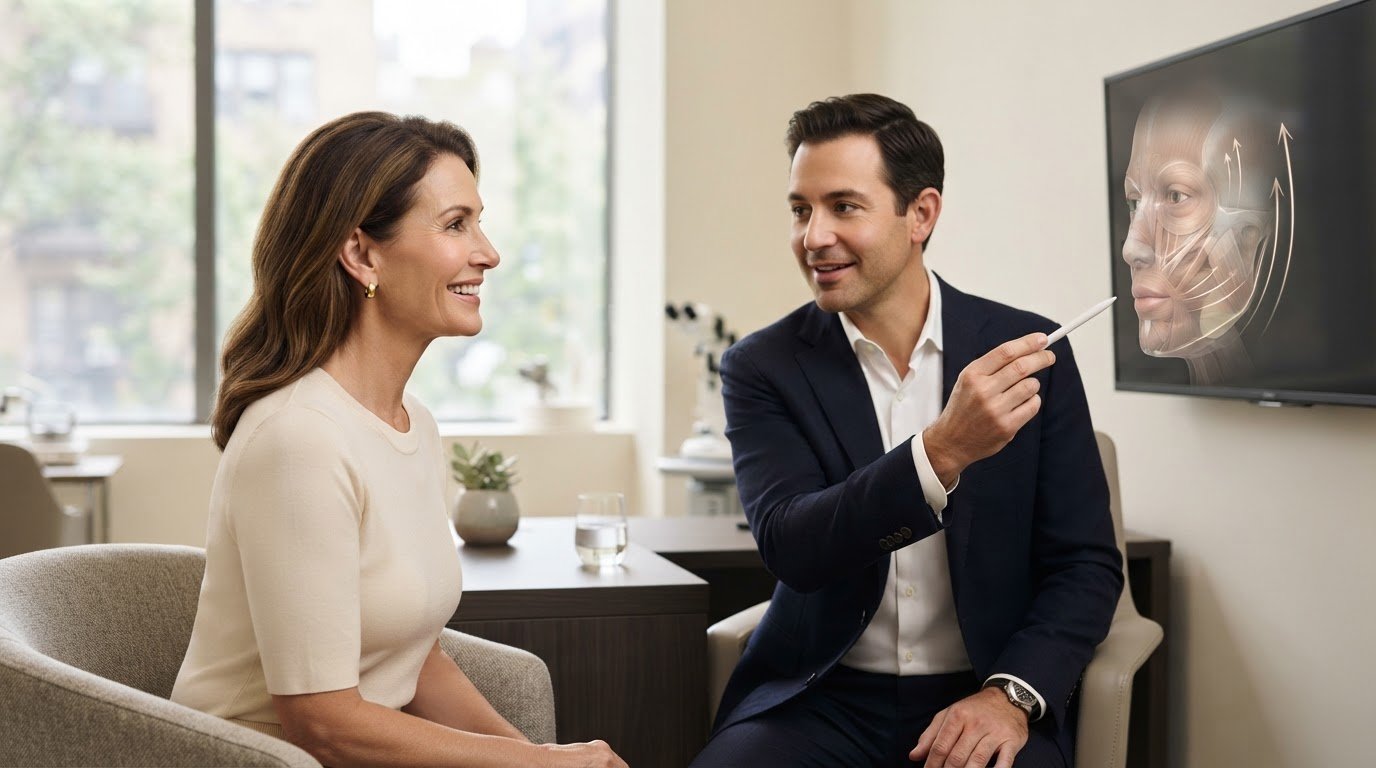
True facial youth isn’t achieved by stretching skin; it’s restored by rebuilding the foundation beneath it. For decades, the greatest fear surrounding facial surgery has been ending up with an artificial, distorted, or windblown appearance. If you feel overwhelmed by conflicting marketing jargon and worry about investing your recovery into a procedure that relapses prematurely, your hesitation is completely justified. Selecting the right path requires understanding which long lasting facelift techniques address the anatomical root of facial descent rather than merely masking it with superficial tension.
In this definitive guide, you’ll discover which surgical approaches deliver authentic, enduring rejuvenation by releasing deep retaining ligaments rather than relying on cutaneous pull. Ahead, we break down the structural mechanics of modern facial repositioning, examine the clinical differences between surface lifts and true deep plane release, and explore how pairing surgical mastery with cellular nutrition ensures your outcome beautifully stands the test of time.
Key Takeaways
- Understand why relying on cutaneous tension triggers premature sagging due to viscoelastic skin creep, whereas releasing deep retaining ligaments provides enduring structural stability.
- Discover how long lasting facelift techniques like the deep plane approach release and vertically reposition descending fat compartments rather than simply folding tissue with surface plication.
- Learn why true vertical vectors and tension-free skin closure are critical to avoiding a distorted appearance and restoring natural midface volume.
- Uncover how pairing sub-SMAS structural repositioning with cellular nutrition and tissue microcirculation preserves vitality long after surgical healing.
- See why anatomical tissue quality and structural laxity matter far more than chronological age when tailoring the right surgical path for your face.
The Anatomy of Facial Aging: Why Superficial Lifts Fail Over Time
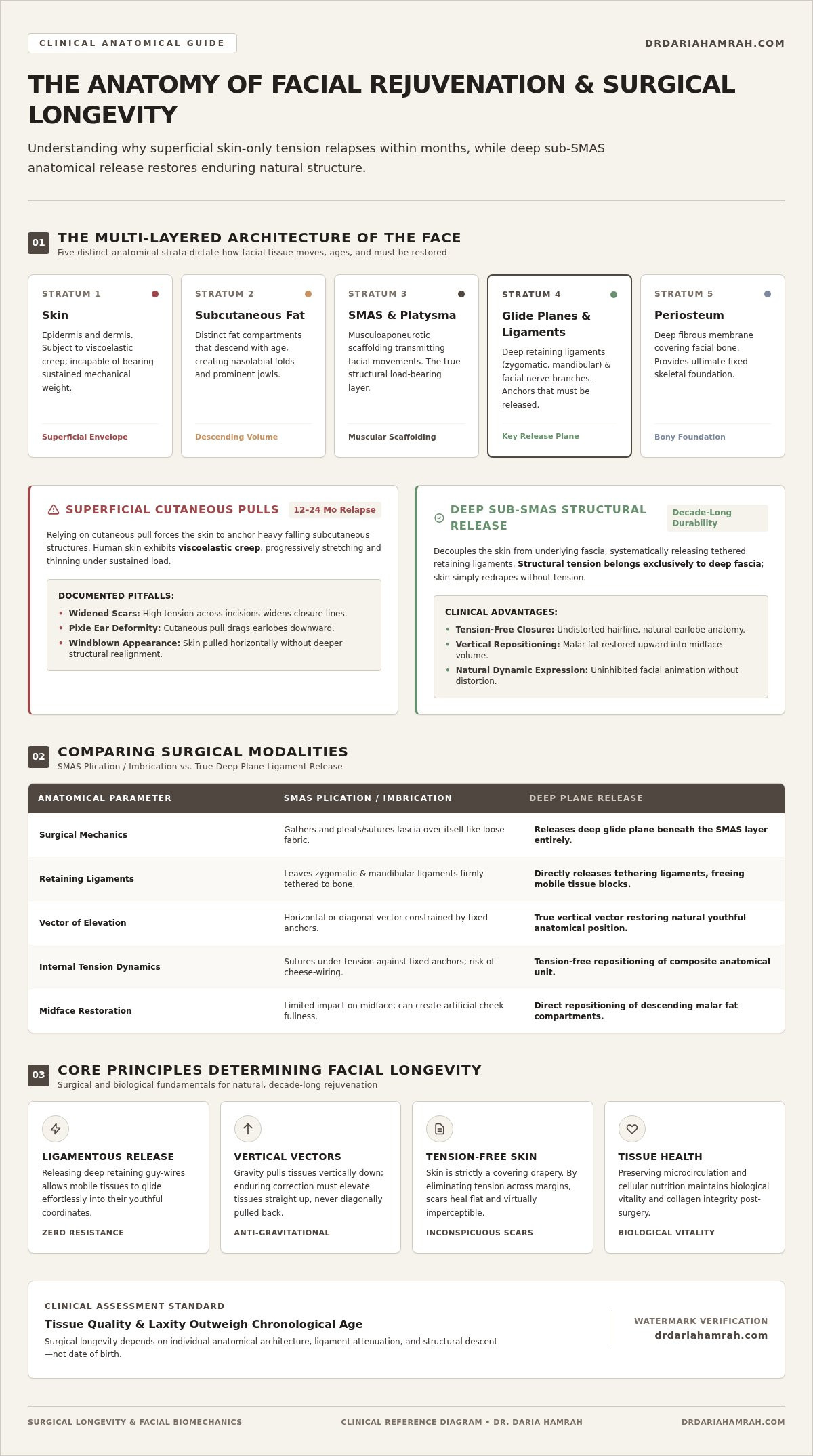
Facial aging isn’t merely skin-deep. It’s a three-dimensional biological event involving the synchronized descent of skin, subcutaneous fat compartments, and retaining ligaments. When a procedure treats aging as a simple excess of skin, failure is inevitable. Biomechanically, human skin exhibits viscoelastic “creep,” meaning it progressively stretches and thins when subjected to sustained tension. Pulling the surface tight creates temporary smoothness, but as the dermal fibers give way, the original laxity returns. Lasting rejuvenation requires repositioning the structural muscular architecture beneath. As noted in this comprehensive overview of rhytidectomy, modern surgical approaches have steadily evolved from simple skin excision toward true deep-layer anatomical realignment. Today’s long lasting facelift techniques prioritize lifting the foundational layers so the skin doesn’t bear mechanical load.
The Multi-Layered Architecture of the Face
To understand why surface pulling fails, one must examine the face’s five distinct anatomical strata:
- Layer 1: Skin (epidermis and dermis)
- Layer 2: Subcutaneous fat
- Layer 3: Superficial Musculoaponeurotic System (SMAS) and platysma muscle
- Layer 4: Deep glide planes, retaining ligaments, and branches of the facial nerve
- Layer 5: Periosteum (the deep fibrous membrane covering the bone)
The SMAS acts as an internal fibrous scaffolding, transmitting muscular contractions into expressive facial movement. Anchoring this continuous sheet to the facial skeleton are strong retaining ligaments, such as the zygomatic and mandibular ligaments. In youth, these biological guy-wires hold soft tissues firmly against gravity. Over decades, repetitive micro-movement and collagen loss cause these ligaments to attenuate, allowing the overlying fat pads to cascade downward into the jowls and nasolabial folds.
The Mechanical Pitfalls of Skin-Only Lifts and Mini-Lifts
When a surgeon pulls only the cutaneous layer without releasing deep retaining ligaments, the skin is forced to anchor heavy falling tissues. It simply can’t handle that weight. The biological response to chronic cutaneous tension is predictable: widened surgical scars, hairline distortion, and dragged earlobes known as “pixie ears.” Quick mini-lifts often rely on this flawed premise, which is why their results frequently relapse within twelve to twenty-four months.
Enduring facial restoration demands an absolute rule of biomechanics: structural tension belongs exclusively to the deep fascia, while skin must simply redrape without tension. Only by decoupling the skin from the underlying SMAS and releasing stubborn ligamentous tethering can long lasting facelift techniques achieve both natural expression and decade-long durability.
Comparing Modern Surgical Techniques: SMAS Plication vs. Deep Plane
Navigating surgical terminology can feel disorienting, yet evaluating long lasting facelift techniques requires a clear understanding of the mechanical differences between folding tissue and releasing it. While skin excision lifts only trim dermal excess, advanced procedures manipulate the deeper SMAS layer. However, how a surgeon engages that layer determines whether your result lasts five years or well over a decade. As highlighted in this review of facelift techniques explained by the ASPS, surgical options range from conservative surface folding to comprehensive sub-fascial release. For a detailed clinical breakdown of these structural differences, review our comprehensive deep plane facelift analysis.
SMAS Plication and Imbrication: Mechanics and Limitations
SMAS plication involves gathering and suturing the muscular fascia over itself, much like taking a pleat in loose fabric. While imbrication trims a strip of the fascia before suturing, neither method releases the retaining ligaments anchoring tissue to bone. Instead, they apply tension against those fixed biological anchors. This limitation forces the lift into an unnatural horizontal or diagonal vector, often creating a tight cheek contour. Over time, internal tension can cause sutures to cheese-wire through soft tissues, leading to gradual loss of definition within five to seven years.
Deep Plane Dissection: Releasing the Retaining Ligaments
Deep plane surgery enters the sub-SMAS glide plane to surgically release the zygomatic, masseteric, and mandibular retaining ligaments. Once freed from these deep tethers, the fallen midface malar fat pad, jowl tissue, and platysma lift smoothly as a single composite unit. This maneuver elevates the cheeks naturally without requiring synthetic fillers to recreate lost volume. Because the tension rests entirely on resilient fibrous fascia, the overlying skin drapes effortlessly across the new contour without stretching.
Longevity Comparison: Why Composite Elevation Outlasts Surface Fixes
The durability gap between these approaches stems directly from tissue mechanics:
- SMAS Plication: Typically maintains structural integrity for five to seven years before ligamentous tension pulls against the suture line.
- Deep Plane Dissection: Consistently provides ten to fifteen years of stability because tissues heal flat in their newly elevated anatomical home.
A composite deep plane lift doesn’t simply fight gravity with sutures; it effectively resets the biological clock, allowing your facial tissues to age naturally from a renewed foundation. If you’re exploring the right structural strategy for your unique facial anatomy, consult with Dr. Daria Hamrah to discuss a personalized surgical approach.
Essential Surgical Principles That Determine True Facelift Longevity
Enduring facial restoration isn’t an accident of genetics or good luck. It’s the direct result of adhering to uncompromising biomechanical rules during surgery. While many methods claim to be long lasting facelift techniques, true aesthetic endurance hinges on three core pillars: precise vector orientation, deliberate tension distribution, and seamless cervical integration. When a surgeon respects these structural mandates while meticulously preserving local microvascular perfusion, tissues heal with maximum biological vitality, safeguarding your result for decades.
Vertical Vectors vs. Lateral Pulling: Avoiding the Windswept Look
Gravity pulls facial tissues straight down. Biomechanically, the correction must mirror the descent by elevating tissues vertically. Traditional techniques often pulled skin laterally toward the ears, which flattens the natural midface curves, widens the corners of the mouth, and produces an unnatural windswept appearance. True vertical repositioning returns descending soft tissue directly over the bony malar prominences, naturally replenishing youthful cheek fullness without synthetic intervention.
Tension-Free Skin Redraping: The Secret to Invisible Healing
Healthy skin should act as a delicate biological mantle, never a structural load-bearer. When deep fascial structures support the entirety of the mechanical weight, the skin can be trimmed and closed with zero tension. This tension-free approach yields crucial aesthetic and physiological advantages:
- Undetectable Scarring: Eliminates tension-induced scar widening around the temporal hairline and post-auricular sulcus.
- Preserved Auricular Landmarks: Prevents blunting of the tragus and eliminates downward traction on the earlobes.
- Enhanced Microcirculation: Unstretched subdermal capillary beds maintain robust blood flow, accelerating wound healing and cellular regeneration.
Cervical Architecture: Integrating the Platysma for an Enduring Jawline
The jawline doesn’t exist in isolation. It forms a single mechanical continuum with the anterior neck. Treating facial descent while ignoring platysmal laxity creates an abrupt, unnatural transition along the mandibular border. Lasting submental definition requires midline platysmaplasty, securing the separated muscular edges together like an internal corset, paired with lateral fascial suspension. For complete facial and cervical harmony, structural repositioning must integrate comprehensive neck lift surgery to eliminate vertical banding and rebuild a sharp, resilient jawline that ages in graceful unison with the midface.
Biological Longevity: Cellular Health and Post-Surgical Tissue Maintenance
Surgical mechanics establish internal architecture, but cellular biology dictates whether that structure endures. Even the most sophisticated long lasting facelift techniques depend fundamentally on healthy microcirculation, robust tissue oxygenation, and steady collagen synthesis during the extended remodeling phase. If the overlying skin loses its dermal density and cellular vitality, secondary laxity can soften the crisp definition created below. True aesthetic longevity emerges when deep structural release is matched by proactive biological care. To explore how systemic wellness fuels wound healing and tissue resilience, examine our complete framework for cellular health and skin longevity.
Targeted Nutritional Support and Longevity Renew Supplementation
Rebuilding severed microvascular beds and forming cross-linked type I and III collagen requires high-grade metabolic substrate. Targeted nutritional protocols featuring bioavailable vitamin C, zinc, amino acids, and systemic antioxidants downregulate acute inflammatory cascades while driving angiogenesis. Clinical supplementation with Longevity Renew Supplements delivers these essential micronutrients directly to healing tissues, neutralizing free radicals and significantly accelerating post-surgical microvascular recovery and lymphatic clearance.
Preserving Dermal Density with Medical-Grade Skincare
A surgical lift elevates muscular planes, but it does not change epidermal cell turnover, repair ultraviolet damage, or erase surface dyschromia. Sustaining your investment requires daily intervention at the cellular level:
- Cellular Signaling: Prescription-strength retinoids and growth-factor peptides stimulate dermal fibroblasts, continuously renewing the extracellular matrix.
- Lipid Barrier Reinforcement: Medical-grade skincare formulations containing pure ceramides and biomimetic lipids prevent transepidermal water loss and soothe healing tissues.
- Photoprotection: Daily broad-spectrum zinc oxide sun defense shields newly redraped tissues from UV-driven matrix metalloproteinases that degrade youthful elastin.
Energy-Based Modalities to Complement Deep Plane Surgery
Surgical repositioning restores volume; surface therapies restore radiance. Once deep tissue remodeling stabilizes around three to six months post-procedure, non-ablative laser skin treatments gently stimulate superficial epidermal renewal without disturbing sub-SMAS anchoring. Pairing deep structural lifting with surface laser therapy creates a luminous, unified result that resists premature breakdown.
Transforming your facial contour requires both surgical precision and metabolic vitality. Schedule a consultation with Dr. Hamrah to develop an integrated structural and cellular rejuvenation plan tailored to your anatomy.
Choosing the Right Technique: Personalized Assessment for Enduring Results
No two faces age along identical vectors. Selecting the appropriate surgical intervention requires an exacting diagnostic evaluation rather than relying on a predetermined surgical template. Chronological age matters far less than biological tissue quality, deep structural descent, and baseline skeletal support. When assessing candidates for long lasting facelift techniques, a specialist must look past surface wrinkles to diagnose the underlying mechanical architecture. To discover how multi-modality planning aligns with individual facial dynamics, explore our comprehensive guide on facial rejuvenation.
Key Diagnostic Criteria: Bone Structure, Soft Tissue, and Laxity
A thorough pre-operative assessment balances multiple structural variables:
- Skeletal Framework: High zygomatic projection and a well-defined mandibular angle offer natural shelves for repositioned soft tissues, while receding bone structure requires distinct vertical vectoring.
- Tissue Quality: Evaluating dermal thickness and intrinsic solar elastosis dictates how the skin will redrape once internal tension is removed.
- Severity of Descent: Pronounced jowls, deep labiomandibular grooves, and midface hollows cannot be resolved with surface folding; they require complete sub-SMAS ligamentous release.
- Periorbital Integration: Incorporating blepharoplasty or brow repositioning harmonizes the upper face with the restored jawline, preventing an unbalanced aesthetic.
The Longevity Facelift Philosophy: Elevating the Standard of Care
The Longevity Facelift pioneered by Dr. Daria Hamrah elevates surgical rejuvenation beyond traditional mechanics. By combining meticulous sub-SMAS release and vertical repositioning with proactive cellular optimization, this philosophy bridges surgical architecture and biological endurance. Choosing a dual-degree, board-certified facial cosmetic surgeon dedicated exclusively to the face ensures an intimate mastery of the intricate glide planes surrounding the facial nerve. The goal is never to look altered, pulled, or frozen, but to appear rested, vibrant, and authentically yourself.
Planning Your Next Steps Toward Lasting Facial Harmony
Preparation empowers you to make informed decisions about your transformation. During your diagnostic consultation, ask direct questions about anatomical planes: Does the surgeon release the zygomatic and masseteric retaining ligaments? What specific vectors will be used to restore cheek elevation? How will incisions be hidden within natural anatomical boundaries? Settling and scar maturation continue through the first full year, but structural stability should endure for over a decade. Take the next step toward authentic transformation by consulting with Dr. Daria Hamrah to create a structural rejuvenation plan tailored to your distinct anatomy.
Invest in Enduring Structural Rejuvenation
Achieving authentic, decades-long restoration isn’t about pulling skin tighter; it’s about honoring human biology. The most effective long lasting facelift techniques succeed because they release deep retaining ligaments and reposition descending architecture along true vertical vectors. When you eliminate cutaneous tension, your facial expressions remain fluid, completely free from distorted or windswept artifacts.
Surgical architecture establishes the framework, but internal vitality preserves it. As a dual-degree, board-certified facial cosmetic surgeon dedicated exclusively to head and neck aesthetics, Dr. Daria Hamrah developed the Longevity Facelift to unite deep anatomical release with systemic wellness. By pairing sub-SMAS repositioning with Longevity Renew cellular nutrition, your tissues receive the biological support necessary to heal resiliently and age gracefully.
You don’t have to settle for fleeting fixes or artificial tension. Schedule a Consultation with Dr. Daria Hamrah to explore a bespoke surgical plan designed to renew your structural youth and empower your vitality for years to come.
Frequently Asked Questions
Which facelift technique lasts the longest?
The deep plane facelift provides the longest-lasting results of any modern technique, consistently enduring for 10 to 15 years. Unlike superficial procedures that rely on skin tension, this approach releases deep facial retaining ligaments and elevates the underlying muscle and fat compartments as a single structural unit. Because tissues heal without mechanical pull, the elevation remains securely anchored to the facial framework far longer than suture-suspended alternatives.
What makes a deep plane facelift last longer than a traditional SMAS lift?
A deep plane facelift lasts longer because it completely releases the zygomatic and mandibular retaining ligaments rather than folding tissue over them. Traditional SMAS plication relies on internal sutures to pull against anchored ligaments, which can loosen or cheese-wire through soft tissue over five to seven years. In contrast, sub-SMAS release allows tissues to be repositioned tension-free, allowing deep structures to heal permanently in their elevated position.
Can a mini facelift provide long lasting structural results?
A mini facelift rarely provides long-term structural results because it addresses only superficial skin and minor localized laxity without releasing deeper retaining ligaments. Due to the biological phenomenon of skin creep, dermal tissues stretch under tension, causing results to relapse within one to two years. For patients seeking true long lasting facelift techniques, addressing the underlying muscular architecture and repositioning descending fat pads is essential for lasting jawline and midface definition.
How many years does a deep plane facelift typically take off your appearance?
A deep plane facelift typically restores ten to fifteen years of youthful contour to the lower face, midface, and neck. Rather than creating an artificial stretch, releasing deep retaining ligaments allows fallen cheek fat pads to return to their anatomical position over the cheekbones. The outcome produces a natural, well-rested appearance where patients look like refreshed versions of themselves rather than surgically altered.
Will a long lasting facelift prevent natural aging in the future?
No surgical procedure stops the natural chronological aging process, but advanced structural techniques reset your biological baseline. After undergoing long lasting facelift techniques like a deep plane elevation, your facial tissues continue to age normally, yet you’ll consistently appear ten to fifteen years younger than if you had never had surgery. The newly anchored composite structures provide lasting resilience against future gravity and soft tissue laxity.
How does tension-free skin closure prevent the windswept facelift look?
Tension-free closure prevents the unnatural windswept look by placing the entire lifting force onto the sturdy fibrous SMAS layer rather than the fragile skin. When deep muscular structures bear all structural tension, the skin simply drapes across the new contour like silk over a frame. This eliminates horizontal pull, prevents distortion around the mouth corners and earlobes, and allows surgical scars to heal as faint, virtually undetectable lines.
What role do supplements and skincare play in extending facelift results?
While surgery repositions descending anatomy, cellular nutrition and medical-grade skincare sustain the biological quality of the skin itself. Targeted micronutrients, such as Longevity Renew Supplements, optimize microcirculation, accelerate wound healing, and support collagen cross-linking during post-operative remodeling. Complementing surgical elevation with daily photoprotection and active retinoids maintains dermal thickness and elasticity, preventing premature surface aging from compromising your deep structural investment.