
Did you know that facial procedures such as facelifts, neck lifts, and blepharoplasty can temporarily change the way your skin responds to everyday skincare? While the skill of your surgeon sets the foundation for your results, thoughtful postoperative skin care is an important part of the recovery process. It is completely normal to feel hesitant about washing your face after surgery. You want to keep the surgical area clean without causing unnecessary irritation, dryness, or friction.
Finding the right facial cleanser after plastic surgery is not simply about choosing the most expensive product. The goal is to select a gentle formulation that respects the skin barrier and fits within the postoperative instructions provided by your surgical team.
In this 2026 guide, we’ll explain what to look for in a cleanser after facial surgery, which ingredients may be appropriate during different stages of recovery, what to avoid while the skin is healing, and how cleansing can eventually become part of a long-term skin longevity routine.
Key Takeaways
- Understand why the skin barrier requires special attention after facial surgery and why gentle cleansing is important during recovery.
- Learn which cleanser characteristics may be appropriate for healing skin, including gentle surfactants, fragrance-free formulations, and barrier-supporting ingredients.
- Understand why the surgeon’s postoperative instructions should take priority over general skincare recommendations.
- Explore how cleansing can gradually transition from a protective postoperative step into part of a long-term skin longevity routine.
- Learn how the Longevity Facelift is a specific modification of the Deep Plane Facelift and why postoperative skincare should be individualized to the procedure and the patient.
Table of Contents
- The Biological Role of Cleansing in Surgical Recovery
- Decoding Ingredients for Healing Skin
- Choosing Facial Cleanser Brands for Postoperative Care
- The Post-Surgical Cleansing Protocol: A Step-by-Step Guide
- Beyond the Wash: Integrating Cleansing Into a Longevity Routine
- Securing the Future of Your Rejuvenation
- Common Questions About Post-Surgical Cleansing
The Biological Role of Cleansing in Surgical Recovery
Recovery from a facial procedure is an active biological process rather than simply a period of waiting. During healing, the skin and underlying tissues undergo inflammation, repair, remodeling, and gradual restoration of the protective barrier.
After surgery, the skin around incisions may be more sensitive, dry, swollen, or reactive than usual. This makes the cleansing step particularly important. The objective is to remove excess oil, debris, and products without creating unnecessary friction or irritation.
The appropriate cleansing routine depends on the procedure, incision locations, dressings, sutures, and individual healing process. Your surgeon’s postoperative instructions should always take priority over general skincare recommendations.
This careful approach to skin care is part of a broader philosophy of cellular health and skin longevity, where the goal is to support healthy tissue throughout recovery and beyond.
Maintaining the Skin Barrier Post-Incision
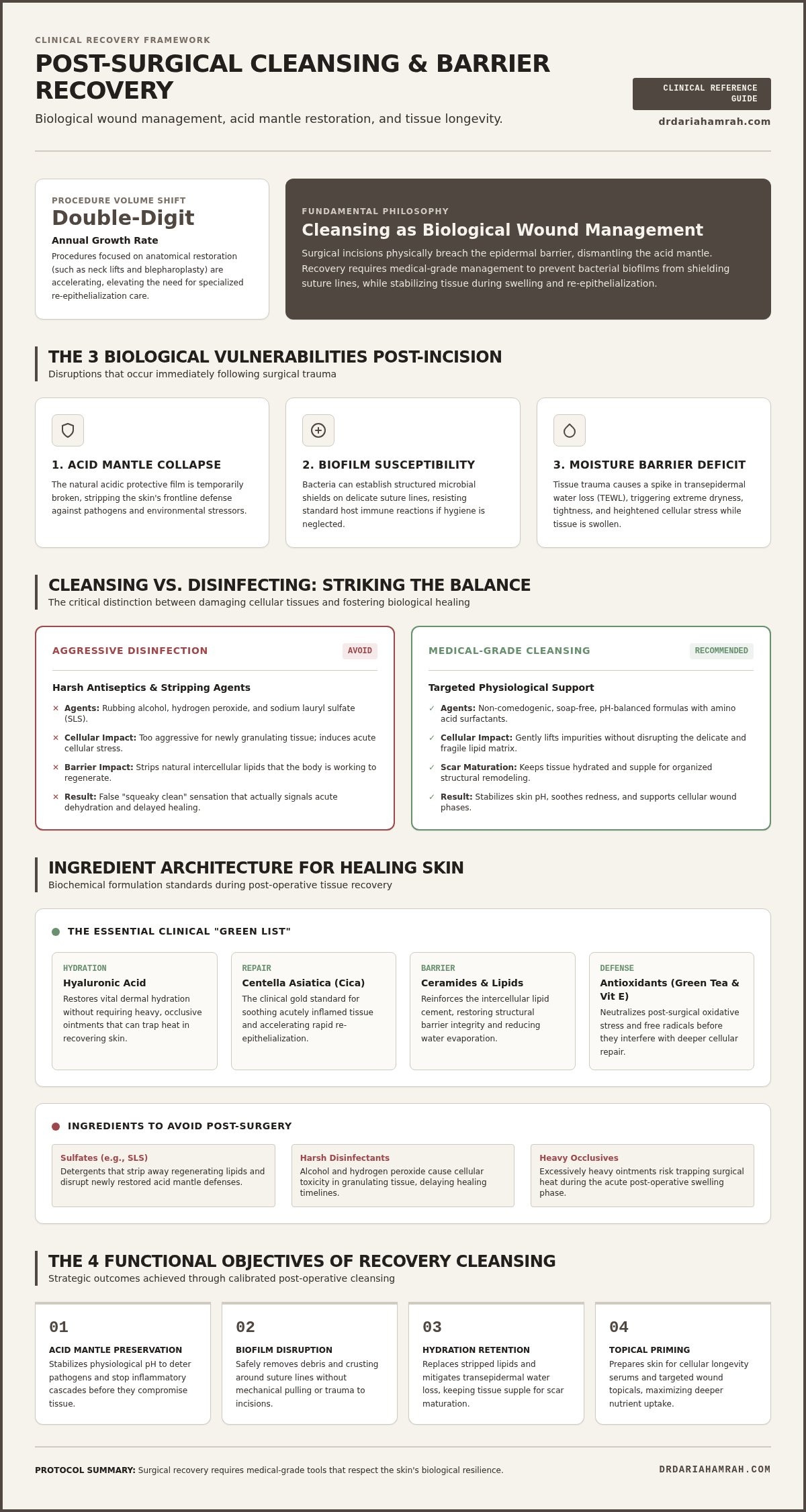
Surgical trauma temporarily changes the skin barrier. During this period, the skin may lose moisture more easily and become more sensitive to products that were previously well tolerated.
A gentle cleanser can help remove impurities without unnecessarily stripping the skin’s natural lipids. A formulation that is fragrance-free, non-abrasive, and appropriate for sensitive skin may be preferable during the recovery period.
However, cleanser should not be applied directly to fresh incisions unless your surgeon has specifically instructed you to do so.
As the incisions heal, your skincare routine can gradually become more comprehensive.
Cleansing vs. Disinfecting: Striking the Balance
More aggressive cleansing is not necessarily better cleansing.
Patients sometimes assume that alcohol, hydrogen peroxide, strong antiseptics, or heavily fragranced products will provide greater protection against infection. However, these products can be irritating to healing tissue and should not be used on surgical wounds unless specifically directed by the surgical team.
The purpose of a facial cleanser is generally to gently remove surface impurities. It is not a substitute for sterile wound care or prescribed postoperative treatment.
Following official guidelines for closed surgical wound care and your surgeon’s specific instructions is the safest approach.
Decoding Ingredients for Healing Skin
Choosing among the best facial cleanser brands for plastic surgery requires looking beyond marketing claims.
A postoperative cleanser should generally be gentle, easy to rinse, and unlikely to cause unnecessary dryness or irritation. The ideal product depends on the patient’s skin type, procedure, incision sites, and stage of recovery.
The Essential Ingredient “Green List”
Ingredients commonly found in gentle, barrier-supportive skincare include:
- Ceramides: Help support the skin’s natural lipid barrier.
- Hyaluronic acid: Helps attract and retain moisture.
- Glycerin: A humectant that helps maintain hydration.
- Panthenol: Can provide moisturizing and soothing properties.
- Centella asiatica: Commonly used in formulations designed for sensitive or irritated skin.
- Gentle surfactants: Help remove oil and debris without the aggressive cleansing effect associated with some stronger detergents.
The presence of an ingredient does not automatically make a product appropriate for postoperative use. The entire formulation matters, as does the patient’s individual tolerance.
Ingredients and Products to Approach Carefully During Recovery
Some ingredients that may be useful in an established skincare routine may be too irritating for freshly healing skin.
Depending on your procedure and surgeon’s instructions, you may need to temporarily avoid:
- Retinoids
- Alpha hydroxy acids such as glycolic acid
- Beta hydroxy acids such as salicylic acid
- Strong exfoliating treatments
- Physical scrubs
- Strong fragrances
- High-concentration active ingredients
These products can often be reintroduced gradually after the skin has healed and your surgeon has cleared them.
If you are unsure about your current regimen, explore medical-grade skincare options with your practitioner before making changes.
Choosing Facial Cleanser Brands for Postoperative Care
Selecting a cleanser after facial surgery should be based on formulation and suitability rather than simply choosing the most expensive or heavily marketed product.
A gentle cleanser can be appropriate whether it is sold through a physician’s office, medical skincare company, or conventional retail channel. What matters most is how the formulation interacts with your skin and whether it fits your recovery stage.
This is especially important after procedures involving larger areas of the face, such as a facelift or Longevity Facelift.
The Longevity Facelift is a specific modification of the Deep Plane Facelift, combining advanced deep plane techniques with a preservation-focused approach to facial rejuvenation. Because the procedure involves deeper facial structures, postoperative care should be individualized according to the surgical plan.
Examples of Gentle Cleanser Options
Several established skincare companies offer gentle cleanser formulations designed for sensitive or compromised skin.
Brands such as SkinCeuticals, EltaMD, and CeraVe offer cleanser options that may be appropriate for some patients depending on their formulation and individual needs.
However, no particular brand is appropriate for every postoperative patient. Your surgeon may recommend a specific cleanser based on your procedure, skin type, incision locations, and healing progress.
The safest approach is to follow your surgeon’s instructions rather than changing products simply because a cleanser is marketed as “medical-grade.”
The Value of Physician-Dispensed Skincare
Physician-dispensed skincare can be useful because your practitioner can coordinate the products with your overall treatment plan.
After surgery, your skincare routine may need to change several times as the skin moves from the immediate healing stage into barrier recovery and eventually long-term maintenance.
A customized regimen can help you determine when to introduce cleansers, moisturizers, sunscreens, retinoids, antioxidants, and other active products.
The goal is not to use the most products possible. It is to use the right products at the right stage of healing.
The Post-Surgical Cleansing Protocol: A Step-by-Step Guide
Touching your face for the first time after surgery can feel intimidating. It is natural to worry about disturbing sutures, irritating swollen tissue, or accidentally affecting the surgical result.
The key is to follow the specific cleansing instructions provided by your surgeon.
There is no universal day-by-day schedule that applies to every facial procedure. A facelift, neck lift, blepharoplasty, rhinoplasty, and other procedures can each have different wound-care requirements.
The Initial Healing Phase
Immediately after surgery, your surgeon may recommend avoiding direct cleansing of certain areas or using a specific wound-care solution.
Depending on the procedure, this may involve sterile saline, prescribed ointments, specialized dressings, or another postoperative protocol.
During this stage:
- Avoid rubbing or scrubbing the surgical areas.
- Do not pick at crusting or scabs.
- Keep dressings and incision sites exactly as instructed.
- Avoid hot water directly on healing areas.
- Use only products approved by your surgical team.
- Contact your surgeon if you notice unexpected drainage, worsening redness, increasing pain, fever, or other concerning symptoms.
Your surgeon’s instructions should always take priority over a general online cleansing schedule.
As the Skin Begins to Heal
Once your surgeon clears you to cleanse the face normally, a gentle cleanser can gradually become part of your daily routine.
Use clean hands and lukewarm water. Apply the cleanser with minimal pressure and avoid unnecessary friction around healing incisions.
Instead of aggressively drying the skin, gently pat it with a clean towel.
As healing progresses, your surgeon may allow you to gradually resume additional skincare products.
Returning to Your Normal Skincare Routine
The transition back to a complete skincare routine should be gradual.
Products containing retinoids, acids, strong antioxidants, exfoliants, or other active ingredients may need to be paused during the early healing period.
Once your skin has recovered and your surgeon has given you clearance, these products can potentially be reintroduced one at a time.
This gradual approach makes it easier to identify irritation and prevents the skin from being overwhelmed by multiple new products at once.
Beyond the Wash: Integrating Cleansing Into a Longevity Routine
Cleansing is one part of a larger skin longevity strategy.
Once the immediate postoperative period has passed, your cleanser should prepare rather than stress the skin. A well-tolerated cleanser removes excess oil, sunscreen, makeup, and environmental debris while allowing the rest of your skincare routine to function comfortably.
The vision of a Longevity Facelift extends beyond the operating room. The procedure addresses structural facial changes, while long-term skin care supports the quality and appearance of the skin covering those structures.
The Longevity Framework for Skin Health
Maintaining your results involves more than cleansing.
A comprehensive skin longevity routine may include:
- Gentle cleansing
- Consistent sun protection
- Appropriate moisturization
- Antioxidant support
- Retinoid therapy when appropriate
- Professional skincare treatments when indicated
- Healthy nutrition
- Adequate sleep
- Regular physical activity
- Avoidance of smoking
- Individualized medical care
The goal is consistency rather than complexity.
A simple routine that you can follow consistently is often more practical than an extensive regimen that causes irritation or becomes difficult to maintain.
Consulting Your Surgeon for a Custom Regimen
Every patient heals differently.
Your postoperative skincare routine should therefore be customized according to your procedure, skin type, incision locations, healing progress, medications, and previous skincare experience.
Your surgeon can tell you when it is appropriate to begin cleansing, moisturize the skin, resume sunscreen, introduce active ingredients, and return to professional treatments.
If you are ready to discuss your personalized rejuvenation and recovery plan, schedule a consultation with Dr. Hamrah.
Securing the Future of Your Rejuvenation
Your facial rejuvenation journey does not end when you leave the operating room. Recovery is an important part of achieving a natural and healthy-looking result.
Choosing an appropriate cleanser, following your surgeon’s wound-care instructions, avoiding unnecessary irritation, and gradually returning to your normal skincare routine can help support the skin during this transition.
The best facial cleanser brands for plastic surgery are not necessarily defined by price or marketing claims. The most appropriate cleanser is the one that fits your skin, your procedure, your stage of healing, and your surgeon’s recommendations.
The Longevity Facelift is a specific modification of the Deep Plane Facelift, designed to address deeper facial structures while maintaining natural facial movement and proportion. Long-term care of the skin complements this structural approach by supporting the health and appearance of the tissue over time.
Your recovery is an opportunity to establish a thoughtful skincare routine that can continue long after the initial healing period.
Explore Medical-Grade Skincare and Longevity Solutions
Common Questions About Post-Surgical Cleansing
When can I start washing my face with a cleanser after a facelift?
The timing varies depending on the procedure, incision locations, dressings, and your surgeon’s postoperative protocol.
Some patients may be cleared to begin gentle cleansing relatively early, while others may need to avoid certain areas until the incisions have progressed further in the healing process.
Always follow the specific instructions provided by your surgeon rather than relying on a fixed number of days.
Is it safe to use drugstore cleansers like Cetaphil or CeraVe after surgery?
Some gentle drugstore cleansers may be appropriate for postoperative skin, depending on the specific formulation and your stage of healing.
The fact that a cleanser is sold at a drugstore does not automatically make it inappropriate, just as a “medical-grade” label does not automatically make another product better.
Look for a gentle, non-abrasive formulation and confirm with your surgical team before using it on healing skin.
What happens if I accidentally get cleanser in my surgical incisions?
If cleanser accidentally comes into contact with a healing incision, do not panic.
Follow your surgeon’s wound-care instructions. Depending on the product and procedure, your surgeon may recommend gently rinsing the area with clean water or sterile saline.
Avoid scrubbing the incision. If you develop persistent irritation, increasing redness, drainage, significant pain, or another concerning change, contact your surgical team.
Can I use a Clarisonic or silicone face brush during surgical recovery?
Mechanical cleansing devices should generally be avoided around healing incisions unless your surgeon specifically clears them.
Brushes and vibrating devices can create friction or pressure that may irritate healing tissue.
Once your skin has fully recovered, your surgeon can advise you on whether a cleansing device is appropriate for your long-term routine.
How many times a day should I wash my face while healing from plastic surgery?
There is no universal frequency for every postoperative patient.
Over-cleansing can contribute to dryness and irritation, while insufficient cleansing may allow excess oil and debris to accumulate.
Your surgeon may recommend a specific schedule based on your procedure and skin condition. Once you are cleared for routine cleansing, a gentle morning and evening routine may be appropriate for many patients.
Should I use warm or cold water when cleansing my face post-operatively?
Lukewarm water is generally preferable to very hot water because excessive heat can increase discomfort and may worsen temporary flushing or swelling.
Very cold water is not necessary unless specifically recommended.
The priority is gentle cleansing without temperature extremes, pressure, or friction.
What are the signs that my cleanser is irritating my surgical skin?
Possible signs include persistent burning or stinging, unusual redness, itching, dryness, tightness, scaling, or the development of a rash.
If irritation develops, stop using the suspected product and contact your surgical team for guidance, particularly if the reaction is occurring close to an incision.
Are there specific cleansers recommended for rhinoplasty versus a facelift?
The ideal cleanser can differ depending on the procedure.
Rhinoplasty patients may have different skincare concerns because of nasal splints, swelling, tape, or congestion, while facelift patients may need to focus more carefully on the skin around the ears, hairline, jawline, and other incision areas.
There is therefore no single cleanser that is universally recommended for every procedure. Your postoperative regimen should be tailored to your surgery and healing progress.
When can I restart my regular skincare products after surgery?
The answer depends on the product and your stage of healing.
Gentle cleansing and moisturization may return earlier, while retinoids, exfoliating acids, strong active ingredients, and professional treatments may need to remain paused for longer.
Your surgeon can tell you when each product is appropriate to reintroduce.
What skincare should I use after a Longevity Facelift?
The Longevity Facelift is a specific modification of the Deep Plane Facelift, and postoperative skincare should be individualized to your surgical plan and skin condition.
During the early recovery period, the focus is generally on gentle cleansing, appropriate wound care, hydration, and protection from environmental irritation.
As the skin heals, your surgeon may gradually reintroduce medical-grade skincare, sunscreen, antioxidants, retinoids, or other treatments appropriate for your skin.
The goal is to support the health and appearance of your skin while allowing the deeper facial tissues to heal appropriately.