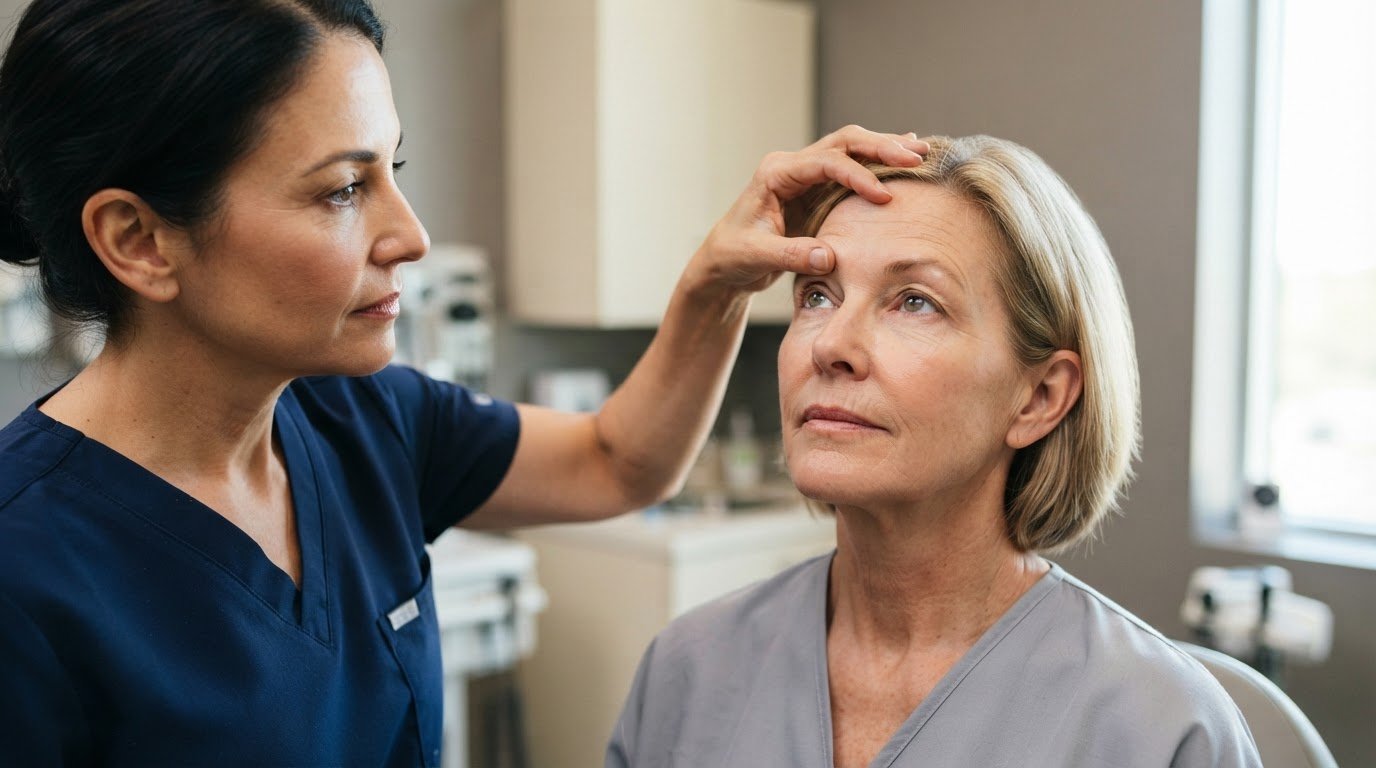
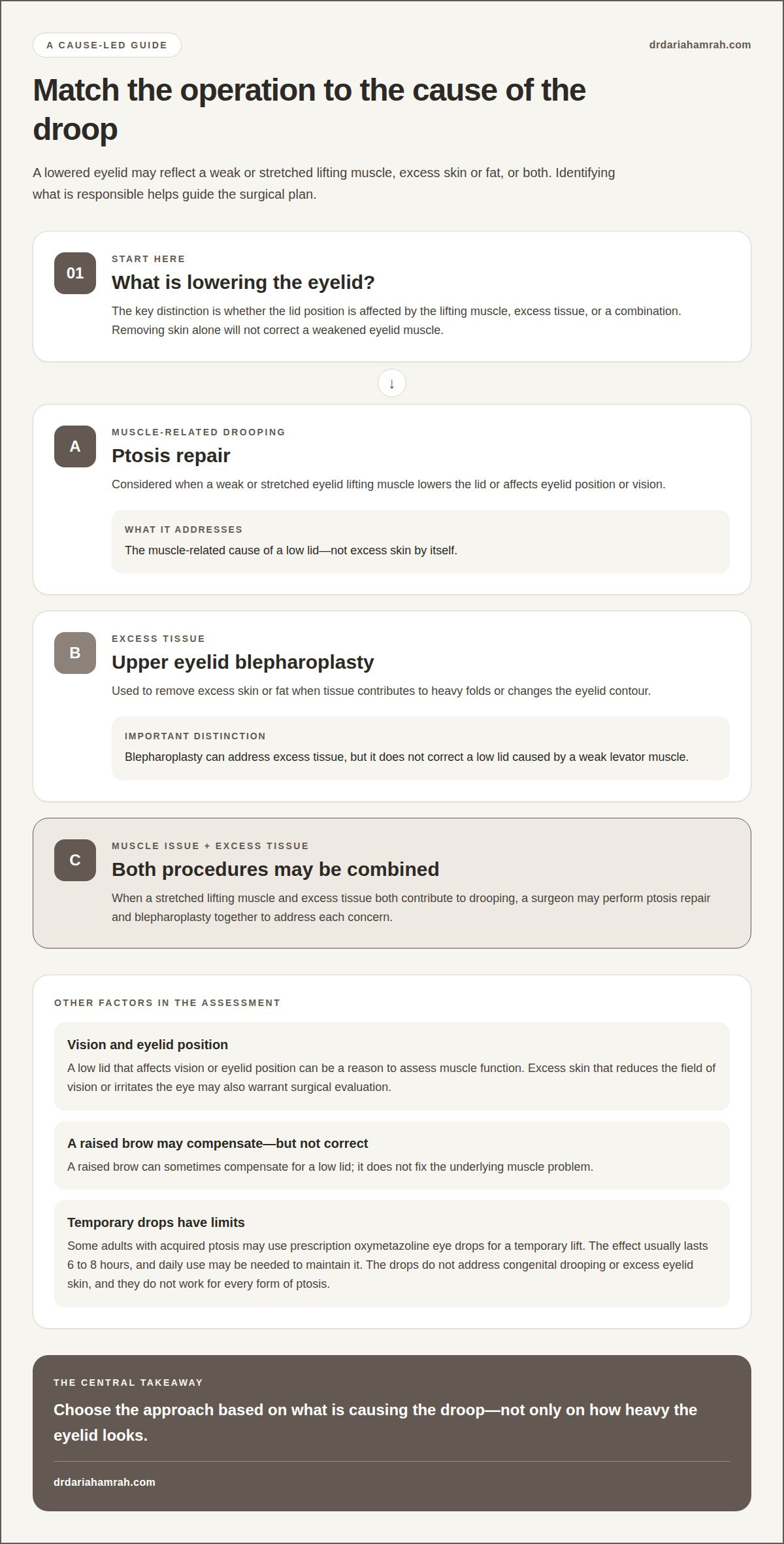
A drooping eyelid doesn’t always call for the same operation. The right droopy eyelid surgery options depend on whether the lid is lowered by a weak or stretched lifting muscle, excess skin or fat, or a combination. Ptosis repair addresses muscle-related drooping, while upper eyelid blepharoplasty removes excess tissue; both procedures may be combined when both issues are present.
It’s understandable to focus on visible heaviness or changes to your field of vision, but choosing among droopy eyelid surgery options starts with identifying what is causing the lid to droop. The distinction matters: removing excess skin alone won’t correct a weakened eyelid muscle.
This guide explains the differences between ptosis repair and blepharoplasty, how surgeons select an approach, and what recovery may involve. You’ll also learn when a brow lift may be relevant and how functional concerns can shape treatment planning. Most patients can return to work and light activities within seven to 10 days, while bruising may take longer to settle. Understanding the options can help you approach the decision with clearer expectations and a more informed sense of what each procedure is designed to address.
Key Takeaways
- The cause of eyelid drooping guides treatment: muscle-related ptosis and excess eyelid skin may call for different procedures.
- When both a stretched lifting muscle and excess tissue contribute to drooping, surgeons may combine procedures to address each concern.
- Recovery varies by procedure; plan for temporary swelling or bruising and follow your surgeon’s instructions for activity and eye care.
- Functional concerns, such as impaired vision, can affect how eyelid surgery is considered for insurance coverage.
- Levator muscle function helps determine which ptosis repair approach may provide the appropriate lift.
What Is Eyelid Surgery?
Surgery can address drooping caused by excess tissue, a weakened lifting muscle, or both. Identifying the cause helps distinguish ptosis repair from blepharoplasty, which addresses different changes around the eyelid.
Causes of Acquired Ptosis
Acquired ptosis is eyelid drooping that develops after birth, often when the levator muscle weakens or stretches with age. Trauma, nerve damage, and previous eye surgery can also cause the upper lid to descend. Congenital ptosis, by contrast, is present from birth. The cause matters because a muscle problem calls for a different approach from loose skin alone.
Some adults with acquired ptosis may use prescription oxymetazoline eye drops for a temporary lift. The effect usually lasts 6 to 8 hours, and daily use may be needed to maintain it. These drops don’t work for every form of ptosis. They don’t address congenital drooping or excess eyelid skin, so they aren’t a substitute for treatment directed at those causes.
When Ptosis Repair Is Recommended
Ptosis repair may be recommended when a weak or stretched eyelid muscle lowers the lid and affects vision or eyelid position. A raised brow can sometimes compensate for a low lid, but it doesn’t correct the underlying muscle problem. Distinguishing the cause helps match the procedure to the problem instead of treating only its visible appearance.
In children, untreated ptosis can interfere with visual development and may contribute to amblyopia or astigmatism. A child with a drooping eyelid should see an eye care specialist promptly for assessment. In adults, sagging skin that reduces the field of vision or irritates the eye can also warrant surgical evaluation. The effect on vision is an important part of assessing the problem.
Ptosis repair targets muscle weakness or stretching, while upper blepharoplasty removes excess skin or fat. When both a stretched muscle and excess tissue contribute to drooping, surgeons may perform both procedures together. Blepharoplasty can reduce heavy folds that disrupt the eyelid’s natural contour, but it won’t correct a low lid caused by a weak levator muscle.
Choose a board-certified surgeon with experience assessing eyelid function and performing the procedure suited to the cause. For American patients, the price depends on the case and is provided after a quote request; factors include whether treatment addresses muscle, excess tissue, or both, and the surgical setting.
Postoperative recovery and restrictions
Recovery after eyelid surgery unfolds in stages, with activity limits and healing time shaped by the procedure. Before surgery, the care team reviews the treatment plan. Ptosis surgery commonly uses local anesthesia with sedation, while frontalis sling fixation is usually performed under general anesthesia.
After surgery, follow your surgeon’s instructions for incision care, eye protection, and follow-up. Risks include dry or itchy eyes, temporary blurred or double vision, difficulty closing the eyes, infection, visible scarring, asymmetry, and reactions to anesthesia. There is no single success rate that applies to every case; results depend partly on the underlying eyelid problem and the procedure selected.
Activity Limits During Recovery
Activity limits reduce strain on healing eyelid tissue and help lower infection risk. Ohio State recommends avoiding eye makeup, saunas, swimming, and contact lenses for two weeks after droopy eyelid surgery. NYU Langone doctors may recommend limiting activities for up to a week while the eye heals. Follow the individual care plan, especially if the eyelid feels dry or doesn’t close fully.
According to Ohio State, patients may resume regular activities within two to three days after surgery, but returning to routine activity doesn’t mean every restriction ends. Removable stitches are taken out five to 10 days after surgery, according to Ohio State. A follow-up appointment is usually scheduled several days to one week after ptosis surgery, allowing the surgeon to assess healing and eyelid position.
Recovery Expectations and Timeline
Recovery expectations include temporary swelling, bruising, and possible dryness, with visible healing continuing after daily activities resume. Mild swelling or bruising after ptosis repair typically lasts one to two weeks. Ohio State reports that bruising may remain for four to six weeks before fully healing, so early appearance isn’t the final result.
Most patients can return to work and light activities within seven to 10 days, depending on their surgeon’s guidance. Ohio State says patients often feel ready to go out in public and return to work about 10 to 14 days after surgery. These timelines describe different milestones: light activity may come before bruising has completely faded. Plan around the nature of your work and the recovery instructions provided.
After ptosis surgery, a larger exposed eye surface can become prone to dryness. New or worsening dry-eye symptoms may appear during the few weeks after surgery. Frontalis sling fixation can also cause incomplete eye closure, which usually resolves two to three months after surgery. Report troublesome symptoms during follow-up, rather than changing eye care or activity restrictions on your own.
For broader facial goals beyond eyelid position, facial treatment planning can help connect your priorities with appropriate options.
Insurance coverage
Insurance decisions often depend on whether drooping affects vision or is primarily a cosmetic concern. Understanding that distinction helps explain the condition’s effects and what the surgical plan is intended to address.
Medical Necessity for Coverage
Medical necessity refers to treatment for a functional problem, such as eyelid drooping that interferes with vision. It matters because insurers often distinguish functional concerns from cosmetic changes. Ohio State says drooping eyelids that cause poor vision are often treated with procedures covered by insurance, while cosmetic procedures often aren’t. The reason for surgery, not just the eyelid’s appearance, is central to this distinction.
Insurance Coverage for Surgery
Insurance coverage for eyelid surgery depends on whether the procedure addresses a vision problem or an appearance goal. A surgeon’s assessment connects eyelid position with its effect on sight. For example, excess upper-lid skin that obstructs vision raises a different concern from under-eye puffiness treated for appearance alone. A forehead or brow lift also addresses a different source of heaviness.
Keep the treatment plan clear. If a proposed operation includes functional and cosmetic goals, describe them separately. The surgical plan might address eyelid tissue that limits vision while also aiming to refine appearance. Separating the purposes helps explain what each part of the procedure is designed to do.
Clinical documentation can help explain the functional concern. The surgeon’s examination describes eyelid position, the tissue contributing to drooping, and the effect on vision. Your account adds practical context, such as difficulty seeing objects above eye level or needing to raise your forehead to see clearly. These details show how the condition affects daily activities.
Before treatment, review the plan and coverage decision with the insurer and surgical team. Ask which procedure is being considered, what functional problem it addresses, and how any cosmetic component is distinguished. If coverage is denied, ask for the reason in writing and whether your plan allows additional clinical documentation or an appeal. Policies and review processes differ, so the insurer’s decision and plan documents guide next steps.
Coverage discussions should distinguish upper- and lower-eyelid concerns. Upper-eyelid skin that interferes with vision is different from lower-lid bags or puffiness treated for appearance. A combined plan can have separate goals, so the surgeon’s explanation should identify each one rather than describing the whole operation as purely cosmetic or functional.
Clear communication supports an informed decision. Before proceeding, make sure the proposed treatment, its purpose, and the insurer’s coverage determination align. This helps you understand which part of the plan addresses vision and which focuses on appearance.
Levator muscle function and procedure selection
The levator muscle raises the upper eyelid, so its function helps determine which surgical approach can correct ptosis. A useful assessment separates muscle-related drooping from brow position, excess skin, and lower-eyelid changes.
When levator function is strong, external levator advancement is commonly recommended. The surgeon reaches the muscle through an incision usually hidden in the upper-eyelid crease, then tightens it to raise the lid. This approach directly addresses the lifting mechanism while placing the incision in a natural facial fold.
Internal ptosis surgery works from beneath the eyelid, without a skin incision. It can shorten Mueller’s muscle or the levator muscle. Surgeons typically shorten Mueller’s muscle when less elevation is needed, and the levator when more lift is needed. The choice depends on how much correction the eyelid position requires.
If eyelid muscle function is poor, a frontalis sling may be selected. This procedure typically connects the upper eyelid to the forehead muscle with a silicone rod. The forehead then helps lift the lid. This is a different mechanical solution from tightening a functioning levator, and may suit cases where that muscle cannot provide enough lift.
Not every heavy upper eyelid is caused by ptosis. Ohio State explains that an eyebrow lift raises eyelid position by lifting the eyebrow or forehead. This may be relevant when brow descent contributes to heaviness. Upper blepharoplasty, by contrast, removes excess eyelid tissue. If muscle weakness and excess skin both contribute, ptosis repair and blepharoplasty may be performed together.
Lower-eyelid symptoms call for a separate assessment. Ohio State says lower blepharoplasty reduces under-eye bags or lower-eyelid puffiness and can be performed with upper blepharoplasty. It addresses lower-lid tissue rather than the levator muscle, so it doesn’t correct upper-lid ptosis by itself. Matching each symptom to its anatomical cause keeps the treatment plan focused.
Eyelid procedures may also be combined with a brow lift, facelift, fat grafting, skin resurfacing, or injectables. Combination planning considers which facial changes share a treatment goal and which need separate procedures. For example, upper-lid muscle weakness and lower-eye bags involve different structures, even when both affect overall facial appearance.
The central decision is functional: strong levator action can support muscle advancement or internal shortening, while poor function may point toward a sling. Brow position, excess skin, and lower-lid puffiness add separate considerations. Matching the approach to the anatomy helps explain why similar-looking drooping can call for different procedures.
Functional blepharoplasty
Functional blepharoplasty addresses excess upper-eyelid skin when it interferes with vision or irritates the skin. It can also improve the eyelid’s appearance, but its medical purpose is to reduce the physical effects of heavy tissue. A patient whose upper-lid skin narrows the field of vision has a different concern from someone seeking an appearance change alone.
During surgery, the surgeon may remove excess skin, remove or reposition bulging fat pads, and tighten underlying muscles if needed. These adjustments address the structures contributing to eyelid heaviness. For example, removing skin can reduce a fold that rests over the lashes, while addressing a bulging fat pad targets puffiness rather than skin laxity.
The goal is thoughtful correction, not maximum removal. According to Ohio State, removing too much skin can prevent the eyelids from closing and increase the risk of dry eye and eye infections. Preserving enough tissue for comfortable closure is therefore part of balancing function and appearance. A surgical plan should account for both the visible fold and how the eyelid moves.
Removing too much fat can also change the contour around the eye. Ohio State notes that some patients may develop a sunken-eye appearance if too much natural fat around the eye socket is removed. Any fat removal or repositioning should reflect the patient’s anatomy, not a general preference for less volume. The surrounding facial structure matters to a natural-looking result.
Functional improvement can include better peripheral vision when overhanging skin blocks part of the visual field. Blepharoplasty may also reduce drooping skin, define the upper-eyelid crease, and improve eye symmetry. These effects are distinct from changing the eyes themselves: eyelid surgery doesn’t change their fundamental shape or color.
There are limits to what blepharoplasty addresses. It doesn’t eliminate dark circles, which may relate to pigmentation or visible blood vessels rather than excess eyelid tissue. Nor does it correct every cause of a low eyelid. The planned treatment needs to target the structure responsible for the specific concern, such as skin, fat, or muscle.
Potential complications include hematoma or seroma, temporary blurred or double vision, dry or itchy eyes, and difficulty closing the eyes completely. Other risks include visible scarring, asymmetry, infection, and an adverse reaction to anesthesia. These possibilities underscore why careful tissue preservation and a clear functional goal matter in surgical planning.
To discuss whether eyelid surgery aligns with your functional and appearance goals, schedule a conversation about your eyelid concerns.
Dr. Daria Hamrah
Dr. Daria Hamrah is a facial cosmetic surgeon whose perspective can help clarify eyelid concerns and facial balance. If you’re weighing ptosis repair, treatment for excess skin, or the difference between functional and cosmetic goals, a focused conversation can explain what each approach is designed to address and help you identify relevant questions.
Her practice offers facial rejuvenation services, including the Deep Plane Facelift (Longevity Facelift), rhinoplasty, Botox, and Hydra-facials. These address different concerns, so they are not substitutes for treatment directed at drooping eyelids. The appropriate next step depends on the cause of the droop and your goals.
Contact Dr. Daria Hamrah to discuss your eyelid concerns and explore an informed path forward.
Make your next step an informed one
Choosing among droopy eyelid surgery options starts with clarifying what matters most to you: comfortable vision, eyelid function, appearance, or a balance of these goals. Your anatomy and priorities can guide a thoughtful discussion about the next step.
Dr. Daria Hamrah offers blepharoplasty as part of her facial cosmetic surgery practice. A conversation about droopy eyelid surgery options can connect your concerns with an approach suited to your goals.
Contact Dr. Daria Hamrah to discuss your options and take the next step with clarity and confidence.
Frequently Asked Questions
What are drooping eyelids?
Drooping eyelids describe an upper lid that sits lower than expected or excess skin that hangs over the lid. The appearance can come from different structures, so the term alone doesn’t identify the cause. For example, a low lid may reflect the lifting muscle, while a heavy fold may come from loose skin. That distinction helps guide treatment.
What is ptosis?
Ptosis is the medical term for a drooping upper eyelid, often related to the muscle that lifts it. It may be present from birth or develop later. Acquired ptosis can follow aging, trauma, nerve damage, or previous eye surgery. Because a low lid and excess skin can look similar, assessing eyelid position and movement helps distinguish ptosis from skin-related heaviness.
Can both eyes be treated at the same time?
Yes, both eyes can be treated in the same surgical plan when the assessment supports addressing them together. The eyelids may have different causes or positions, so the plan can account for differences between them. For example, one lid may droop more, or excess skin may be more noticeable on one side. Treatment planning considers each eye while aiming for a balanced appearance.
Is ptosis surgery only for older adults?
No. Ptosis can be congenital, meaning present from birth, or acquired later in life. A child with a drooping eyelid should be assessed promptly by an eye care specialist because eyelid position can affect visual development. In adults, the decision to consider surgery depends on the cause and effects of drooping, not age alone. The approach follows the eyelid’s condition and function.
What Doesn’t Blepharoplasty Do?
Blepharoplasty doesn’t change the fundamental shape or color of your eyes. It also doesn’t remove dark circles, which may result from pigmentation or visible blood vessels rather than eyelid tissue. For example, removing excess upper-lid skin won’t correct discoloration beneath the eyes. Understanding these limits helps align expectations with the procedure’s purpose: addressing eyelid tissue, contours, or puffiness, not every feature around the eyes.
What Should I Expect During My Blepharoplasty Consultation?
Expect a discussion of your eyelid concerns, the changes you hope to address, and whether they relate to excess skin, fat, or muscle. Be ready to describe functional effects, such as difficulty seeing above eye level, as well as your appearance goals. You can also discuss whether one or both eyelids concern you and ask how the proposed procedure relates to your anatomy and priorities.
What happens if ptosis is left untreated?
Untreated ptosis can obstruct part of the visual field, especially when the upper lid sits low. In children, eyelid drooping can interfere with visual development and may contribute to amblyopia or astigmatism, so prompt assessment matters. Adults may notice that the lid blocks their sight or that they raise their forehead to see clearly. The effects depend on the eyelid’s position and the person’s needs.
When is ptosis repair medically necessary?
Ptosis repair may be medically necessary when eyelid drooping interferes with vision or creates a functional problem, rather than being an appearance concern alone. For instance, a low upper lid that blocks sight differs from a cosmetic request to refine the eyelid crease. A clinical assessment connects eyelid position with its effect on vision. Insurance coverage often distinguishes procedures that address poor vision from cosmetic surgery.