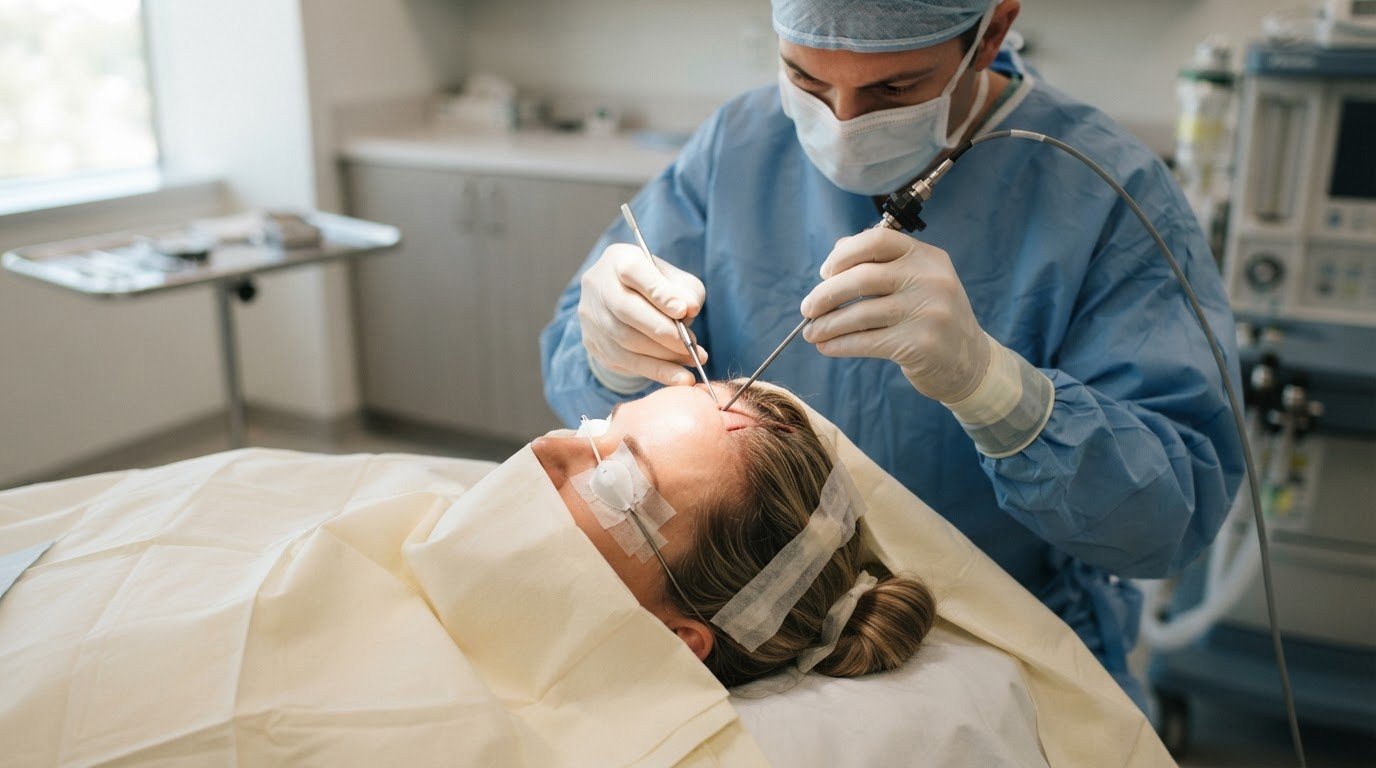
A brow lift for frown lines can soften vertical lines between the brows when the procedure addresses the muscles that create them. Its primary effect is to reposition the brows, so it doesn’t necessarily smooth every forehead wrinkle. The incision approach and the muscles treated shape the result.
It makes sense to expect a brow lift to affect the lines that can make you look tense or concerned. But vertical frown lines and horizontal forehead wrinkles form differently, and treating one area doesn’t automatically resolve the other.
Here, you’ll learn how a brow lift may affect different types of wrinkles, how endoscopic techniques use small hairline incisions and a camera to guide treatment, and what to discuss with a surgeon. Understanding the differences can help you focus on the changes you want and the approach that may address them.
Key Takeaways
- A brow lift mainly changes brow position; its effect on vertical lines between the brows can differ from its effect on horizontal forehead creases.
- Learn how endoscopic techniques use small incisions hidden in the hairline and a camera to guide work beneath the skin.
- Compare incision approaches by considering their placement, the tissue addressed, and how each may relate to your hairline and goals.
- Use recovery expectations as part of planning: swelling and bruising can affect when you feel ready to return to work and regular activities.
- Prepare to discuss which muscles and areas contribute to your concerns, your medical history, and the treatment approach with your surgeon.
What Is a Brow Lift?
A brow lift, also called a forehead lift, repositions the brow and adjusts tissues beneath the forehead. This surgery can change the appearance of a heavy or lowered brow and may soften some lines between the eyebrows. A brow lift for frown lines focuses on the brow area, but it doesn’t erase every crease. The effect depends on which muscles and tissues the technique addresses.
Who is a good candidate for brow lift surgery? It may suit adults concerned about a low or heavy brow, including patients commonly seeking surgery from their late 40s through their 60s and beyond. The concern matters more than age alone: brow position, facial anatomy, skin, and the source of the lines all shape treatment planning.
Endoscopic surgery is a minimally invasive surgical approach, not a nonsurgical treatment. The surgeon makes several small incisions within the hairline, then uses an endoscope, a narrow camera, to guide adjustments beneath the skin. Compared with an open approach, it involves minimal skin removal and a more limited lift. It may suit cases where modest repositioning is appropriate for the forehead and brow.
Brow lift surgery is generally performed as an outpatient procedure, so patients return home the same day. Swelling and bruising may occur during the 10 days following surgery. If bandages are used, they’re removed within one to three days. As incisions heal, temporary numbness or itching can occur and should diminish with time. These changes can influence how soon the forehead’s appearance feels settled.
Plan recovery around the incision, healing, and your surgeon’s instructions. Hairline stitches are removed one week after surgery. Most people return to work or school within 10 to 14 days, while strenuous exercise and heavy lifting should be avoided for a few weeks. Mount Sinai advises avoiding strenuous activities for two weeks after forehead and brow lift surgery. Follow-up visits let the surgical team assess healing and incision sites.
How long do brow lift results last? Results can last many years or even decades, although aging may gradually reduce them. Healing continues beyond the early recovery period, so the first days of swelling don’t show the final appearance. For example, a patient returning to work after 10 to 14 days may still be healing. Recovery milestones and long-term changes are distinct parts of the surgical timeline.
Does Endoscopic Brow Lifts Reduce Forehead Wrinkles?
An endoscopic brow lift changes brow position and adjusts underlying tissue through small hairline incisions. Its main purpose is elevation, not broad smoothing of the forehead. The effect on wrinkles depends on the muscles involved. Vertical lines between the eyebrows arise from different muscle activity than horizontal forehead creases, so the same surgical change may affect each area differently.
A brow lift for frown lines differs from Botox because surgery repositions brow tissue, while Botox temporarily relaxes targeted muscles. Botox and Dysport wrinkle results last 3-4 months on average. A brow lift’s effect depends on the approach and tissues treated, rather than temporarily reducing muscle movement.
What nonsurgical treatments can reduce frown lines? Botox can soften lines caused by repeated muscle contraction, while fillers and laser treatments may improve the appearance of facial lines and folds. Microneedling or PRP may also be considered in treatment plans for deeper forehead lines. The best fit depends on whether muscle movement, volume, or skin texture contributes most.
Horizontal forehead wrinkles often remain because the frontalis muscle must keep working after surgery. This muscle raises the brows, and repeated contraction can crease the forehead skin. A brow lift may change the brow’s position, but its effect on forehead wrinkles can vary. For example, someone with prominent lines when raising their eyebrows may still see those creases after brow elevation.
The relationship can be more nuanced. Some people contract the frontalis muscle to hold low brows upward, creating or deepening horizontal lines. Repositioning the brow may reduce that constant effort and help prevent permanent wrinkles from worsening. But the muscle still needs to raise the brows during expression, so existing creases may remain.
Vertical frown lines, sometimes called “11 lines,” form between the eyebrows through activity in the corrugator and procerus muscles. A coronal brow lift can directly excise muscles that contribute to these lines. That differs from an endoscopic approach, which uses limited incisions and may involve less direct muscle removal. The method matters because treating brow height alone isn’t the same as addressing the muscles creating a frown.
For a useful treatment discussion, note when each crease appears. Lines visible at rest may reflect lasting skin changes; lines that deepen with expression point to muscle activity. The surgeon can assess brow position, forehead movement, and whether eyelid heaviness contributes to repeated brow elevation. These observations help distinguish concerns suited to surgery from those better addressed with nonsurgical treatment.
If your main concern is movement-related frown lines, Botox treatment for frown lines may be part of a nonsurgical discussion. Laser skin treatments can address skin quality and surface texture. Matching treatment to the cause helps keep expectations focused on the change each option is designed to make.
Small hairline incisions and endoscopic guidance
An endoscopic brow lift uses three to five short incisions near the hairline. Through them, the surgeon guides an endoscope, a small camera, and instruments beneath the skin. The camera shows underlying tissue and muscles, helping guide adjustments without one long forehead incision. This approach uses minimal skin removal and a limited lift, so the degree of repositioning differs from that of more open techniques.
Incision placement is part of the treatment plan, not simply a choice between visible and hidden scars. In an endoscopic procedure, the small incisions sit within the hairline. A coronal brow lift instead uses an incision that runs from ear to ear across the top of the head, with most of it several centimeters inside the hairline. The scar is concealed within the hair.
Open and endoscopic approaches also differ in how much access they provide. The coronal incision gives the surgeon access across the forehead, while endoscopic instruments work through limited openings. For frown lines, the important distinction is what the operation does beneath the skin: repositioning the brow alone may not address the muscles producing vertical creases. A coronal lift can directly excise muscles that cause the “11 lines” between the eyebrows.
What happens during brow lift surgery, and how long is recovery? During an endoscopic procedure, the surgeon uses a camera and instruments through hairline incisions to adjust underlying tissue and muscles; the operation takes one to two hours. Mount Sinai says recovery from an endoscopic brow lift requires a few days of rest, while open brow lift surgery typically involves one to two weeks of downtime.
Swelling and bruising also vary by approach. Swelling after an endoscopic brow lift usually lasts one to two days, while swelling after an open brow lift may last up to a week. Brow lift scars are usually hidden in the hairline and become less noticeable after several months of healing. Numbness or itching can occur as incisions heal and diminish over time.
The upper eyelids can look heavier when the brow sits low, so an assessment should distinguish brow position from eyelid concerns. For example, lifting the brow may improve the appearance of hooded eyes, but the incision approach still needs to match the anatomy and desired degree of lift. A surgeon considers hairline position, forehead proportions, brow asymmetry, and whether vertical frown muscles need direct treatment. These details help determine whether endoscopic access or an open incision better suits the surgical goal.

Surgeon qualifications and individualized treatment planning
A sound plan starts by identifying what causes the concern: brow descent, eyelid position, muscle activity, or a combination. During an in-person or teleconference consultation, a board-certified plastic surgeon familiar with brow lift techniques can assess these features and discuss an endoscopic or open approach. The consultation should connect your goals with the anatomy being treated, rather than treating every forehead line as the same problem.
For example, sagging eyebrows can make the upper eyelids appear heavy, while excess eyelid skin can create a similar appearance. A brow lift changes brow position; eyelid surgery addresses tissue at the eyelid. When both concerns are present, the surgeon evaluates each area and explains whether combining procedures fits the treatment plan. Identifying the source of heaviness helps avoid choosing an operation that addresses only part of the concern.
Frown lines also deserve focused assessment. The corrugator and procerus muscles contribute to vertical lines between the eyebrows, while frontalis activity raises the brows and contributes to horizontal forehead creases. A surgeon may consider reducing the corrugator and procerus muscles when planning a brow lift. The assessment should also rule out eyelid ptosis as a possible cause of frontalis strain, since it can change how the brows and forehead work together.
Use the consultation to clarify the intended change and the trade-offs of each approach. Discuss incision placement, brow height, asymmetry, hairline position, and whether eyelid surgery is part of the plan. Ask how the proposed treatment addresses your specific concern, such as vertical frown lines at rest or heaviness above the eyelids. A clear explanation should distinguish brow repositioning from direct muscle treatment.
Cost depends on the individual case. Factors include the procedure, its complexity, and whether eyelid surgery is combined. Mount Sinai says insurance generally does not cover procedures or treatment done purely for cosmetic reasons. This distinction matters when the goal is appearance rather than correcting a functional concern. Discuss the planned procedures and their purpose together, so the financial and surgical plans reflect the same treatment scope.
Choosing a qualified plastic surgeon means looking for relevant credentials and familiarity with the specific technique under consideration. A surgeon experienced with both endoscopic and open approaches can explain why one incision pattern may better suit your forehead, hairline, and desired brow change. For instance, a low hairline or substantial brow asymmetry may affect the planning discussion. An individualized assessment links the surgical method to your anatomy, rather than treating incision choice as one-size-fits-all.
Brow lift effects on vertical frown lines
Vertical frown lines form between the eyebrows, where the corrugator and procerus muscles draw tissue inward. A brow lift can affect these lines when the surgical plan addresses the muscles, not just the brow’s position. That distinction matters: repositioning may change the expression around the forehead, while direct muscle treatment targets a source of the crease.
A coronal brow lift can directly excise muscles that cause the “11 lines” between the eyebrows. This can soften vertical frown lines through a different mechanism than simply raising the brows. The planned degree of muscle treatment is central to understanding the expected change. Ask which tissues the proposed procedure will reposition and whether the corrugator muscles will be addressed.
Not every line responds in the same way. A crease that appears mainly during frowning reflects active muscle movement; a line visible at rest may also involve lasting skin changes. For example, compare the space between your eyebrows when your face is relaxed and when you intentionally frown. That difference helps describe your concern during a consultation, though it doesn’t determine the operation on its own.
Brow position can also shape the surrounding facial expression. A lowered brow may contribute to a tense or tired appearance, while lifting it changes the position of the upper face. The goal isn’t simply to make the eyebrows higher. Brow height, natural asymmetry, and muscle action should be considered together so repositioning suits your facial structure.
Horizontal forehead creases follow another pattern. The frontalis muscle raises the eyebrows and may keep working to hold them up. Because that function remains necessary after surgery, a brow lift typically doesn’t significantly improve horizontal forehead wrinkles. In some cases, reducing the effort needed to hold low brows may help prevent permanent lines from worsening, but existing creases may remain.
This is why “frown lines” should be described precisely. Note whether they appear during expression, remain visible at rest, or accompany a low brow position. Also describe any difference between the two sides. These observations help a surgeon distinguish muscle-driven vertical lines from forehead creases and determine whether excess skin, brow position, or muscle activity is the main concern.
During facial rejuvenation planning, focus on the mechanism behind the line, not just its name. A brow lift may change position and treat selected muscles, while other lines may need a different approach. For an informed discussion of your goals, discuss your facial rejuvenation options with a qualified surgeon.
Dr. Daria Hamrah: Deep Plane Facelift (Longevity Facelift)
The Deep Plane Facelift (Longevity Facelift) is a broader facial rejuvenation option for people whose concerns extend beyond brow position or frown lines. Dr. Daria Hamrah’s approach is designed to support natural-looking results and long-term tissue health. It isn’t a substitute for evaluating the specific muscles or brow tissues involved in vertical lines. Rather, it may be worth discussing when facial aging concerns involve more than the upper forehead and brow area.
If your primary concern is frown lines, focus the conversation on what causes them and which treatment addresses that cause. If you’re also considering broader facial rejuvenation, Dr. Daria Hamrah can discuss whether the Deep Plane Facelift fits your goals. Contact Dr. Daria Hamrah to discuss your concerns and treatment options.
Make your next conversation focused and personal
Choosing a brow lift for frown lines starts with a clear description of what you want to change. Notice whether the lines appear with expression or remain visible at rest, and consider how brow position affects your overall expression. Bring those observations to a consultation, then discuss how the proposed plan relates to your facial anatomy and priorities.
That conversation can also clarify whether your goals extend beyond the brow. Dr. Daria Hamrah offers Botox, rhinoplasty, and the Deep Plane Facelift (Longevity Facelift), each addressing different concerns. The right next step is the one that aligns with your goals, not simply the procedure with the most familiar name.
Contact Dr. Daria Hamrah to discuss your options and explore a thoughtful path toward the changes you want.
Frequently Asked Questions
What Doesn’t a Forehead Lift Do?
A forehead lift doesn’t reliably erase every wrinkle or stop facial aging. Horizontal creases can remain because the frontalis muscle still raises the eyebrows, and lines visible at rest may involve lasting skin changes. The procedure also doesn’t correct eyelid ptosis simply by changing brow position. For example, if heaviness comes from the eyelid rather than a low brow, the treatment plan needs to address that distinction.
What is the ideal shape of youthful brows?
There isn’t one ideal brow shape for every face. Brow position and contour naturally vary with facial structure, age, and individual features. A balanced appearance generally considers how the brows relate to the eyes and forehead, rather than aiming for a fixed arch or height. For example, a pronounced arch may not suit someone’s natural features, while a subtle adjustment may better preserve their characteristic expression.
Can a brow lift reduce frown lines between the eyebrows?
A brow lift can reduce vertical frown lines when the surgical plan addresses the muscles that contribute to them. Raising the brows alone is different from treating the corrugator or procerus muscles. This distinction is useful when discussing a line that remains visible at rest versus one that appears mainly during frowning. Describe both situations during consultation so the treatment discussion focuses on the source of your concern.
What types of brow lift surgery are used to treat frown lines?
Common approaches include endoscopic, temporal, and coronal brow lifts. An endoscopic lift uses small hairline incisions and camera guidance. A temporal lift focuses on the outer brow. A coronal lift uses a longer incision across the scalp and can allow direct treatment of muscles associated with vertical frown lines. These techniques differ in access and tissue treatment, so the approach depends on brow position, hairline, and the specific lines being addressed.
How much does brow lift surgery cost in the United States?
Cost depends on the individual case. Factors include the surgical approach, the extent of treatment, and whether another procedure is planned at the same time. For a useful estimate, describe the areas you want addressed and whether your goals include eyelid changes alongside brow repositioning. The proposed treatment plan helps define the procedure’s scope and associated costs.
Does insurance cover a brow lift for frown lines?
Insurance generally doesn’t cover procedures or treatment performed purely for cosmetic reasons, according to Mount Sinai. A brow lift sought to change appearance is typically considered cosmetic. If your concern also involves vision or another functional issue, describe the specific effect during consultation and discuss the purpose of the proposed treatment. Coverage depends on the reason for care and the terms of your insurance plan.
What are the risks and side effects of a brow lift?
Possible effects include swelling, bruising, mild discomfort, dry eyes, numbness, and itching around healing incisions. Temporary or permanent nerve damage is also a listed surgical risk. For example, altered sensation near an incision may occur as tissues heal. Discuss your medical history, medications, and concerns before surgery, and follow the surgical team’s instructions during recovery. Knowing which changes are expected and which require prompt attention is part of informed preparation.
How do I find a qualified brow lift surgeon near me?
Look for a board-certified plastic surgeon familiar with the brow lift technique being considered. During consultation, ask the surgeon to explain how your brow position, forehead movement, hairline, and eyelids shape the plan. You can also discuss whether the concern involves muscle activity or excess skin, and how the proposed incision provides access to those tissues. A clear, individualized explanation helps you understand the reasoning behind the surgical approach.