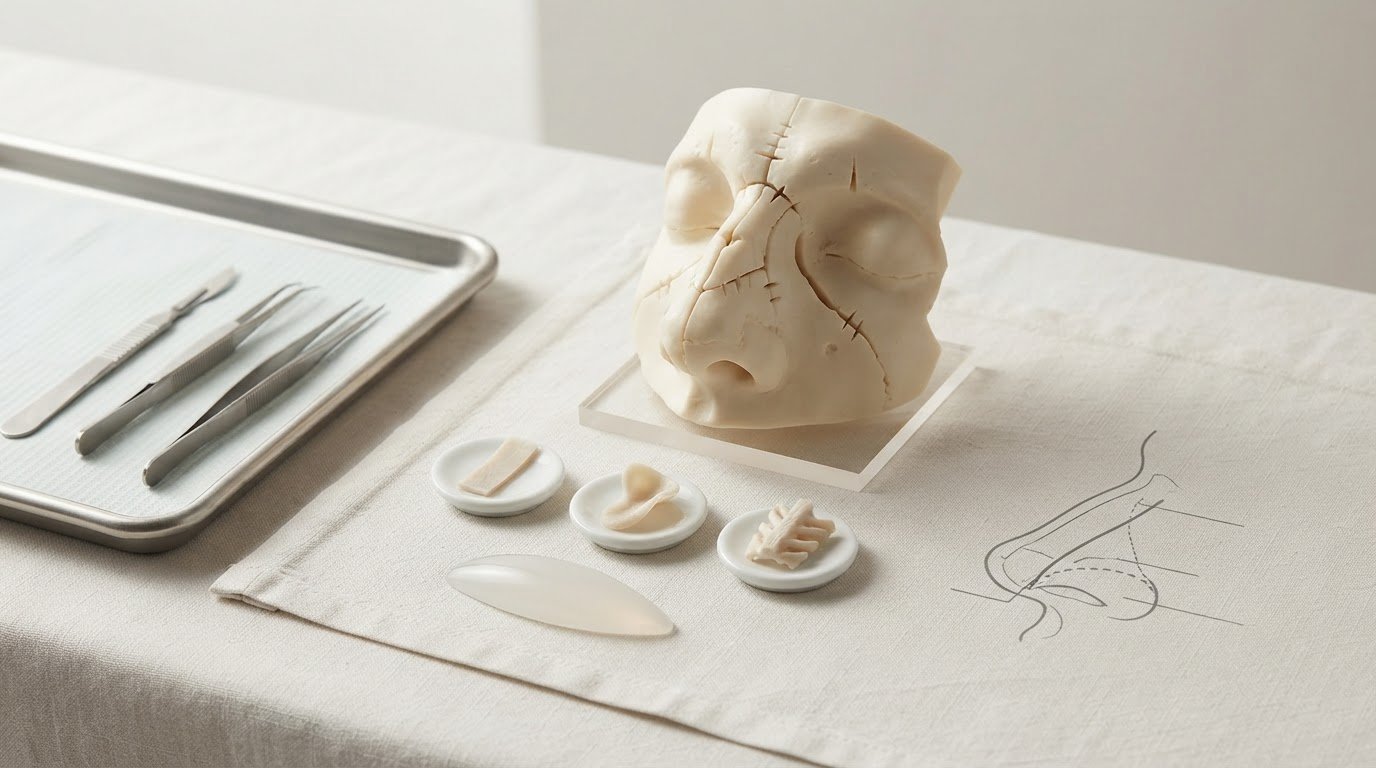
A balanced nasal bridge rarely comes from one technique alone. Bridge rhinoplasty techniques may involve reshaping or repositioning bone, adding height with cartilage grafts or an implant, and choosing an open or closed approach. The right combination depends on the goal, whether that is narrowing a wide bridge, reducing a bump, or building up a low profile.
It’s natural to focus on the bridge as a single feature, but its proportions are closely connected to the nasal tip and the rest of the face. A refined bridge may not create harmony if the tip’s projection or position is out of balance.
This guide explains how bridge rhinoplasty works and how bone reshaping, cartilage grafts, implants, and incision choices affect the plan. It also covers why surgeons may combine bridge work with tip adjustments or hump reduction, and how those choices influence the overall profile.
Key Takeaways
- Bridge augmentation can create the appearance of a narrower nose by adding height and changing proportions, without necessarily narrowing the nasal bones.
- Septal, ear, and rib cartilage each have different structural qualities and uses, so the graft material and placement affect the bridge’s shape and support.
- Synthetic implants avoid harvesting cartilage but have distinct considerations, including visibility, infection, and extrusion risks.
- Open and closed approaches differ in incision placement; bridge augmentation can be performed through either approach.
- Pairing bridge work with a tip adjustment or hump reduction can help the nasal profile look more balanced as a whole.
What Is Nose Bridge Rhinoplasty?
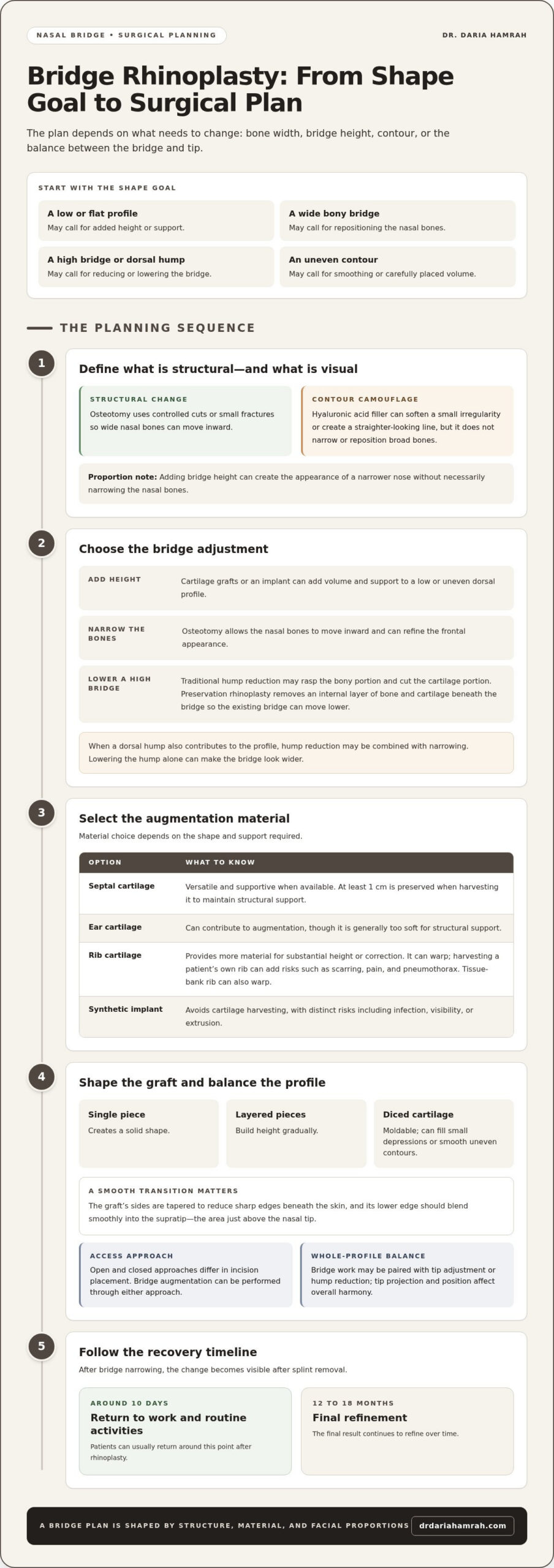
Nose bridge rhinoplasty reshapes the upper, bone-supported part of the nose to adjust its height, width, or contour. A surgical plan may narrow the bones, lower a high bridge, or add volume to change facial proportions.
Bridge Augmentation for a Narrowing Appearance
Bridge augmentation adds height to create the appearance of a narrower nose without necessarily narrowing its bones. A low bridge can make the nose look wider and the face less defined, so carefully placed cartilage grafts can change how the bridge relates to surrounding features. The graft’s shape and position influence the visible contour, while its sides and lower edge need smooth transitions beneath the skin.
This approach may suit someone concerned about a flat profile rather than excess width in the nasal bones. It changes proportion, not bone width.
Surgical Approaches to a Wide Bridge
Osteotomy narrows a wide bridge by making controlled cuts or small fractures that allow the nasal bones to move inward. A wide bridge often reflects larger nasal bones, commonly a genetic trait. Repositioning those bones can refine the frontal appearance. If a dorsal hump also contributes to the profile, surgeons may combine hump reduction with narrowing, since lowering the hump alone can make the bridge look wider.
In the United States, assess a surgeon’s board certification, rhinoplasty experience, and examples of comparable results. Osteotomy involves deliberate bone cuts or fractures. Cartilage grafts can warp, while synthetic implants carry risks such as infection, visibility, or extrusion.
Bridge rhinoplasty pricing depends on the case and is provided after a quote request; factors include the complexity of bone reshaping, graft or implant use, and whether procedures are combined.
Filler and Bridge Width
Hyaluronic acid filler can add volume to the nose in an office procedure, but it doesn’t physically narrow a wide bridge. Added volume may camouflage a small contour irregularity or create a straighter-looking line, but it cannot reposition broad nasal bones. Actual bone narrowing requires a surgical approach, such as osteotomy, rather than filler.
For example, filler may visually soften a shallow dip beside a bump, while bone reshaping addresses the width itself. The difference is structural change versus contour camouflage.
Lowering a High Nasal Bridge
A surgeon can lower a high bridge by reducing excess bone and cartilage, particularly when a dorsal hump creates the raised contour. Traditional hump reduction may involve rasping the bony portion and cutting the cartilage portion. Preservation rhinoplasty instead removes an internal layer of cartilage and bone beneath the bridge, allowing the existing bridge to move lower.
The surgical sequence is to assess the bridge and surrounding proportions, select the reshaping method, then perform the planned bone or cartilage adjustment. After bridge narrowing, patients can usually return to work and routine activities around 10 days after rhinoplasty; final refinement takes 12 to 18 months. The narrower bridge becomes visible after splint removal.
Septal, ear, and rib cartilage grafts
Surgeons address a nasal hump by reducing excess bone and cartilage, then refining any resulting irregularities. For a low or uneven dorsal profile, cartilage grafts or an implant can add support and height where needed.
Shaping Dorsal Grafts
A dorsal graft is shaped to raise or smooth the bridge and blend with the surrounding nasal contours. Its lower edge should transition smoothly into the supratip, the area just above the nasal tip. The graft’s sides are tapered to reduce sharp edges that could show beneath the skin.
These details matter because an abrupt edge can create a visible line instead of a continuous profile. For example, a graft that is too broad at the sides may look conspicuous even if it adds the intended height. Shaping takes the bridge, supratip, and skin into account.
Layered and Diced Cartilage
Surgeons can place cartilage grafts as a single piece, stack them in layers, or dice and wrap them in a membrane. A single piece creates a solid shape; layering builds height gradually. Diced cartilage is moldable and can fill small depressions or smooth an uneven dorsal contour.
One variation uses finely diced cartilage wrapped in a thin fascia graft. Septal cartilage is versatile: it provides support and can be softened by morselizing it into smaller pieces. When taking septal cartilage, surgeons preserve at least 1 cm to maintain the nose’s structural support.
Grafts and Implants for Bridge Correction
Grafts use the patient’s tissue to add height or support, while implants provide a synthetic alternative without harvesting cartilage. Septal cartilage can be useful when available. Ear cartilage can contribute to bridge augmentation, though it is generally too soft for structural support. Rib cartilage can provide more material for substantial height or correction.
Rib cartilage has trade-offs. It can warp, and harvesting a patient’s own rib cartilage can add risks such as scarring, pain, and pneumothorax. Tissue-bank rib cartilage is another option, but it can also warp. Synthetic implants avoid graft harvesting, yet carry risks including infection, visibility, or extrusion. Material choice depends on the shape and support required.
For a dorsal contour concern that calls for surgical reshaping, rhinoplasty care connects bridge planning with the nose’s overall structure.
Autologous tissue versus synthetic implants for bridge augmentation
Bridge augmentation adds height or support to the nasal dorsum using the patient’s own tissue or a synthetic implant. The options differ in material, placement, and potential complications, so the decision involves more than the desired contour. It also concerns the source of graft material and how an implant behaves within nasal tissue.
Autologous grafts use cartilage from the patient, commonly from the septum, ear, or rib. Using the patient’s own tissue avoids placing a synthetic material in the bridge. The amount and firmness available vary by source: septal cartilage can support shaping, while rib cartilage can provide material for greater augmentation. Harvesting rib cartilage adds a separate surgical site and risks including pain, scarring, and pneumothorax.
Donor rib cartilage from a tissue bank is another graft option. It avoids harvesting the patient’s rib, although it can warp, as can the patient’s own rib cartilage. Donor cartilage may also have a higher resorption risk than a patient’s own rib cartilage, though that risk is described as low. These distinctions matter when planning a stable dorsal shape.
Synthetic implants avoid graft harvesting and provide preformed material for bridge augmentation. Silicone, Medpor, and Gore-Tex are materials used for nasal bridge implants. Silicone implants can be visible and carry risks of scar capsule formation, infection, or extrusion. L-shaped silicone designs can place excessive tension on the nasal tip, while I-shaped designs appear to have a lower extrusion risk than L-shaped designs.
ePTFE, a form of expanded polytetrafluoroethylene, allows tissue ingrowth. This integration can make the implant difficult to remove, and the material is permanent. Synthetic implants can also cause delayed reactions, increase pressure at the nasal tip, or extrude through the skin. Silicone has a good track record in Asian rhinoplasty despite its generally poor reputation, and synthetic implants are more commonly used in patients with thicker skin.
The trade-off is especially relevant in revision surgery. A surgeon can remove an existing dorsal augmentation implant and replace it with the patient’s own tissue. This changes the material beneath the skin, but also requires graft planning and surgical work to create the new contour. Comparing these procedures means weighing the desired bridge height against harvesting, implant integration, and removal considerations.
In short, autologous tissue avoids a synthetic implant, while implants avoid harvesting graft material. The material, skin thickness, required support, and revision history all shape the choice. Neither option removes the need to consider its specific risks.
Closed rhinoplasty approach and hidden incisions
Open rhinoplasty uses an external incision and may leave an external scar. Closed rhinoplasty accesses the nasal bridge without an external scar. Both approaches can be used to augment the bridge, so incision choice depends on the planned correction and the access needed.
In closed rhinoplasty, incisions are placed inside the nose and remain out of view externally. This approach can be used for bridge augmentation, including placing material to raise the dorsum. The benefit is specific: there is no external incision scar, although the procedure still involves surgery and internal access to nasal structures.
Open rhinoplasty adds an external incision to the internal access. This can allow the surgeon to work on the nasal framework while viewing it directly. The external scar is a factor to discuss during consultation. The word “open” describes the surgical approach, not a different goal for the bridge.
Neither approach automatically determines the final contour. For example, someone seeking added bridge height may need a graft positioned along the dorsum, while someone seeking a smoother line may need work focused elsewhere. The planned change, graft or implant, and shape requiring correction all inform how the surgeon accesses the nose.
A consultation with a plastic surgery specialist should connect your goals to a defined surgical plan. Discuss whether the bridge needs augmentation, narrowing, or contour refinement, then ask how the proposed incision approach enables that work. Reference photos can help describe your desired profile, but the discussion should also consider what those images mean for your own nasal structure.
Useful questions focus on the approach, not just scar visibility. Ask where incisions will be placed, whether the planned bridge work can be performed through a closed approach, and why an open approach may be more suitable if proposed. For example, clarify how the chosen access supports placement and shaping of a dorsal graft.
During planning, the specialist can explain the intended steps and how each relates to the bridge. If you are considering an implant, ask how it will be positioned. If you are considering cartilage, ask how the graft will be shaped and blended. These details make the distinction between open and closed approaches more concrete.
Incision choice is one part of rhinoplasty planning, alongside material, bridge proportions, and the desired contour. A clear consultation should leave you understanding whether the approach uses an external incision, what correction it supports, and how it fits the overall plan.
Combining bridge rhinoplasty with other procedures
The nasal bridge doesn’t exist in isolation. Combining bridge reshaping with another rhinoplasty procedure can help the profile read as one balanced structure rather than separate features adjusted independently. For example, pairing bridge reduction with tip deprojection addresses both a raised dorsum and a tip that projects too far forward.
Tip projection describes how far the nasal tip extends from the face. It isn’t the same as nasal length, a distinction that matters in surgical planning. If you are concerned about a prominent profile, the tip’s projection may contribute to the overall appearance as much as the bridge. Adjusting both can bring the profile closer to your goal.
Bridge work can also be combined with tip adjustment to maintain proportion. The surgeon considers how the planned bridge height or contour will relate to the tip after reshaping. For instance, reducing a dorsal hump can make the bridge appear wider, so narrowing may be considered alongside hump removal. The combined plan accounts for how one change affects another.
A useful planning conversation starts with your concern and translates it into specific features. Is the priority a hump, a wide bridge, a low profile, an overprojected tip, or more than one feature? Bring photos of preferred noses if helpful, and discuss which qualities you want to achieve. The surgeon should also explain the expected surgical outcomes and how each planned procedure contributes.
Combining procedures doesn’t mean every feature should change. If you want a straighter bridge, you may not want a different tip. If you are seeking tip refinement, a bridge adjustment may help achieve proportion. The clearest plan links each proposed step to a defined concern and distinguishes cosmetic goals from structural changes, such as repositioning nasal bones or supporting the bridge with a graft.
Ask how each procedure changes the overall contour, what the surgeon intends to correct, and whether a proposed implant is permanent. For example, ePTFE implants are permanent and can be difficult to remove, a consideration if implant augmentation is part of the plan. Understanding this alongside planned bridge and tip changes supports informed consent.
Rhinoplasty planning is most useful when it connects the bridge, tip, and profile in one discussion. To explore how a tailored rhinoplasty plan could address your bridge and tip goals, arrange a consultation.
Dr. Daria Hamrah: Deep Plane Facelift (Longevity Facelift)
Dr. Daria Hamrah provides rhinoplasty and the Deep Plane Facelift (Longevity Facelift), which supports facial rejuvenation. If you’re considering bridge surgery, Dr. Hamrah can discuss how the planned changes relate to your nasal structure and facial proportions. A focused consultation can clarify whether your concern involves bridge height, width, a dorsal contour, or the relationship between the bridge and nasal tip.
The next step is a conversation about your goals, the techniques that may address them, and the trade-offs of grafts, implants, or bone reshaping. This keeps the decision grounded in your anatomy rather than a single feature or reference image.
Contact Dr. Daria Hamrah to discuss rhinoplasty and your nasal bridge goals.
Shape a Plan Around Your Goals
Your next step is to turn a general wish for change into a clear description of what you want your profile to express. Consider which features matter most, how you want your nose to relate to your other features, and what you hope will remain unchanged. These priorities can make a consultation more focused and personal.
Bring reference images if they help explain your preferences, while keeping the conversation centered on your own facial structure. Ask how different bridge rhinoplasty techniques could support your goals, what trade-offs each approach involves, and how the plan accounts for the nasal tip and overall proportions. A thoughtful discussion should leave you clearer about your options, without pressure to choose a procedure.
Dr. Daria Hamrah offers rhinoplasty for patients considering changes to the nasal bridge. If you’re ready to discuss your goals and questions, contact Dr. Daria Hamrah. Your informed next step can begin with a conversation grounded in your priorities.
Frequently Asked Questions
What Is the Nasal Bridge?
The nasal bridge is the upper part of the nose, where bone provides support beneath the skin. It meets the lower, cartilage-supported portion near the middle of the profile. For example, a bump along the upper bridge may involve both bone and cartilage, while a low bridge relates to its height and projection. These structural differences help explain why treatment focuses on different areas.
What are osteotomies?
Osteotomies are controlled cuts or small fractures in bone that allow a surgeon to reposition it. In rhinoplasty, they can bring the nasal bones closer together to narrow a wide bridge or adjust alignment. The term describes a bone-shaping step, not a complete rhinoplasty plan. For example, osteotomies may accompany hump reduction when the resulting bridge needs further refinement.
What is the Best Augmentation Rhinoplasty Method?
The right augmentation method depends on the height and support the nasal bridge needs. A small contour adjustment may call for shaped cartilage, while more substantial rebuilding may involve rib cartilage or an implant. Skin thickness, the desired profile, and existing nasal structure also matter. A useful consultation compares the intended contour with the material’s support and specific risks.
Will narrowing my bridge affect my breathing?
Bridge narrowing changes the nasal bones, while breathing also depends on the internal nasal passages and supporting structures. A change in outer width alone doesn’t explain how airflow may be affected. Before surgery, describe symptoms such as persistent blockage, difficulty breathing through one side, or prior nasal injury. Include these concerns in the surgical plan so functional and cosmetic goals are considered together.
What is bridge rhinoplasty and what nasal bridge concerns can it address?
Bridge rhinoplasty is surgery that changes the height, width, alignment, or contour of the upper nose. The bridge rhinoplasty techniques used depend on the concern: bone repositioning can address width or crookedness, while reshaping can reduce a bump. Augmentation can build up a low profile. Clarify your priorities by describing the feature that draws your attention in front-facing and side-profile views.
What techniques are used to augment or build up a low nasal bridge?
Surgeons can build up a low bridge with cartilage grafts or a synthetic implant. Cartilage may come from the septum, ear, or rib, and can be placed as a shaped piece, in layers, or in diced form. Hyaluronic acid filler can also add temporary volume without surgery, but it doesn’t move or narrow nasal bones. The aim is to choose an approach suited to the desired contour.
What materials are used for nasal bridge grafts, and how do they compare?
Bridge grafts can use septal, ear, or rib cartilage, including tissue-bank rib cartilage. Septal cartilage is versatile; ear cartilage is softer, while rib cartilage can provide material for greater height or structural correction. Rib cartilage can warp, and harvesting a patient’s own rib adds risks such as pain, scarring, and pneumothorax. Synthetic materials include silicone, Medpor, and Gore-Tex, each with considerations such as infection, visibility, or difficulty removing the implant.
What is the typical cost of bridge rhinoplasty in the United States, and what affects the price?
Pricing is provided after a quote request and depends on the case. Factors include the complexity of bone reshaping, whether a graft or implant is used, and whether procedures are combined.