
Can rhinoplasty refine a rounded nasal tip without making it look pinched or compromising support? It’s a reasonable concern. A bulbous appearance may reflect the shape or spacing of the tip cartilages, thicker skin, soft tissue, or a combination of factors. Rhinoplasty for bulbous tip refinement is therefore not a one-size-fits-all adjustment.
A natural-looking plan starts with understanding what contributes to fullness and how the tip relates to the rest of your face. You’ll learn what an individualized assessment considers, how surgical approaches may reshape or support the tip, and what to discuss about breathing, scars, and recovery before deciding.
Dr. Daria Hamrah, a board-certified facial cosmetic surgeon, approaches rhinoplasty as a conversation about your anatomy, goals, and facial balance. This guide explains the options and questions that can help you make that conversation more informed, with refinement considered in the context of both appearance and nasal structure.
Key Takeaways
- A rounded nasal tip describes an appearance, not a single diagnosis. Different anatomical features can contribute to fullness.
- Rhinoplasty for bulbous tip refinement is planned around individual anatomy, with attention to both definition and structural support.
- Clarify whether your priority is a more defined tip or a broader change in nasal shape, and discuss the trade-offs of each goal.
- Prepare for an informed decision by organizing your goals, health history, questions, and any breathing concerns.
- An individualized discussion with Dr. Daria Hamrah can connect your goals with facial balance and the considerations of your nasal anatomy.
What Does a Bulbous Nasal Tip Look Like, and Why Can It Occur?
A bulbous nasal tip looks rounded, broad, or less defined. The term describes appearance, not a diagnosis or one specific anatomical problem. A useful distinction is that tip fullness refers to the shape and definition at the end of the nose, not necessarily the size of the nose as a whole. Someone may have a rounded tip with a relatively narrow bridge, or a fuller-looking tip as part of a nose that is proportionately larger overall.
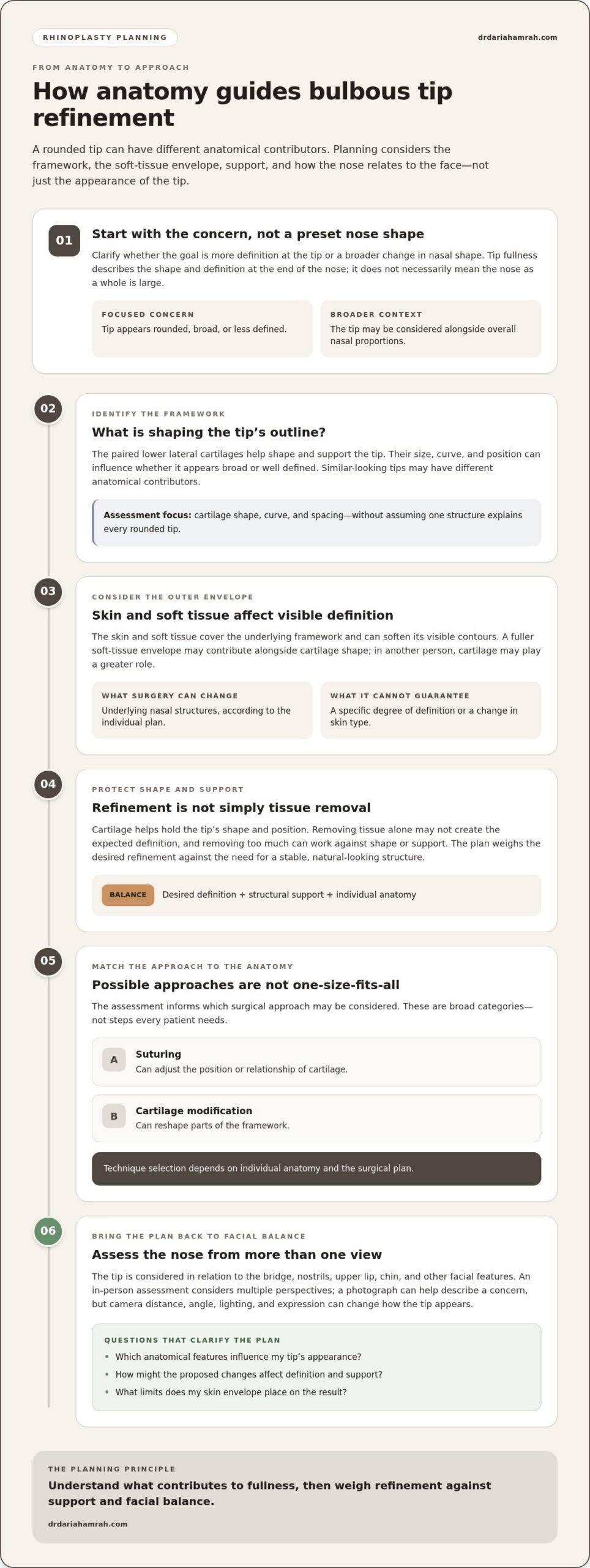
Several features can contribute to the appearance. The shape, curve, or spacing of the cartilage may affect the tip’s outline, while the soft tissue and skin over it influence how clearly the underlying framework shows. That is why rhinoplasty for bulbous tip concerns begins with understanding an individual’s anatomy rather than assuming one structure explains every rounded tip. A general overview of rhinoplasty procedures provides context, but assessing a specific nose requires more than a broad description.
Which structures can contribute to a rounded nasal tip?
The lower lateral cartilages are paired structures that help shape and support the nasal tip. Their size, curve, and position can influence whether the tip appears broad or well defined. Skin and soft tissue form an outer envelope over this framework. Like a covering over a sculpted form, that envelope can soften visible contours, so the cartilage beneath may not translate directly into a sharp outline. More than one factor may be involved.
For example, the cartilage may create a wider contour, while thicker skin or fuller soft tissue further reduces visible definition. In another person, cartilage shape may play a greater role. These are possibilities, not conclusions that can be drawn from appearance alone. Similar-looking tips can have different anatomical contributors, so an individualized examination is needed to understand how the structures relate.
How can tip fullness affect facial balance?
A rounded tip may draw the eye because it sits at the center of the face and can appear prominent from certain views. Prominence is not the same as imbalance, and there is no single nose shape that suits every face. Perceived balance depends on how the tip relates to the bridge, nostrils, upper lip, chin, and other facial features, as well as on your aesthetic preferences.
Photographs can help you describe what you notice, but one image cannot show the full picture. Camera distance, angle, lighting, and facial expression can change how wide or defined the tip appears. A side view also reveals different contours than a front view. An in-person assessment considers the nose from multiple perspectives and in relation to the face as a whole. This helps distinguish a specific concern about tip definition from a broader concern about nasal proportions, without assuming the goal should be a narrow, upturned, or standardized shape.
How Anatomy Guides Rhinoplasty for a Bulbous Tip
Planning involves more than identifying a rounded tip. An examination considers the cartilage framework, the skin and soft-tissue envelope, the tip’s support, and how the nose relates to the rest of the face. These features work together, so changing one without accounting for the others may not produce the intended appearance. The assessment helps identify what is shaping the tip and what should be preserved.
That assessment informs the possible surgical approaches. Suturing can adjust the position or relationship of cartilage, while cartilage modification can reshape parts of the framework. These are broad categories, not steps every patient needs. Technique selection depends on the individual anatomy and the surgical plan. The plan also considers overall proportions rather than treating the tip as an isolated feature.
Removing tissue alone may not resolve limited definition. If skin and soft tissue soften the visible contours, reducing underlying cartilage may not make the tip look as defined as expected. If the framework provides important shape or support, removing too much could work against a balanced result. A considered plan weighs the desired refinement against the need to maintain a stable, natural-looking structure.
Why skin thickness matters when setting expectations
Skin characteristics influence how clearly changes to the underlying framework may show. A thicker or less pliable skin envelope can soften contours, while other skin characteristics may reveal structural changes differently. Surgery can alter underlying structures, but it cannot change a person’s skin type or guarantee a particular degree of definition. Expectations should be based on an individual examination, not assumptions about skin tone or a single photo.
Why nasal tip support matters during refinement
Cartilage helps hold the tip’s shape and position, much like a frame supports a structure. Refinement must account for that role. Excessive alteration can affect the tip’s shape or support, which is why the aim is not simply to remove as much tissue as possible. The appropriate balance depends on the framework, skin envelope, and goals identified during assessment. No single approach fits every nose.
When discussing rhinoplasty for bulbous tip concerns, useful questions include: Which anatomical features influence my tip’s appearance? How might the proposed changes affect definition and support? What limits does my skin envelope place on the result? These questions turn a general wish for a more refined tip into a clearer, anatomy-informed discussion. A rhinoplasty consultation with Dr. Daria Hamrah can focus on your anatomy, goals, and facial balance.
Refinement Without Overcorrection: Comparing Goals and Trade-Offs
Before deciding how much to change, clarify what “refinement” means to you. You may want the tip to look more defined while keeping the rest of your nose much as it is. Or your concern may involve the tip alongside the bridge, projection, or overall proportions. Neither goal is inherently better. The right scope depends on your priorities, anatomy, and how proposed changes relate to nasal function and structural support.
Removing more tissue does not automatically produce better definition. A plan focused only on making the tip smaller may overlook the support needed for its shape or the way the skin envelope affects visible contours. Thoughtful planning weighs the requested change against what can be adjusted while maintaining a proportionate, supported result. The aim is not maximum reduction, but a clear, shared understanding of the goal and its trade-offs.
| Desired change | Anatomical considerations | Questions for clinical discussion |
|---|---|---|
| More definition at the tip | Cartilage shape and support, skin characteristics, and how clearly the framework may show through the skin | What may be limiting definition, and what degree of change is realistic for my anatomy? |
| A change focused mainly on the tip | How the tip relates to the bridge, nostrils, and overall nasal proportions | Would focusing on the tip address my concern while preserving the features I want to keep? |
| A broader change to nasal shape | The relationship between proposed changes, facial balance, nasal support, and relevant functional concerns | How would a wider plan affect the tip, the rest of the nose, and breathing considerations? |
What does a conservative refinement goal mean?
Conservative refinement means seeking greater definition in a way that respects existing anatomy and facial proportions. It does not mean choosing the smallest possible change or avoiding meaningful adjustment. Instead, it contrasts an individualized goal with pursuing a uniformly narrow or sharply sculpted tip simply because that shape is fashionable. Discussing what you hope to see, and what you do not want changed, helps frame a plan around your features.
What concerns should be weighed before changing tip structure?
Consider both the visible change and what must remain in place to support the tip. Skin characteristics and healing can also influence how definition appears over time, so a planned adjustment cannot guarantee a specific final appearance. In a discussion about rhinoplasty for bulbous tip concerns, ask how the proposed goal accounts for support, facial harmony, and function, and what uncertainties apply to your case.
Describe your priorities in concrete terms: which view concerns you most, what feature you hope to refine, and which aspects of your nose feel integral to your appearance. This gives the clinical discussion a useful starting point without treating a reference image or preferred shape as a promise. A sound plan connects your goals with the anatomy and trade-offs that matter for you.
What to Expect Before and After Bulbous Tip Rhinoplasty
Good preparation helps turn uncertainty into an informed decision. A consultation for rhinoplasty for bulbous tip concerns should cover both the appearance you hope to refine and relevant functional issues, such as breathing concerns. It should also give you time to understand the proposed plan, its limitations, and what recovery may involve. Use the conversation to make sure your priorities and questions are clearly understood.
A useful way to prepare is to move through the decision in stages:
- Define your goals. Describe what draws your attention to the tip and what kind of change would feel meaningful. Consider which features you want to preserve.
- Share your health history. Discuss medical conditions, previous nasal procedures, breathing concerns, and medications or supplements you take.
- Have an examination. The surgeon evaluates your nose, considers your concerns, and assesses relevant functional factors.
- Review the plan. Discuss the proposed approach, expected limitations, potential risks, and how your anatomy informs the recommendations.
- Give informed consent. Take time to understand the procedure and recovery instructions, and raise any remaining questions before deciding.
What should you discuss during a rhinoplasty consultation?
Be specific about the views or features that concern you, while leaving room for a clinical assessment of what may be achievable. Tell the surgeon about prior nasal procedures, breathing changes, relevant health conditions, and medications. Ask how your anatomy shapes the plan, what limitations or risks apply to your situation, and how follow-up will be arranged. Clear answers help you weigh the decision without relying on assumptions.
What recovery questions deserve clear answers?
Healing does not follow an identical schedule for everyone. Swelling and other changes evolve over time, and the appearance during early recovery may not reflect the settled result. Before surgery, ask what to expect at each stage, which activities to avoid, how to care for the surgical area, and when follow-up visits occur. Confirm whom to contact if an unexpected symptom or concern arises.
- Ask which changes during recovery are expected and which concerns should prompt a call to the clinical team.
- Clarify the surgeon’s instructions for activity, wound care, and follow-up rather than relying on general advice.
- Make sure you know how to reach the appropriate member of the care team if questions arise after surgery.
Individual recovery and follow-up instructions come from your clinical team. Keep those instructions accessible and follow them closely. Do not use another person’s recovery experience as a substitute for guidance tailored to you. For an individualized discussion of your goals and questions, learn about rhinoplasty with Dr. Daria Hamrah.
How Dr. Daria Hamrah Approaches Rhinoplasty for a Bulbous Tip
Once you understand the possible anatomical factors and trade-offs, the next step is applying that knowledge to your own goals. Dr. Daria Hamrah is a board-certified facial cosmetic surgeon whose approach to rhinoplasty is grounded in patient-centered, clinically informed care. A consultation is an individualized discussion, not a preset formula. It considers your nasal anatomy, the changes you hope to see, facial balance, and any concerns about function or recovery.
For a bulbous-looking tip, that means discussing what you notice and how it fits into your broader goals. You might be focused on definition from the front, the way the tip relates to your bridge, or preserving features that feel central to your appearance. An individual assessment helps put these priorities in context. Online photos can offer ideas, but they cannot determine which structures contribute to your nasal shape or what changes may be appropriate.
How does an individualized assessment support informed decisions?
Your goals and nasal anatomy provide the starting point for a conversation about possible surgical changes. The discussion should clarify what may be addressed, what limitations your anatomy may present, and how the plan considers facial balance and relevant functional concerns. Bring your questions, including what you hope to preserve. Understanding the reasoning behind a recommendation can help you weigh the options without expecting a particular outcome.
Informed decision-making also leaves room to discuss uncertainty. Ask what the proposed plan is intended to change, what it is not intended to change, and what risks or compromises deserve attention in your case. A clear consultation connects your priorities with the clinical assessment, so the decision is based on more than a general label like “bulbous tip.”
For broader context, Dr. Hamrah’s comprehensive rhinoplasty guide explores how nasal surgery relates to facial harmony and structural integrity. As you read, consider which questions apply to your goals, such as whether your concern is limited to the tip or involves the overall shape of your nose.
What is a thoughtful next step if you are considering surgery?
Start by writing down what concerns you, what change would feel meaningful, and what you need to understand before making a decision. A consultation gives you the opportunity to discuss those priorities alongside an examination of your nose. This is more useful than trying to diagnose your anatomy from online images, which cannot show the full structure or account for how each feature relates to your face.
There is no need to rush the decision. If you are considering rhinoplasty, read about Dr. Daria Hamrah’s rhinoplasty care and the considerations involved in discussing your goals and anatomy.
Let Your Goals Guide the Next Step
Considering a change does not mean you need to decide today. Give yourself room to identify what matters most: the feature you hope to refine, what you want to preserve, and what you need to understand before moving forward. Those priorities can make a future conversation more focused and help you evaluate whether a proposed plan aligns with your expectations.
For rhinoplasty for bulbous tip concerns, a personal assessment brings your questions into a discussion grounded in your own features. Dr. Daria Hamrah is a board-certified facial cosmetic surgeon, and rhinoplasty is part of the practice’s surgical care. If you are ready to explore whether surgery fits your goals, arrange a rhinoplasty consultation with Dr. Daria Hamrah.
Take the next step at your own pace. A thoughtful decision begins with clear information, an open conversation, and goals that feel true to you.
Frequently Asked Questions
Is rhinoplasty for a bulbous tip different from a full rhinoplasty?
Tip refinement describes a focus within rhinoplasty, not a universally separate operation. The scope depends on your anatomy, goals, and whether other nasal structures or function are part of your concern. You may be focused on the tip in front-facing views but also notice how it relates to the bridge in profile. A consultation helps clarify which concerns belong in the plan and which changes you want to preserve.
Can bulbous tip rhinoplasty affect breathing?
It can, depending on the structures involved and the surgical plan. Share any ongoing blockage, side-to-side differences in airflow, or prior nasal procedures during your assessment. These details help the surgeon consider function alongside appearance and explain relevant risks for your situation. If breathing changes after surgery, follow the clinical team’s instructions about when and how to report them rather than trying to assess the cause yourself.
Is bulbous tip rhinoplasty permanent?
Rhinoplasty changes are intended to be long-lasting, but no result is guaranteed to remain identical indefinitely. The nose continues to heal after surgery, and natural aging can affect facial tissues over time. Your anatomy and recovery also influence how the result appears. Ask your surgeon what changes to expect during healing, how long-term expectations are framed, and which factors may influence the result in your case.
Does thick skin limit definition after bulbous tip rhinoplasty?
Skin thickness can influence how clearly changes beneath the skin are visible, but it does not determine candidacy by itself or predict one specific outcome. During an assessment, the surgeon can discuss how your skin characteristics relate to your goals and what degree of definition may be realistic. If you have a reference image in mind, use it to explain what you like, not as a promise of an identical result.
Will bulbous tip rhinoplasty leave a visible scar?
Scarring depends in part on the surgical approach and where incisions are placed. Some approaches use incisions inside the nostrils, while others may include an incision on the tissue between them. Healing and scar visibility differ from person to person. Ask which approach is being considered for your plan, where incisions may be, and what care instructions apply. Another patient’s scar appearance does not predict your own.
How old should someone be to consider rhinoplasty for a bulbous tip?
There is no one age that establishes suitability for everyone. Assessment considers physical development, health, motivations, and the person’s understanding of surgery and its risks. For a younger person, development and appropriate consent need particular attention. Rather than relying on a general age rule or comparing yourself with someone else, discuss timing and personal circumstances directly with a qualified surgeon before making decisions about surgery.