
What if the right non-surgical anti-aging treatments depend less on your age and more on the change you want to address? It’s easy to get lost in names, mechanisms, and promises, especially when treatments that sound similar work in different ways. Some may soften the appearance of expression lines, while others focus on skin texture or uneven-looking tone. They don’t all address the same concerns, and results vary.
A clearer starting point is your goal, not the treatment label. This guide compares Botox, laser skin treatments, Hydra-facials, and medical-grade skincare, including the concerns each may be suited to address. It also explains why an individualized clinical assessment matters: facial anatomy, skin condition, health history, and expectations all help shape a suitable plan.
Think of a treatment plan as a considered sequence, not a one-size-fits-all menu. Nonsurgical care may suit some concerns; others may call for a different conversation. Understanding the difference can help you ask better questions, weigh realistic outcomes, and choose a plan aligned with your priorities.
Key Takeaways
- Non-surgical anti-aging treatments are distinct tools, not interchangeable solutions for every visible sign of aging.
- Identify whether your priority is expression lines, uneven-looking tone, skin texture, or firmness before comparing treatment categories.
- Set realistic expectations by distinguishing surface-focused goals from concerns involving more substantial laxity or structural change.
- Use a step-by-step decision process to weigh your goal, suitable options, and potential tradeoffs during an individualized clinical assessment.
- Botox, Hydra-facials, laser treatments, and medical-grade skincare serve different roles within facial rejuvenation.
What Do Non-Surgical Anti-Aging Treatments Actually Address?
Non-surgical anti-aging treatments is a broad label, not the name of one procedure. It includes approaches that may address visible changes in the face, from skin texture and uneven-looking pigmentation to expression lines and changes in firmness. These concerns can overlap, but they don’t necessarily share a cause or respond to the same type of care. A general overview of non-surgical facial rejuvenation treatments illustrates how varied the category is.
Start by separating what you notice at the skin’s surface from changes related to facial movement or tissue support. A line that appears with an expression, an area of uneven-looking tone, and a sense of reduced firmness are different observations. Naming the concern gives a clinician a more useful starting point than choosing a treatment because it’s popular or associated with a particular age group.
A treatment category describes a tool; a personalized treatment plan explains whether, why, and how that tool fits your individual goals.
Why ‘anti-aging’ is not one specific treatment
The phrase groups options with different targets and mechanisms. Some focus on the appearance or feel of the skin; others relate to facial movement. Botox, for example, is an injectable option associated with expression-related concerns, not a treatment for skin texture or laxity. Laser treatments, Hydra-facials, and medical-grade skincare are skin-focused options with distinct purposes. They shouldn’t be treated as interchangeable.
Instead of asking for an “anti-aging” treatment, describe what you’ve noticed and what you’d like to change. Is a line visible at rest or mainly during expression? Is your concern uneven-looking tone, rough texture, or firmness? Those details help guide a conversation about relevant approaches and realistic expectations.
How individual aging patterns shape treatment goals
Faces change in individual ways. Sun exposure, skin characteristics, patterns of expression, and changes in firmness can all influence what stands out to you. Two people may both mention lines, for instance, while one is focused on lines that appear with movement and the other is concerned about the overall look of their skin. Similar words don’t always point to the same goal.
An assessment can connect your concern with your health history and expectations before a plan is formed. Consider these prompts before discussing options:
- Which specific feature draws your attention?
- When and where is it most noticeable?
- What kind of change would feel worthwhile to you?
- Are there limits or concerns that should inform the approach?
Clear answers make the conversation more specific. They can also help distinguish a surface-focused goal from one involving movement or underlying support, so the plan reflects your priorities rather than a trend or broad label.
How the Main Non-Surgical Anti-Aging Treatment Categories Differ
Once you’ve identified the concern, compare treatments by what they’re designed to address, not by how prominent or appealing the name sounds. The categories below have different purposes. A clinical assessment helps determine whether an option fits your skin, health history, and expectations.
| Category | General purpose | Concern it may be considered for |
|---|---|---|
| Botox | Injectable option that reduces activity in targeted facial muscles | Lines associated with repeated facial expressions |
| Laser skin treatments | Uses laser energy; approach and intended target vary by device | Selected skin appearance concerns, assessed individually |
| Hydra-facials | Facial treatment focused on the skin | Skin-care goals discussed during an assessment |
| Medical-grade skincare | Products incorporated into an individualized skin-care routine | Ongoing skin-care priorities |
Treatment categories aren’t interchangeable: each has a different focus, so compare them against your concern rather than a trend or promise. These options also sit within broader discussions of cosmetic care, including Harvard Medical School on non-surgical skin treatments. That broader context is useful, but it doesn’t replace a personal clinical evaluation.
Injectables and expression-related concerns
Botox is an injectable option that works by reducing activity in targeted facial muscles. Since repeated movement can contribute to expression-related lines, it may be considered for that type of concern. It isn’t a treatment for pigmentation, skin texture, or laxity. Candidacy, possible risks, and expected effects depend on the individual, so discuss them with a clinician before treatment.
Skin-focused treatments, facials, and daily care
Laser skin treatments form a broad category. Devices and approaches vary, so don’t assume every laser targets the same concern or works in the same way. Hydra-facials and medical-grade skincare are separate from injectable treatments: they’re skin-focused options, not substitutes for addressing facial muscle activity. For a wider view of how skin care can sit within facial rejuvenation, explore this facial rejuvenation guide.
Dr. Daria Hamrah is a board-certified facial cosmetic surgeon whose practice includes nonsurgical facial rejuvenation. The practice offers Botox, Hydra-facials, laser skin treatments, and medical-grade skincare. An individualized assessment can help clarify your priorities and expectations before you consider these options. Explore Dr. Hamrah’s approach to facial rejuvenation as you consider which questions to bring to that conversation.
What Non-Surgical Treatments Can, and Cannot, Realistically Do
Nonsurgical care may be a reasonable choice when your goals align with what a particular treatment is intended to address. But it’s a misconception that every visible change can be meaningfully improved without surgery. A skin-focused concern and a more substantial change in facial firmness or structure may call for different conversations. The aim isn’t to find one treatment that does everything. It’s to understand what an option may address, what it may not, and whether that tradeoff fits your priorities.
Some goals are relatively focused: you may want to discuss expression lines, uneven-looking tone, or skin texture. Other concerns may involve more pronounced laxity or a change in facial support. Nonsurgical treatments may be considered as part of an individualized plan, but they shouldn’t be presented as equivalent to surgery for every concern. Recognizing a limitation doesn’t mean surgery is necessary. The appropriate path depends on your goals and clinical assessment.
Why results and maintenance differ by treatment
Different treatments work in different ways, so their effects, timing, and maintenance needs aren’t interchangeable. An injectable, a laser treatment, a facial, and a skincare routine each involve distinct approaches. Even within one category, the specific treatment and your response can shape what to expect. There’s no universal schedule or duration that applies to everyone.
Before deciding, discuss the intended goal, possible risks, how progress will be assessed, and what follow-up might involve. Maintenance decisions should reflect your response, preferences, and clinician guidance, rather than an assumed timetable or pressure to repeat treatment. A thoughtful plan leaves room to reassess.
When a nonsurgical approach may not match the concern
If your main concern is pronounced laxity or a more substantial structural change, a surface-focused treatment may not match the scale of your goal. An honest assessment can help clarify that distinction before you invest in an approach unlikely to address your primary concern. A surgical consultation can be an educational way to understand the full range of options, not a commitment to proceed.
For structural concerns, Dr. Daria Hamrah offers Deep Plane Facelift surgery. A consultation can help you understand how a surgical approach differs from nonsurgical care. The decision to consider surgery remains personal. Some people prefer nonsurgical care, some explore surgery, and some choose to wait. The right next step is the one that reflects your priorities and informed understanding.
Use these questions to keep expectations grounded during an assessment:
- What specific change matters most to me?
- Is my goal focused on skin appearance, movement, firmness, or facial structure?
- What might this option reasonably address, and what would remain outside its scope?
- How will my health history, preferences, and response inform the plan?
These questions make comparisons more meaningful. Non-surgical anti-aging treatments can be useful when the concern, treatment approach, and expectations align. A plan should account for benefits and limitations alike, leaving you better informed rather than promising a particular result.
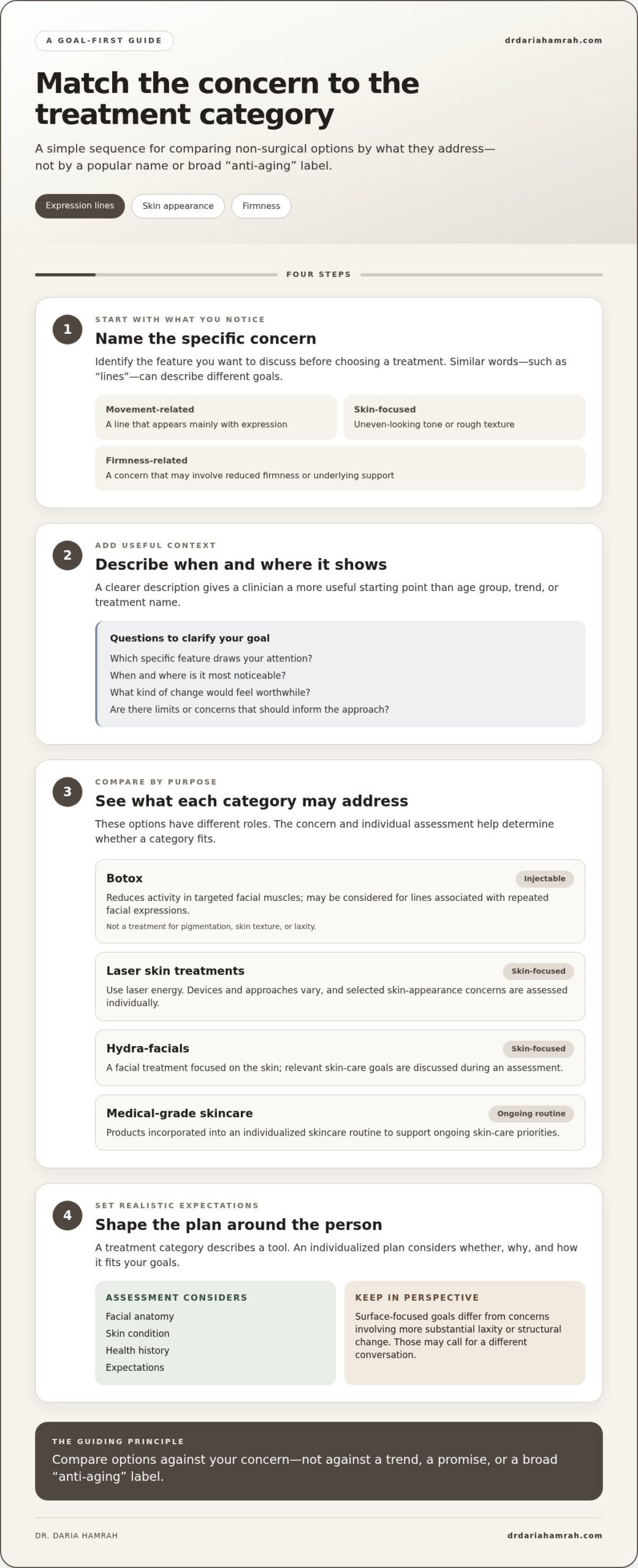
Match Non-Surgical Anti-Aging Treatments to Your Goals
A useful consultation starts with a clear description of what you want to address, not a commitment to a particular procedure. This four-step sequence can help you compare non-surgical anti-aging treatments and make the conversation more productive.
- Name the concern. Identify whether you’re focused on expression lines, uneven-looking tone, skin texture, or firmness. Be specific about what you notice and where.
- Define the goal. Describe the change you hope to see in practical terms. “Look younger” is broad; “soften the appearance of lines when I smile” gives a clinician a clearer starting point.
- Review suitable categories. Discuss which approaches may relate to your concern, and why. A desired appearance doesn’t automatically make a particular treatment appropriate for you.
- Assess the tradeoffs. Consider risks, limitations, follow-up, maintenance, and whether the treatment approach fits your preferences and priorities.
Start with the change you want to address
Choose one or two priorities rather than trying to address every feature at once. Before an assessment, write down when a concern is most noticeable or what makes it important to you. Photos you already have may help explain what you mean, while notes can keep the discussion focused. These are communication tools, not a way to diagnose yourself or determine which treatment is suitable.
Personal factors matter, too. Skin characteristics, health history, previous treatments, and your comfort with different approaches can all inform candidacy and planning. Two people seeking a similar change may have different considerations. A clinician can connect your priorities to the available categories and discuss whether an option’s limits and possible effects align with your expectations.
Build a plan around evidence, suitability, and expectations
A considered plan includes more than a proposed treatment. It should make space to discuss why an option may fit, what it is not intended to address, relevant risks, and alternatives, including the option of waiting. Ask how progress would be reviewed and what follow-up or maintenance might involve. You don’t need to proceed before you understand the tradeoffs.
Use this checklist during your clinical discussion:
- What concern is this treatment intended to address, and what may remain unchanged?
- What risks or limitations are relevant to my health history and skin characteristics?
- What alternatives could be considered, including no treatment?
- What course of care and follow-up might be appropriate for me?
- How will my response and preferences guide any future maintenance decisions?
Skin-focused care can also sit within a broader conversation about wellness and long-term vitality. This cellular health and skin longevity framework offers wider context without replacing an individualized clinical assessment. For guidance grounded in your concerns and priorities, schedule a personalized facial rejuvenation assessment.
A Personalized, Longevity-Minded Approach to Nonsurgical Care
Choosing among non-surgical anti-aging treatments isn’t simply a matter of selecting a procedure from a menu. It begins with understanding your concern, health context, and what kind of change feels meaningful to you. Dr. Daria Hamrah is a board-certified facial cosmetic surgeon whose practice includes surgical and nonsurgical facial rejuvenation. That perspective supports a broader conversation about which options may fit your goals and where their limits may be.
The practice offers Botox, Hydra-facials, laser skin treatments, and medical-grade skincare. These options serve different roles, so an individualized discussion can help distinguish a concern that may be approached with an injectable from one that calls for skin-focused care. A thoughtful plan may center on one option, combine approaches where appropriate, or recommend no procedure. The aim is informed decision-making, not a predetermined treatment.
Connecting aesthetic goals with skin health
Facial rejuvenation can be considered alongside a broader interest in wellness and long-term vitality. That doesn’t mean skincare or supplements reverse aging, or that a wellness practice guarantees a procedural result. Rather, it recognizes that aesthetic decisions sit within a person’s wider health context and should be approached with care. Cellular health can provide a useful framework for questions and discussion, while treatment decisions still depend on individual assessment and realistic expectations.
For skin-focused goals, the conversation may include how Hydra-facials, laser skin treatments, or medical-grade skincare relate to your priorities. The appropriate choice depends on your skin and clinical assessment, not a general promise about what a category can do. Clear explanations help you understand the purpose and limits of each option.
What an informed next step can look like
A consultation is an opportunity to describe what you hope to address and discuss your health history, relevant options, and tradeoffs. You can also talk through what you’re comfortable with and what you’d prefer to avoid. The conversation doesn’t have to end with a procedure. It may clarify a single approach, a combination of options, or a decision to wait.
- Bring one or two priorities so the discussion stays focused.
- Share relevant health information and previous treatments.
- Ask for a clear explanation of the options that relate to your goals.
- Take time to consider whether the proposed approach feels right for you.
Good care leaves room for questions and a measured decision. If you’re ready to learn more about this individualized perspective, explore Dr. Daria Hamrah’s approach to facial rejuvenation.
Choose Your Next Step With Clarity
Your next step doesn’t need to be a treatment decision. It can simply be a clearer conversation about what you hope to address, what matters most to you, and what you feel comfortable considering. That keeps the focus on your priorities rather than pressure to pursue every available option.
In an individualized assessment, Dr. Daria Hamrah’s perspective as a board-certified facial cosmetic surgeon informs a broader discussion of facial rejuvenation. The practice’s Botox, Hydra-facials, laser skin treatments, and medical-grade skincare offer different avenues to consider, guided by your concerns and clinical context. No single path is right for everyone, and taking time to understand your options is part of thoughtful care.
Use what you’ve learned about non-surgical anti-aging treatments to begin with informed questions and realistic expectations. Schedule a personalized facial rejuvenation assessment with Dr. Daria Hamrah to discuss your goals and the options that may suit them.
Frequently Asked Questions
What is the most effective non-surgical anti-aging treatment?
There isn’t one most effective treatment for every person or concern. The useful question is which option suits your priority. For example, if you’re bothered by lines that appear with repeated expressions, ask about approaches intended for movement-related concerns. If your focus is uneven tone, the discussion may be different. A clinician can help weigh your goals, health context, potential risks, and alternatives before recommending an approach.
Can non-surgical treatments tighten loose skin?
Some nonsurgical approaches may be considered for selected concerns involving mild looseness, but they shouldn’t be assumed to correct pronounced loose skin. The degree and location of laxity, skin characteristics, and your desired change all affect what may be appropriate. Ask what kind of change is realistic for your specific concern and what might remain. A clinical assessment can clarify whether a nonsurgical approach aligns with your expectations.
How long do non-surgical anti-aging treatments last?
There’s no single duration that applies across treatments or individuals. The course can vary with the treatment, the concern being addressed, your response, and other personal factors. Rather than relying on a general timeframe, ask what changes to look for, when your clinician would reassess, and what follow-up could involve. This can help you decide whether the expected course fits your preferences and whether ongoing maintenance feels appropriate.
Are non-surgical anti-aging treatments safe?
Safety depends on the treatment, your health history, and how the procedure is performed. Nonsurgical doesn’t mean risk-free. Before proceeding, discuss relevant medical conditions, medications, allergies, past procedures, and any history of skin reactions. Ask about possible side effects, warning signs that need attention, and what to do if you’re concerned after treatment. A careful assessment helps determine whether an option is suitable and supports informed consent.
Can I combine Botox with laser treatments or facials?
Combining treatments may be considered, but the right sequence and timing depend on the specific procedures and your individual plan. Don’t assume treatments can be performed together or on a particular schedule simply because they address different concerns. Tell your clinician about recent and planned treatments, including facials, and ask whether spacing or other precautions are appropriate. A coordinated plan can account for your skin’s condition and the intended purpose of each treatment.
When should I consider surgery instead of nonsurgical treatments?
Consider discussing surgery if your main concern involves substantial looseness or structural changes that a nonsurgical option may not meaningfully address. A consultation can help clarify the difference between your goal and what each approach may achieve; it doesn’t obligate you to choose surgery. You can use the conversation to understand alternatives, potential tradeoffs, and whether your priorities are better served by nonsurgical care, surgery, or waiting.